- 234 Balaclava Road, Caulfield North VIC 3161
- contactus@guests.com.au
- (03) 9509 7033
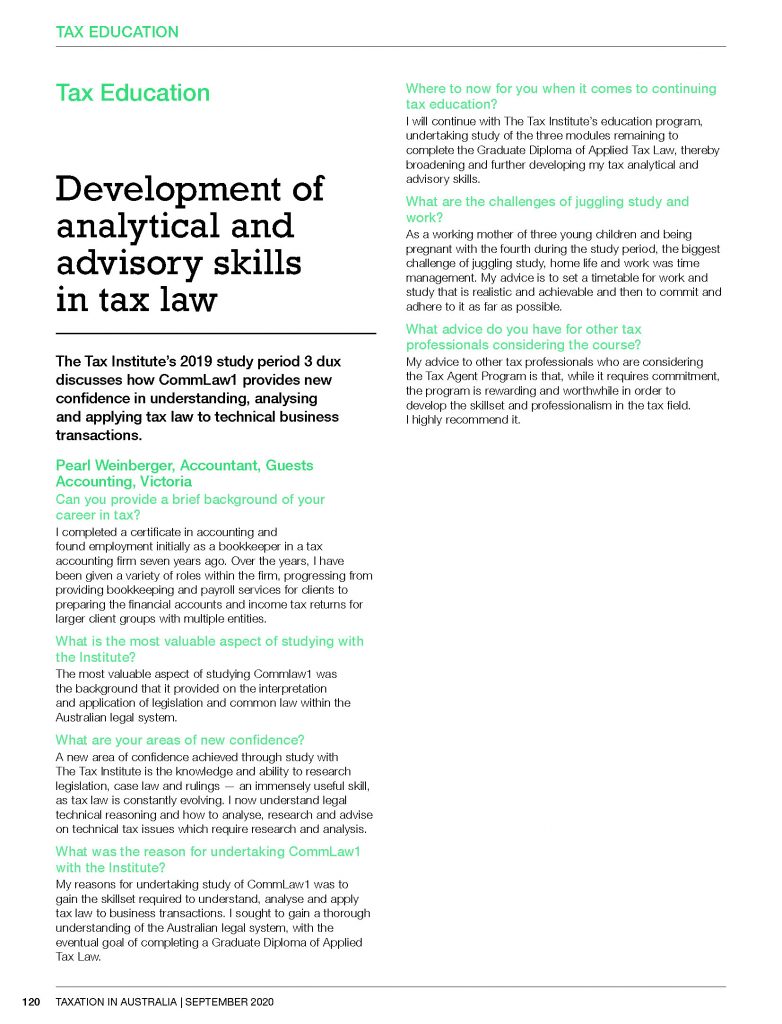
HARD WORK PAYS OFF FOR ONE OF OUR BRIGHT EMPLOYEES
Federal Budget 2020

PERSONAL TAXATION
Personal tax cuts brought forward to 1 July 2020
In the Budget, the Government announced that it will bring forward to 1 July 2020 the personal tax cuts (Stage 2) that were previously legislated in 2018 to commence from 1 July 2022. The Stage 3 tax changes remain unchanged and commence from 1 July 2024, as previously legislated:
- Stage 2 tax rates – was 1 July 2022, now 1 July 2020; and
- Stage 3 tax rates – unchanged; to commence on 1 July 2024, as previously legislated.
The Government will bring forward the Stage 2 personal income tax cuts to 1 July 2020 (from 1 July 2022, as previously legislated in 2018). The Treasurer said this will see more than 11 million taxpayers get an immediate tax cut backdated to 1 July 2020.
From 1 July 2020:
- the top threshold of the 19% personal income tax bracket will increase from $37,000 to $45,000; and
- the top threshold of the 32.5% tax bracket will increase from $90,000 to $120,000.
The new low income tax offset (maximum $700) has also been brought forward to 2020–2021, while the low and middle income tax offset (maximum $1,080) has been retained for 2020–2021.
Mr Frydenberg said more than seven million individuals are expected to receive tax relief of $2,000 or more for the 2020–2021 income year compared with the 2017–2018 tax settings. Low and middle income tax payers will receive relief of up to $2,745 for singles and $5,490 for dual income families.
Stage 3: from 2024–2025
The Stage 3 tax changes remain unchanged and commence from 1 July 2024, as previously legislated. From 1 July 2024, the 32.5% marginal tax rate will be cut to 30% for one big tax bracket between $45,000 and $200,000. This will more closely align the middle tax bracket of the personal income tax system with corporate tax rates. The 37% tax bracket will be entirely abolished at this time under the Government’s already legislated plan.
Therefore, from 1 July 2024, there will only be three personal income tax rates: 19%, 30% and 45%. From 1 July 2024, taxpayers earning between $45,000 and $200,000 will face a marginal tax rate of 30%.
With these changes, around 94% of Australian taxpayers are projected to face a marginal tax rate of 30% or less.
Low income offsets: new LITO brought forward and LMITO retained
The Government announced in the Budget that the new low income tax offset (LITO) will be brought forward to start as from the 2020–2021 income year. The new LITO was intended to replace the existing low income and low and middle income tax offsets as from 2022–2023. Although the existing LITO is scrapped, the low and middle income offset (LMITO) will be retained for 2020–2021.
Bringing forward the new LITO is a consequence of bringing forward to 2020–2021 the tax cuts that were scheduled to start in 2022–2023.
The maximum amount of the new LITO is $700. The LITO will be withdrawn at a rate of 5 cents per dollar between taxable incomes of $37,500 and $45,000 and then at a rate of 1.5 cents per dollar between taxable incomes of $45,000 and $66,667.
The amount of the LMITO is $255 for taxpayers with a taxable income of $37,000 or less. Between $37,000 and $48,000, the value of LMITO increases at a rate of 7.5 cents per dollar to the maximum amount of $1,080. Taxpayers with taxable incomes from $48,000 to $90,000 are eligible for the maximum LMITO of $1,080. From $90,001 to $126,000, LMITO phases out at a rate of 3 cents per dollar.
CGT exemption for “granny flats”
The Budget confirms that the Government will put in place a “targeted” CGT exemption for granny flat arrangements.
Under the measure, CGT will not apply to the creation, variation or termination of a granny flat arrangement providing accommodation where there is a formal written agreement in place. The Budget states that it will apply to arrangements that provide accommodation for “older Australians or those with a disability”. There are no further details as to what constitutes “older” or “disability”.
The exemption will only apply to agreements that are entered into because of “family relationships or other personal ties” and will not apply to commercial rental arrangements.
It is intended that the measure commence from 1 July 2021 (i.e. next financial year), subject to the passage of necessary legislation.
The measure was earlier announced by the Treasurer and Assistant Treasurer on 5 October 2020, the day the Government also publicly released the Board of Taxation’s report on the taxation of granny flat arrangements (the report had been provided to the Government in November 2019). That report recommended the CGT exemption.
First Home Loan Deposit Scheme: additional 10,000 places
The Government will allocate an additional 10,000 places for first home buyers under the existing First Home Loan Deposit Scheme.
Under the existing Scheme, eligible first home buyers can obtain a loan to build a new home or purchase a newly built home with a deposit of as little as 5%. The Scheme provides a Government-backed guarantee equals to the difference between the deposit (of at least 5%) and 20% of the purchase price. Applications can be made as part of the standard home loan application process through participating lenders. The Scheme has already helped almost 20,000 first home buyers.
The Treasurer said eligible first home buyers will also be able to take advantage of the Federal Government’s First Home Super Saver Scheme and HomeBuilder. First home buyers may also be eligible for State and Territory grants and concessions.
The additional 10,000 places under the scheme will be provided from 6 October 2020. The additional guarantees will be available until 30 June 2021.
BUSINESS TAXATION
Small business tax concessions extended to medium businesses
The Budget confirmed the Government’s announcement on 2 October 2020 that a range of tax concessions currently available to small businesses (aggregated annual turnover under $10 million) will be made available to medium sized businesses (aggregated annual turnover of $10 million or more but less than $50 million). The extension of these concessions to medium businesses will be delivered in three phases:
- From 1 July 2020, eligible businesses will be able to immediately deduct certain start-up expenses and certain prepaid expenditure.
- From 1 April 2021, eligible businesses will be exempt from the 47% FBT on car parking and multiple work-related portable electronic devices, such as phones or laptops, provided to employees (note that an FBT exemption for retraining redeployed employees will also apply from 2 October 2020).
From 1 July 2021:
- eligible businesses will be able to access the simplified trading stock rules, remit PAYG instalments based on GDP adjusted notional tax, and settle excise duty and excise-equivalent customs duty monthly on eligible goods;
- The time limit for the ATO to amend income tax assessments will be reduced from four to two years for eligible business for income years starting from 1 July 2021; and
- the ATO power to create a simplified accounting method determination for GST purposes will be expanded to apply to businesses below the $50 million aggregated annual turnover threshold.
The eligibility turnover thresholds for other small business tax concessions will remain at their current levels.
Outright capital assets deduction until 30 June 2022 for most businesses
Businesses with aggregated annual turnover of less than $5 billion will be enable to deduct the full cost of eligible capital assets acquired from 7:30pm AEDT on 6 October 2020 (Budget night) and first used or installed by 30 June 2022.
Full expensing in the year of first use will apply to new depreciable assets and the cost of improvements to existing eligible assets. For small and medium sized businesses (with aggregated annual turnover of less than $50 million), full expensing will also apply to second-hand assets.
Businesses with aggregated annual turnover between $50 million and $500 million can still deduct the full cost of eligible second-hand assets costing less than $150,000 that are purchased by 31 December 2020 under the current instant asset write-off rules. Businesses that hold assets eligible for the $150,000 instant asset write-off will have an extra six months (until 30 June 2021), to first use or install such assets.
Small businesses (with aggregated annual turnover of less than $10 million) can deduct the balance of their simplified depreciation pool at the end of the income year while full expensing applies. The provisions which prevent small businesses from re-entering the simplified depreciation regime for five years if they opt-out will continue to be suspended.
Loss carry-back from 2019–2020, 2020–2021 and 2021–2022
The Government will allow eligible companies to carry back tax losses from the 2019–2020, 2020–2021 or 2021–2022 income years to offset previously taxed profits in 2018–2019 or later income years.
Corporate tax entities with an aggregated turnover of less than $5 billion will be able to apply tax losses against taxed profits in a previous year, generating a refundable tax offset in the year in which the loss is made.
The tax refund will be limited by requiring that the amount carried back to not exceed the earlier taxed profits and to not generate a franking account deficit. The tax refund will be available on election by eligible businesses when they lodge their 2020–2021 and 2021–2022 tax returns.
Companies that do not elect to carry back losses under this measure can carry losses forward as normal.
Instant asset write-off: minor change
The following information sets out the rates and thresholds as they currently operate – but should be read in the context that the instant asset write-off rules are effectively irrelevant for most eligible assets purchased after 6 October 2020 until 30 June 2022. The rules set out three taxpayer categories.
For this reason, businesses with aggregated annual turnover between $50 million and $500 million can still deduct the full cost of eligible second-hand assets costing less than $150,000 that are purchased by 31 December 2020 under the instant asset write-off provisions. The tweak is this: businesses that hold assets eligible for the $150,000 instant asset write-off will have an extra six months, until 30 June 2021, to first use or install those assets.
The new outright deduction rules do not apply to second-hand goods, other than those acquired by small and medium businesses (with aggregated annual turnover of less than $50 million) – who can fully expense costs associated with second-hand goods.
Accordingly, there were no changes to the rules, other than a slight tweaking for costs relating to second-hand goods acquired by large businesses (with annual aggregated turnover between $50 million and $500 million).
Given the largesse of the new outright deduction for capital assets until 30 June 2022, the instant asset write-off rules have become temporarily irrelevant for most taxpayers (those with aggregated annual turnover of less than $5 billion).
Small business entities
Those taxpayers with aggregated turnover of less than $10 million and who satisfy the other tests in Subdiv 328-C of ITAA 1997 can qualify as small business entities for the purpose of the instant asset write-off rules. A depreciating asset is a low cost asset if its cost as at the end of the income year in which the taxpayer starts to use it, or installs it ready for use, for a taxable purpose is less than the relevant threshold: s 328-180.
For small business entities, when the asset is first acquired and first used/installed ready for use, or the amount is included in the second element of cost from:
- 3 April 2019 to 11 March 2020 – the threshold is $30,000
- 12 March 2020 to 31 December 2020 – the threshold is $150,000.
The threshold is due to revert back to $1,000 on 1 January 2021 (although it has not been $1,000 since 2015).
Medium business entities
The next category of taxpayer for instant asset write off purposes is medium sized business entities. This applies to those with an aggregated annual turnover of $10 million or more, but less $50 million.
For medium business entities, when the asset is first acquired and first used/installed ready for use, or the amount is included in the second element of cost from:
- 3 April 2019 to 11 March 2020 – the threshold is $30,000
- 12 March 2020 to 31 December 2020 – the threshold is $150,000.
There was an increase in the threshold from $30,000 to $150,000 when the COVID measures started. The instant asset write-off under s 40-82 will cease to be available to medium businesses from 1 January 2021.
Large business entities
The third category of taxpayer for instant asset write off purposes is large business entities. This applies to those with an aggregated annual turnover of $10 million or more, but less $500 million. The write-off has only been available to such entities while the COVID measures are in place.
For large business entities, when the asset is first acquired and first used/installed ready for use, or the amount is included in the second element of cost from:
- 12 March 2020 to 31 December 2020 – the threshold is $150,000.
to first use or install assets (rather than 31 December 2020). It otherwise ceases on 31 December 2020.until 30 June 2021As noted, taxpayers in this category have
Depreciation rules still relevant
There were no changes to the capital allowance rules in the 2020–2021 Federal Budget. This means that the depreciation rules as currently legislated will not change.
This is not a surprise, given the ability of pretty much all businesses to claim an outright deduction for new asset purchases from 7 October 2020 to 30 June 2022.
Note, though, that as part of its response to the COVID-19 pandemic, the Government had earlier enacted to allow businesses with aggregated turnovers of less than $500 million in an income year to deduct capital allowances for depreciating assets at an accelerated rate. This is a temporary measure – it is due to finish on 30 June 2021.
It is worth revisiting these rules because there may be acquisitions that may fall outside the outright deduction rules but still qualify for depreciation (eg certain second-hand goods). The rules still have an ongoing relevance for acquisitions made on or before 6 October 2020.
Due to the temporary nature of the concession, the measures were enacted in the Income Tax (Transitional Provisions) Act 1997 (TPA).
To be eligible for the accelerated depreciation, the depreciating asset must be (s 40-125 TPA):
- new and not previously held by another entity (other than as trading stock or for the purposes of reasonable testing or trialling) – this excludes most second-hand assets;
- first held on or after 12 March 2020 (a post-11 March 2020 asset); and
- first used or first installed ready for use for a taxable purpose on or after 12 March 2020 and before 1 July 2021.
A depreciating asset will not qualify for the accelerated depreciation if (s 40-120(3) TPA):
- the decline in value of the asset has already been deducted under the instant asset write-off rules;
- the decline in value of the asset is worked out using low-value and software development pools; or
- the decline in value of the asset is worked using Subdiv 40-F of ITAA 1997 (ie certain primary production depreciating assets).
In terms of working out the accelerated depreciation, different rules apply depending on whether or not an entity is using the simplified rules for capital allowances for small businesses.
An entity with aggregated turnover of less than $500 million in the income year that does not use the simplified depreciation rules may deduct an amount at an accelerated rate for qualifying assets. The amount the entity can deduct in the income year the asset is first used or installed ready for use for a taxable purpose is:
- 50% of the cost (or adjustable value where applicable) of the depreciating asset; and
- the amount of the usual depreciation deduction that would otherwise apply but calculated after first offsetting a decline in value of 50%.
A small business entity (with aggregated turnover less than $10 million in the income year) that uses the simplified depreciation rules may deduct an amount equal to 57.5% (rather than 15%) of the taxable purpose proportion of the adjusted value of a qualifying depreciating asset added to the general small business pool in an income year.
Corporate residency test to be clarified
The Government will make technical amendments to clarify the corporate residency test.
The law will be amended to provide that a company that is incorporated offshore will be treated as an Australian tax resident if it has a “significant economic connection to Australia”. This test will be satisfied where both the company’s core commercial activities are undertaken in Australia and its central management and control is in Australia.
The Government said that the corporate residency rules are fundamental to determining a company’s Australian income tax liability. The ATO’s interpretation following the High Court’s decision in Bywater Investments Ltd v FCT (2016) 104 ATR 82 departed from the long-held position on the definition of a corporate resident. The Government asked the Board of Taxation to review the definition in 2019–2020.
This measure is consistent with the Board’s key recommendation in its 2020 report: Review of Corporate Tax Residency and will mean the treatment of foreign incorporated companies will reflect the position prior to the High Court’s decision in Bywater.
The measure will have effect from the first income year after the date of the enabling legislation receives assent, but taxpayers will have the option of applying the new law from 15 March 2017 (the date on which the ATO withdrew Ruling TR 2004/15: Residence of companies not incorporated in Australia — carrying on a business in Australia and central management and control).
FBT exemption for retraining redeployed employees
The Budget confirmed the Government’s announcement on 2 October 2020 that it will provide an FBT exemption for employer-provided retraining and reskilling benefits provided to redundant, or soon to be redundant, employees where the benefits are not related to their current employment.
Currently, FBT is payable if an employer provides training to its employees that is not sufficiently connected to their current employment. For example, a business that retrains their sales assistant in web design to redeploy them to an online marketing role in the business can be liable for FBT. By removing FBT, the Treasurer said employers will be encouraged to retain redundant employees to prepare them for their next career.
The FBT exemption will not extend to retraining acquired by way of a salary packaging arrangement or training provided through Commonwealth supported places at universities, which already receive a benefit, or extend to repayments towards Commonwealth student loans.
In addition, the Government said it will consult on allowing an individual to deduct education and training expenses they incur themselves where the expense is not related to their current employment. In this respect, the Government acknowledged that the current rules, which limit self-education deductions to training related to current employment, may act as a disincentive to individuals to retrain and reskill to support their future employment and career.
The FBT exemption will apply from 2 October 2020.
Note that an FBT exemption from 1 April 2021 will also apply for eligible businesses on car parking and multiple work-related portable electronic devices, such as phones or laptops.
The proposed FBT exemption for retraining employees follows a Senate Committee recommendation calling for eligible outplacement training to be included under the FBT exemption. The interim report by the Senate Select Committee on Financial Technology and Regulatory Technology recently called on the Government to explore the inclusion of eligible outplacement training under the FBT exemption for eligible start-ups.
FBT record-keeping: reducing compliance burden
To reduce the FBT compliance burden, the Government will provide the ATO with the power to allow employers to rely on existing corporate records, rather than employee declarations and other prescribed records, to finalise their FBT returns.
Currently, the FBT legislation prescribes the form that certain records must take and forces employers, and in some cases employees, to create additional records in order to comply with FBT obligations.
This measure will apply from the start of the first FBT year (1 April) after the date the enabling legislation receives assent.
R&D Tax Incentive changes
The Government has announced a number of changes to the R&D tax offset measures contained in the Treasury Laws Amendment (Research and Development Tax Incentive) Bill 2019 and deferred the start date of those measures to income years starting on or after 1 July 2021.
In broad terms, the Bill proposes:
- increasing the R&D expenditure threshold from $100 million to $150 million and making the threshold a permanent feature of the law;
- linking the R&D tax offset for refundable R&D tax offset claimants to claimants’ corporate tax rates plus a 13.5% premium;
- capping the refundability of the R&D tax offset at $4 million per annum; and
- increasing the targeting of the incentive to larger R&D entities with high levels of R&D intensity.
Refundable tax offset increased
For companies with an aggregated annual turnover of less than $20 million, the refundable R&D tax offset will be set at 18.5% above the claimant’s company tax rate (compared to 13.5% in the Bill).
Annual cap on cash refunds abandoned
The Government will not proceed with the measure proposed in the Bill to impose an annual cap on R&D tax offset refunds of $4 million (with any remaining offset amounts being treated as non-refundable carry-forward tax offsets).
The Bill provided an exclusion from the annual cap for eligible expenditure on clinical trials registered as R&D activities. This carve out acknowledged opportunities for growth in the medical technology, biotechnology and pharmaceutical sectors. The Budget Papers do not provide any guidance as to whether clinical trials will be given special recognition by other means under the R&D incentive rules.
R&D intensity bands reduced
For companies with aggregated annual turnover of $20 million or more, the Government will reduce the number of R&D intensity tiers from three to two.
The Bill makes provision for R&D premium offsets (above the company’s tax rate) tied to a company’s incremental R&D intensity (notional deductions/total expenses).
State COVID-19 business support grants: NANE income
The Federal Government announced that the Victorian government’s business support grants for small and medium business will be non-assessable, non-exempt (NANE) income for tax purposes. The Victorian Government announced the grants on 13 September.
The Federal Government will extend this arrangement to all states and territories on an application basis. Eligibility would be restricted to future grants program announcements for small and medium businesses facing similar circumstances to Victorian businesses.
A new power will be introduced in the income tax laws to make regulations to ensure that specified state and territory COVID-19 business support grant payments are NANE income.
Eligibility for this treatment will be limited to grants announced on or after 13 September 2020 and for payments made between 13 September 2020 and 30 June 2021.
JobMaker Hiring Credit
The Budget announced that the Government will provide $4 billion over three years from 2020–2021 to accelerate employment growth by supporting organisations to take on additional employees through a hiring credit. The JobMaker Hiring Credit will be available to eligible employers over 12 months from 7 October 2020 for each additional new job they create for an eligible employee.
Eligible employers who can demonstrate that the new employee will increase overall employee headcount and payroll will receive $200 per week if they hire an eligible employee aged 16 to 29 years or $100 per week if they hire an eligible employee aged 30 to 35 years. The JobMaker Hiring Credit will be available for up to 12 months from the date of employment of the eligible employee with a maximum amount of $10,400 per additional new position created.
To be eligible, the employee will need to have worked for a minimum of 20 hours per week, averaged over a quarter, and received the JobSeeker Payment, Youth Allowance (other) or Parenting Payment for at least one month out of the three months prior to when they are hired.
New jobs created until 6 October 2021 will attract the JobMaker Hiring Credit for up to 12 months from the date the new position is created.
To be eligible, the employee must have received the JobSeeker Payment, Youth Allowance (Other), or Parenting Payment for at least one of the previous three months at the time of hiring.
The JobMaker Hiring Credit will be claimed quarterly in arrears by the employer from the ATO from 1 February 2021. Employers will need to report quarterly that they meet the eligibility criteria.
To attract the JobMaker Hiring Credit, the employee must be in an additional job created from 7 October 2020. To demonstrate that the job is additional, specific criteria must be met, requiring that there is an increase in:
- the business’s total employee headcount (minimum of one additional employee) from the reference date of 30 September 2020; and
- the payroll of the business for the reporting period, as compared to the three months to 30 September 2020.
Employer eligibility
Employers are eligible to receive the JobMaker Hiring Credit if they:
- have an ABN;
- are up to date with tax lodgment obligations;
- are registered for PAYG withholding;
- are reporting through Single Touch Payroll (STP);
- meet the “additionality criteria”;
- are claiming in respect of an eligible employee; and
- have kept adequate records of the paid hours worked by the employee they are claiming the hiring credit in respect of.
Newly established businesses
Newly established businesses and businesses with no employees at the reference date of 30 September 2020 can claim the JobMaker Hiring Credit where they meet the criteria. The minimum baseline headcount is one, so employers who had no employees at 30 September 2020 or whose business was created after this reference date will not be eligible for the first employee hired, but will be eligible for the second and subsequent eligible hires.
Supporting small business and responsible lending
The Budget confirmed that the Government will implement reforms to support consumers and businesses affected by COVID-19 to facilitate Australia’s economic recovery. The reforms are designed to reduce regulatory burden to ensure a timely flow of credit and resolution for distressed business. These include:
- introducing a new process to enable eligible incorporated small businesses in financial distress to restructure their own affairs;
- simplifying the liquidation process for eligible incorporated small businesses;
- support for the insolvency sector;
- introducing a standard licensing regime for debt management firms who represent consumers in dispute resolution processes with credit providers;
- removing duplication between the responsible lending obligations contained in the National Consumer Credit Protection Act 2009 and the Australian Prudential Regulation Authority (APRA) standards and guidance for authorised deposit-taking institutions (ADIs) and establishing a similar new credit framework for non-ADIs;
- enhancing the regulation of small amount credit contracts and consumer leases to ensure that the most vulnerable consumers are protected.
Wage subsidy for new apprentices
The Government will provide a capped 50% wage subsidy to businesses who take on a new Australian apprentice from 5 October 2020 to 30 September 2021.
It will be available to employers of any size or industry, Australia-wide, regardless of geographic location or occupation. There are two important caps:
- it is limited to 100,000 new apprentices or trainees in total; and
- the 50% subsidy will be limited to $7,000 per quarter ($28,000 per annum).
More information can be found on the Department of Education, Skills and Employment website. The payment will be paid in respect of commencing or recommencing apprentices; that is, it will be possible to re-employ former apprentices whose employment had been terminated.
The scheme will run from 5 October 2020 to 30 September 2021. The measure was earlier announced by the Prime Minister on 5 October 2020. The Department of Education, Skills and Employment states that the start date for claims is 1 January 2021; that is, payments will be made in arrears.
SOCIAL SECURITY
$250 cash payments for income support recipients
The Government will pay two $250 economic support payments for eligible income support recipients and concession card holders. The payments will be made from November 2020 and early 2021 to eligible income support recipients and concession card holders, including:
- Age Pension;
- Disability Support Pension;
- Carer Payment;
- Family Tax Benefit, including Double Orphan Pension (not in receipt of a primary income support payment);
- Carer Allowance (not in receipt of a primary income support payment);
- Pensioner Concession Card (PCC) holders (not in receipt of a primary income support payment);
- Commonwealth Seniors Health Card holders; and
- eligible Veterans’ Affairs payment recipients and concession card holders.
The $250 cash payments are tax exempt and will not count as income support for social security purposes. These cash payments follow the two $750 stimulus payments in April and July 2020 for social security and veteran income support recipients and concession card holders.
Paid Parental Leave: alternative work test
The Government announced in the Budget that it is also supporting new parents whose employment was interrupted by the COVID-19 pandemic by introducing an alternative Paid Parental Leave work test period for a limited time.
Under normal circumstances, parents must have worked 10 of the 13 months prior to the birth or adoption of their child to qualify, but that is being temporarily extended to 10 months out of the 20 months for births and adoptions that occur between 22 March 2020 and 31 March 2021. This measure is estimated to allow about 9,000 mothers to regain eligibility for Parental Leave Pay and allow a further 3,500 people to claim Dad and Partner Pay.
SUPERANNUATION
Super reforms: accounts to be stapled to members; best financial interests duty; other
The Government will provide $159.6 million to implement reforms to superannuation to improve outcomes for super fund members.
The Your Future, Your Super package, which will seek to reduce the number of duplicate accounts held by employees as a result of changes in employment and prevent new members joining underperforming funds, includes:
- YourSuper portal – the ATO will develop systems so that new employees will be able to select a superannuation product from a table of MySuper products through the YourSuper portal;
- stapled accounts – an existing superannuation account will be “stapled” to a member to avoid the creation of a new account when that person changes their employment. Future enhancements will enable payroll software developers to build systems to simplify the process of selecting a superannuation product for both employees and employers through automated provision of information to employers;
- MySuper benchmarking – from July 2021, APRA will conduct benchmarking tests on the net investment performance of MySuper products, with products that have underperformed over two consecutive annual tests prohibited from receiving new members until a further annual test that shows they are no longer underperforming. Non-MySuper accumulation products where the decisions of the trustee determine member outcomes will be added from 1 July 2022. The funding for this initiative will be met through an increase in levies on regulated financial institutions; and
- super trustees – best financial interests duty – to improve transparency and accountability of super funds, the Government will legislate to compel super trustees to also act in the best “financial” interests of their members.
The Treasurer said this package of reforms will help improve the $3 trillion superannuation system, and save members $17.9 billion over 10 years, by:
- having an individual’s super follow them – preventing the creation of unintended multiple superannuation accounts when employees change jobs. Instead, an individual’s super will follow them so that a new employer will pay their super contributions into the individual’s existing account;
- making it easier to choose a better fund – members will have access to a new interactive online YourSuper comparison tool which will encourage funds to compete harder for members’ savings. It will show a member’s current super accounts and prompt them to consider consolidating accounts if they have more than one;
- holding funds to account for underperformance – to protect members from poor outcomes and encourage funds to lower costs, the Government will require superannuation products to meet an annual objective performance test. Those that fail will be required to inform members by 1 October 2021. Persistently underperforming products will be prevented from taking on new members; and
- improving transparency and accountability – the Government will increase trustee accountability by strengthening their obligations to ensure trustees only act in the best financial interests of members. The Government will also require super funds to provide better information regarding how they manage and spend members’ money in advance of Annual Members’ Meetings.
All measures will commence by 1 July 2021.
Stapled accounts: how they will work
The first phase of the reforms is proposed to commence on 1 July 2021. Employers will no longer automatically create a new superannuation account in their chosen default fund for new employees when they do not decide on a super fund. Instead, employers will obtain information about the employee’s existing super fund from the ATO, if it is not provided by the employee. The employer will do this by logging onto ATO online services and entering the employee’s details. Once an account has been selected, the employer will pay super contributions into the employee’s account.
The second phase of the reforms will see the ATO provide a new service for employers. As of 1 July 2022, the ATO will enable digital software providers to give employers the option to automate the communications between the employer’s payroll system and the ATO system. Once this new service is adopted, it will remove the need for the employer to manually enter into their payroll system their employees’ superannuation fund details, reducing business administration costs.
Under both phases, if an employee does not have an existing super account (eg is new to the workforce) and does not make a decision regarding a fund, the employer will pay the employee’s super into their nominated default super fund.
Super trustees: best financial interests duty
The Government will legislate to compel super trustees to act in the best financial interests of their members. Consistent with the recommendation of the Productivity Commission to clarify what it means for a trustee to act in members’ best interests, the Government said it will put beyond doubt that trustees must act in the best financial interests of members. The measure seeks to remove ambiguity on how super trustees should be spending members’ money.
It will also give effect to the statement in the Explanatory Memorandum to the Superannuation Legislation Amendment (MySuper Core Provisions) Act 2012 that “RSE [Registrable Superannuation Entity] licensees will have a heightened obligation to act in the best financial interests of members that accept the default option”.
In addition to strengthening the duty owed by trustees, the onus on demonstrating compliance with the new duty will be reversed so that trustees must establish that there was a reasonable basis to support their actions being consistent with members’ best financial interests.
To ensure that the best financial interests duty is complied with by super funds, these changes will be accompanied by anti-avoidance measures, to ensure payments from the super fund to a third party (including an interposed or a related entity) do not undermine the intent of the changes. No materiality threshold will apply to the new duty.
The penalty provisions introduced by the Government under the Treasury Laws Amendment (Improving Accountability and Member Outcomes in Superannuation Measures No 1) Act 2019 will apply for breaches of the new duty for both the trustee and individual directors.
Super Guarantee: no change to rate increase set for July 2021
The Budget did not announce any change to the timing of the next Super Guarantee (SG) rate increase. The SG rate is currently legislated to increase from 9.5% to 10% from 1 July 2021, and by 0.5% per year from 1 July 2022 until it reaches 12% from 1 July 2025.
Prior to the Budget, there was speculation as to whether the Government may consider delaying this legislated SG rate increase in the interest of promoting spending and jobs, at the expense of workers’ retirement savings. Association of Superannuation Funds of Australia (ASFA) modelling has previously suggested that an average income earner aged 30 today, and on a $70,000 salary would have $71,600 less when retiring at 67 if the SG stays at 9.5%.
While the Budget did not announce any change to the start date for the SG rate increase, the Government probably does not need to decide this policy issue until next year’s Federal Budget in May 2021, ahead of the 1 July 2021 legislated change date for the SG rate.
Client Alert – October 2020

COVID-19 and FBT: updated ATO advice
The ATO has updated its COVID-19 and fringe benefits tax (FBT) advice, providing a useful outline of some issues that may arise due to an employer’s response to COVID-19.
Tip: Although the following summary deals with FBT specifically, it is worth thinking through the related income tax consequences. Contact us to find out more.
Working from home devices
Items provided to employees to allow them to work from home (or otherwise offsite) due to COVID-19 will usually be exempt from FBT if they are primarily used by employees for work.
Also, the minor benefits exemption or the otherwise deductible rule may apply if an employer:
- allows an employee to use a monitor, mouse or keyboard that they otherwise use in the workplace;
- provides them with stationery or computer consumables; or
- pays for their phone and internet access.
The minor benefits exemption may apply for minor, infrequent and irregular benefits under $300.
In addition, the otherwise deductible rule may allow an employer to reduce the taxable value of benefits by the amount that an employee can claim as a once-only deduction.
Garaging work cars at employees’ homes, and logbooks
Employers may have been garaging work cars at their employees’ homes due to COVID-19. There may not be an FBT liability depending on:
- the type of vehicle;
- how often the car is driven; and
- the calculation method chosen for car benefits.
Employees’ driving patterns may have changed due to the effects of COVID-19. If an employer uses the operating cost method, it may have an existing logbook. If so, the employer can still rely on this logbook to make a reasonable estimate of the business kilometres travelled. However, the employer can also choose to keep a new logbook that is representative of its business use throughout the year.
The issue of logbooks is also addressed in more detail in the COVID-19 and car fringe benefits fact sheet.
There is also a separate ATO fact sheet on these matters.
Emergency accommodation, food and transport
An employer will not have to pay FBT if it provides emergency accommodation, food, transport or other assistance to an employee where:
- the benefit is emergency assistance to provide immediate relief; and
- the employee is, or is at risk of being, adversely affected by COVID-19.
An employer will also not have to pay FBT for benefits that are considered “emergency assistance”.
Items that help protect employees from COVID-19
An employer may need to pay FBT on items it gives employees to help protect them from contracting COVID-19 while at work. These include gloves, masks, sanitisers and antibacterial spray.
The ATO says, however, that these benefits are exempt from FBT under the emergency assistance exemption if employers provide them to employees who:
- have physical contact with – or are in close proximity to – customers or clients while carrying out their duties; or
- are involved in cleaning premises.
Where employment duties are not of this kind, the minor benefits exemption may apply if an employer provides an employee with minor, infrequent and irregular benefits under the value of $300.
Emergency health care
There is a limited exemption from FBT if an employer provides emergency health care to an employee who us affected by COVID-19.
If an employer pays for its employee’s ongoing medical or hospital expenses, FBT applies. However, if an employer pays to transport an employee from the workplace to seek medical help, that cost is exempt from FBT.
Flu vaccinations for employees working from home
Providing flu vaccinations to employees is generally exempt from FBT because it is work-related preventative health care.
COVID-19 testing
COVID-19 testing also qualifies for the FBT exemption for work-related medical screening, under ceration conditions.
Cancelled events
An employer will not have to pay FBT if it is required to pay non-refundable costs for cancelled events that its employees were due to attend.
However, an employer may have to pay FBT if its employees were required to pay for their attendance at the cancelled event and the employer reimbursed them. This would be an expense payment fringe benefit – unless the otherwise deductible rule applies.
ATO updates on new JobKeeper arrangements
The ATO has also released an array of new and updated information sheets addressing the changes to JobKeeper. Here is a summary of some main points to consider.
Actual decline in turnover test
The ATO states that the actual decline in turnover test can be satisfied in two ways, using:
- the basic test; or
- the alternative test.
The basic test involves the comparison of actual GST turnover for the relevant comparison periods (eg September 2020 to September 2019). Generally, businesses will use the basic test. The option of an alternative test has been made available for some cases where the normal comparison period is not appropriate. There is also a modified basic test for group employer labour entities.
The actual decline test is similar to the “original” decline in turnover test, except that:
- it must be used for specific quarters only;
- actual sales made in the relevant quarter must be used, not projected sales, when working out GST turnover; and
- sales must be allocated to the relevant quarter in the same way a business would report those sales to a particular BAS (if registered for GST).
Decline in turnover tests
The ATO states that existing JobKeeper participants have already satisfied the original decline in turnover test, and do not need to satisfy it again. They do, however, need to satisfy the actual decline in turnover test.
New participants also need to satisfy the actual decline in turnover test. Although they need to satisfy the original decline in turnover test, they will satisfy it if they satisfy the actual decline in turnover test – and they can enrol on that basis.
Employers now unable to claim JobKeeper should notify their eligible employees. Employees should also be advised that the employer is no longer obligated to pay them the amount equivalent to JobKeeper. Those employees will not be eligible to be nominated for JobKeeper by any other entity.
There is no obligation to do monthly reporting during extension period in which an employer is not eligible to receive JobKeeper.
JobKeeper key dates
For the JobKeeper fortnights starting 28 September 2020 and 12 October 2020 only, the ATO is allowing employers until 31 October 2020 to meet the wage condition for all employees included in the JobKeeper scheme. In addition, to claim payment for the September JobKeeper fortnights, employers must have enrolled by 30 September.
80-hour threshold for employees
The ATO states that a full-time employee who has been employed for their full 28-day reference period will usually satisfy the 80-hour threshold.
However, closer examination may be required for eligible employees who are:
- part-time;
- long-term casual;
- not paid on an hourly basis; and/or
- stood down.
If an employee has been stood down, an alternative reference period may apply to them.
Any overtime performed by an employee in the course of their employment in their 28-day reference period will count towards the 80-hour threshold. It is the actual hours of overtime performed that count; that is, if a penalty rate loading applies, it does not increase the number of hours counted.
Eligible employees
Employers cannot claim for employees who:
- were first employed after 1 July 2020;
- left employment before 1 July 2020 (except in limited circumstances);
- have been, or have agreed to be, nominated by another employer (except in limited circumstances); or
- are casual employees, unless they were employed by the employer on a regular and systematic basis during the 12-month period that ended 1 July 2020.
If employees have multiple employers, they can usually choose which employer they want to be nominated by. However, if employees are long-term casuals and have other permanent employment, they must choose their permanent employer. They can’t be nominated for the JobKeeper payment by more than one employer.
Employers must also have given a JobKeeper employee nomination notice to any additional employees who first become eligible on or after 3 August 2020 using the 1 July test. This should have been given to any newly eligible employees by 24 August 2020. If not already done, the ATO says it should be done as soon as possible.
Extended COVID-19 support and relief measures
JobKeeper
The end date of the JobKeeper scheme has now been extended from 27 September 2020 to 28 March 2021, as announced by Prime Minister Scott Morrison on 21 July 2020. The relevant legislation also amends tax secrecy provisions in relation to JobKeeper and extends certain provisions of the Fair Work Act 2009 implemented in response to COVID-19.
From 27 September until March 2021, there will be a two-tiered JobKeeper payment:
- for the December quarter, payments will be reduced from $1,500 to $1,200 per fortnight per employee, or $750 for workers employed for less than 20 hours a week; and
- for the March quarter, payments will be $1,000 per fortnight, or $650 for workers employed for less than 20 hours a week.
The employment reference date has also been extended from 1 March to 1 July 2020 via a change in the statutory rules.
The law now requires that an eligible financial service provider issues a written certificate that relates to a specified employer, stating that the employer satisfied the 10% “decline in turnover test” for the designated quarter applicable to a specified time.
Coronavirus Supplement
The period for payment of the COVID-19 Supplement has now been extended from 25 September to 18 December 2020, but at the reduced rate of $250 per fortnight (down from $550). This measure was announced by Federal Treasurer Josh Frydenberg on 21 July 2020. A further instrument will be made to extend the COVID-19 Supplement from 19 December to 31 December 2020.
The income-free area is temporarily increased to $300 a fortnight for certain JobSeeker Payment recipients for the period 25 September 2020 to 31 December 2020, and the partner income taper rate for JobSeeker Payment recipients has been adjusted.
COVID-19 early release of super
As part of the Economic and Fiscal Update in July 2020, the Government announced that it would extend the application period to allow those dealing with adverse economic effects of COVID-19 to access up to $10,000 of their super (tax-free) for the 2020–2021 year. This has now been achieved, allowing an application via the myGov website to access $10,000 of super until 31 December 2020 (extended from 24 September).
Bankruptcy concessions and director liability safe harbour extension
The Government has announced that it will extend its temporary insolvency and bankruptcy protections until 31 December 2020. Federal Treasurer Josh Frydenberg said that regulations will be made to extend the temporary increase in the threshold at which creditors can issue a statutory demand on a company and the time companies have to respond to statutory demands they receive.
The changes will also extend the temporary relief for directors from any personal liability for trading while insolvent.
ASIC grants hardship relief for withdrawals from frozen funds
The Australian Securities and Investments Commission (ASIC) has announced new relief measures for operators of managed funds to facilitate withdrawals by members who are facing financial hardship during the COVID-19 pandemic.
The conditional relief will apply to all responsible entities (REs) of registered managed investment schemes (MIS) that have become “frozen funds”.
At times of extreme market volatility, some managed funds may need to suspend redemptions and freeze funds to protect the interests of the members as a whole. A fund is frozen when the responsible entity has suspended or cancelled redemptions to prevent withdrawals from destabilising their fund. When a fund is frozen members will generally not have access to their investments for a period of time. This does not necessarily mean that there has been a loss of asset value or that investors will not get their money back eventually.
The relief measures will ease some of the statutory restrictions on REs and improve access to investments by members who meet specific hardship criteria. REs will still have to act in the best interests of members.
Super choice of fund and enterprise agreements
With recent changes to Australia’s superannuation law, the “choice of super fund” regime now extends to employees covered by enterprise agreements and workplace determinations made from 1 January 2021.
Federal Treasurer Josh Frydenberg has said this will allow another 800,000 people to make choices about where their super guarantee contributions are invested, representing around 40% of all employees covered by a current enterprise agreement. The measure was originally announced as part of the Government’s response to the Murray Financial Services Inquiry (FSI) in October 2015.
Super guarantee amnesty now closed
The ATO has reminded employers that the superannuation guarantee (SG) amnesty closed on 7 September 2020. The amnesty enabled employers to self-correct historical SG underpayments, without incurring the normal penalties, for SG shortfalls from 1 July 1992 until 31 March 2018.
Any amnesty applications received by the ATO after 11:59pm on 7 September will not qualify for the amnesty and but instead will be treated as a standard lodgment of a super guarantee charge (SGC) statement.
The ATO will notify late applicants in writing of the quarters that aren’t eligible for the SG amnesty and charge the administrative component ($20 per employee per quarter), also considering whether to remit the additional SGC penalty (up to 200%). A minimum penalty of 100% will apply if the ATO subsequently commences an audit in respect of non-disclosed quarters covered by the amnesty.
The ATO will issue a notice of amended assessment with the increased SGC amount owing. Any SGC payments made after 7 September 2020 are not deductible, even if they relate to SG shortfalls disclosed under the amnesty.
To retain the benefits of the amnesty, the law requires an eligible employer to pay the outstanding SGC amount in full or enter into a payment plan with the ATO. Note that the SGC amount disclosed in an amnesty application must be paid to the ATO (not the employee’s super fund).
Amnesty payments made after 7 September 2020 are not deductible (including amounts paid under a payment plan after 7 September). If an employer is subsequently unable to maintain payments under a payment plan, the ATO will disqualify the employer from the amnesty and remove the amnesty benefits for any unpaid quarters.
Client Alert – September 2020
JobKeeper Changes: Turnover Test And Employment Start Date
Prime Minister Scott Morrison announced further changes to JobKeeper on 7 August 2020. The changes are intended to ensure that eligibility for the revised JobKeeper scheme – to commence on 28 September 2020 – will be based on a single quarter tax period, rather than multiple quarters as previously announced. Employees hired as at 1 July 2020 will now also be eligible to receive JobKeeper.
Treasury has updated its JobKeeper factsheets as at 7 August 2020 to incorporate the PM’s announcements.
The JobKeeper rules implemented in March 2020 in response to the COVID-19 pandemic were due to finish on 27 September 2020. The Government then announced on 21 July 2020 that the scheme would be extended for six months (until 28 March 2021), in an amended form.
The key highlights of JobKeeper Version 2 – to start on 28 September – are that:
- the extended scheme will apply at a top rate of $1,200 per employee (down from the current $1,500) per JobKeeper fortnight from 28 September 2020 until 3 January 2021, then drop to $1,000 until 28 March 2021;
- lower rates will apply for part-time and casual employees; and
- businesses will be required to re-test their eligibility for the payment scheme to access the extension.
Changes to turnover test
The latest changes relate to the eligibility test announced in JobKeeper Version 2.
JobKeeper Version 2 originally required that, from 28 September 2020, businesses and not-for-profits seeking to claim JobKeeper payments would have to meet a further decline in turnover test for each of the two periods of extension, as well as meeting the other existing eligibility requirements. That is, at that time businesses would have been required to reassess their eligibility for the JobKeeper extension with reference to their actual turnover in the June and September quarters 2020.
The PM has eased the proposed changes to turnover tests for businesses Australia-wide.
The changes mean that businesses will now only be required to show the requisite actual decline in turnover for the September quarter, rather than for both the June and September quarters. Similarly, businesses will only need to demonstrate a decline in turnover for the December 2020 quarter, rather than each of the June, September and December 2020 quarters.
JobKeeper reference date now 1 July 2020
For JobKeeper fortnights beginning on or after 3 August 2020, the reference date for determining certain employee eligibility conditions has been changed from 1 March 2020 to 1 July 2020. The purpose of this change is to extend the scope of JobKeeper so that “it also benefits employers of more recently engaged employees”.
Importantly, the changed rules preserve the existing eligibility of employees for JobKeeper payments; that is, those for whom employers are currently receiving JobKeeper, termed “1 March 2020 employees” because they satisfied the rules as at that date.
As a result, for JobKeeper fortnights beginning on or after 3 August 2020, an individual can be an eligible employee if they:
- meet the eligibility requirements with reference to the new 1 July 2020 date; or
- qualify as a 1 March 2020 employee.
Newly eligible employees
The later reference date provides the opportunity for qualifying employers to access JobKeeper for those employees who they engaged after 1 March 2020 and who were in an employment relationship as at 1 July 2020. That is, for new employees engaged after 1 March.
The changes also allow employers to qualify for JobKeeper payments for those employees who do not qualify as 1 March 2020 employees, but became eligible by meeting the conditions under the new 1 July 2020 reference date.
Existing and re-employed employees
The amending rules make no changes to the existing eligibility of employees who are already covered by JobKeeper; that is, those for whom the employer has been receiving the benefit based on their status as at 1 March 2020. In other words, eligible 1 March 2020 employees do not need to retest (and potentially lose) their eligibility for their employer due to the introduction of the 1 July 2020 date, or satisfy any new nomination requirements.
Although employees do not qualify as 1 March 2020 employees if their employment has ceased since 1 March, they may qualify for JobKeeper if they are engaged by another employer as at 1 July 2020. Further, if 1 March 2020 employees are made redundant by an employer and are later re-employed by the same employer (including after 1 July 2020), there is scope for them to qualify without further testing.
Employer obligations
Employers that are already participating in the JobKeeper program are required to give a notice to all employees about the revised JobKeeper reference date, other than:
- employees to whom the employer has previously given a notice in writing advising that the employer has elected to participate in the JobKeeper scheme;
- employees who had previous provided the employer with a nomination form in relation to the JobKeeper scheme;
- individuals who the employer reasonably believes do not satisfy the 1 July 2020 requirements; an
- employers that are ACNC-registered charities that have elected to disregard certain government and related supplies and the individual’s wages and benefits are funded from such government and related sources.
Further, to be eligible for the JobKeeper payment for any newly eligible employees under the 1 July 2020 reference date, a qualifying employer must provide notice to the ATO of information about that employee and their nomination.
Where an employer has provided this notification to the ATO for entitlement to receive JobKeeper payments in respect of the eligible employee, the employer must notify the employee within seven days.
For those employers entering JobKeeper for the first time, the notification requirement will apply to all their employees.
PM announces pandemic leave disaster payment for Victoria
Prime Minister Scott Morrison announced on 3 August 2020 a Federal Government “pandemic leave disaster payment”. The payment will be a one-off amount of $1,500, available to workers in Victoria who have no sick leave available who have to self-isolate for 14 days as a result of an instruction by a public health officer.
It will only apply to workers in Victoria, where the Government has declared a “state of disaster” and imposed Stage 4 lockdowns, which are expected at this point to run until mid-September.
The Victorian Government has already announced that it will provide a disaster payment, principally made to those on short-term visas; that is, those who are not permanent residents or citizens of Australia who otherwise would not have accessed Commonwealth payments. The Federal Government will provide its payment to those who fall outside that scope and who don’t have leave available to them because it has been used up.
Accessing the Federal Government payment
Services Australia has provided further details on its website. It states that, to get this payment, the applicant must:
- be at least 17 years old;
- live in Victoria; and
- have no income from paid work, including sick leave entitlements.
In addition, the Victorian Department of Health and Human Services must also have told the applicant to self-isolate or quarantine. They must have done this because the applicant:
- has COVID-19;
- has been in close contact with a person who has COVID-19;
- cares for a child, aged 16 years and under, who has COVID-19; and/or
- cares for a child, aged 16 years and under, who has been in close contact with a person who has COVID-19.
If a person has to self-isolate more than once, they can claim this payment each time. However, a person cannot get this payment if they already receive:
- an income support payment, ABSTUDY Living Allowance, Paid Parental Leave or Dad and Partner Pay;
- the JobKeeper payment; or
- the Victorian Coronavirus (COVID-19) Worker Support Payment.
Coronavirus Worker Supplement Payment (Victoria)
The Victorian Government announced its Coronavirus Worker Supplement Payment on 30 July. To be eligible for a one-off $1,500 Coronavirus (COVID-19) Worker Support payment, the claimant must have been instructed by the Department of Health and Human Services:
- to self-isolate or quarantine at home because they are either diagnosed with coronavirus (COVID-19) or are a close contact of a confirmed case; or
- that a child aged aged under 16 in the claimant’s care needs to self-isolate or quarantine at home because they are either diagnosed with coronavirus (COVID-19) or are a close contact of a confirmed case.
To receive the payment, the claimant must:
- be 17 years and over;
- be currently living in Victoria (including people on Temporary Protection Visas and Temporary Working Visas 457 and 482);
- be likely to have worked during the period of self-isolation or quarantine and are unable to work as a result of the requirement to stay at home;
- not be receiving any income, earnings or salary maintenance from work;
- have exhausted sick leave entitlements, including any special pandemic leave; and
- not be receiving the JobKeeper payment or other forms of Australian Government income support.
There is no requirement for a claimant to be a citizen or permanent resident to be eligible for the Victorian Government payment.
Loans put on hold and debt forgiveness: ATO’s views
The ATO has “clarified” its position on loans put on hold during COVID-19. The ATO will consider a debt to be forgiven for tax purposes if:
- the debtor is somehow relieved from the legal obligation to repay it; or
- there is evidence that the creditor won’t insist on repayment or rely on the obligation for repayment.
A debt is not considered to be forgiven if a creditor only postpones an amount payable and the debtor acknowledges the debt – unless there is evidence that the creditor will no longer rely on the obligation for repayment.
Residency and source of income in the COVID-19 era
The ATO has issued an update on residency and source of income. It deals with issues from the perspectives of an Australian resident and a foreign resident in the context of a change of residency due to COVID-19.
In terms of Australian residents, the update addresses those who are temporarily overseas and those who have had to return to Australia early from certain foreign service. The latter may involve the “91 days of continuous foreign service” test.
Where the update is interesting regards what it says about foreign residents who are stuck in Australia because of the COVID-19 pandemic. The ATO acknowledges that “COVID-19 has created a special set of circumstances that must be taken into account when considering the source of the employment income earned by a foreign resident who usually works overseas but instead performs that same foreign employment in Australia”.
Whether salary or wages earned from continuing foreign employment working remotely while in Australia temporarily is assessable depends on:
- whether it is from an Australian or a foreign source; and
- whether a double tax agreement (DTA) applies.
Where the remote working arrangement is short-term (three months or less), the ATO readily accepts that income from that employment will not have an Australian source.
For working arrangements longer than three months, the ATO says that individual circumstances need to be examined to determine if a person’s employment is connected to Australia.
ATO’s employees guide for work expenses updated
The ATO has updated its employees guide for work expenses for 2019–2020. The document is designed to assist employees to determine whether incurred expenses are tax deductible and outlines the substantiation requirements.
The following are highlighted as being new for 2019–2020:
- The additional method for calculating running expenses incurred as a result of working from home (the “shortcut method” allowing an 80 cents per hour deduction) was introduced to help employees working from home during the COVID-19 pandemic. This method was initially only available to use from 1 March 2020 to 30 June 2020, but has now been extended to 30 September 2020.
- Taxation Ruling TR 2020/1 Income tax: employees: deductions for work expenses under s 8-1 of ITAA has been released. This ruling provides guidance on when an employee can claim a deduction for a work expense.
The employees guide highlights “common myths” about expenses – for example, the myths that everyone can automatically claim $150 for clothing and laundry, 5,000 km of travel under the cents per kilometre method for car expenses, or $300 for work-related expenses, even if they didn’t spend the money, or that employees can claim gym membership if they need to be fit for work.
FBT: cars garaged at employees’ homes during COVID-19
The ATO has published a fact sheet to assist employers in determining if they have an FBT liability where cars are garaged at employees’ homes because of COVID-19.
The fact sheet states that the ATO will accept that an employer isn’t holding a car for the purposes of providing fringe benefits where the car isn’t being driven at all, or is only being driven for maintenance purposes. Provided that the employer elects to use the operating cost method and maintains odometer records, the employer will not have an FBT liability for a car. Without electing to use the operating cost method or not having odometer records, the statutory formula method applies and an FBT liability will arise as the car garaged at the employee’s home is taken to be available for private use.
Where a home-garaged car is being driven by an employee for business purposes, the ATO says the employer may be able to reduce the taxable value of the car fringe benefit by taking into account the business use, provided the employer has logbook records and odometer records for the period in question. Logbook records will need to be for at least:
- 12 continuous weeks; or
- until the car stops being garaged at home, if this is less than 12 weeks.
The fact sheet also provides information on logbook requirements for car fringe benefits and options for employers to consider where COVID-19 has impacted driving patterns.
COVID-19 Business Continuity Plan – Stage 4 Restrictions

| Guests Accounting has prepared and put in place a number of measures to ensure that we have the capacity to continue operations remotely. Our systems are prepared and controls have been implemented for all our staff to work remotely having access to their systems as if they were sitting in the office. We would also like to reassure our bookkeeping and payroll clients that we anticipate you will experience minimal change with your current arrangements. Communicating with Partners and Staff Our switchboard will operate as usual. All Partners and staff of Guests Accounting will have direct access to their emails and this will be our preferred form of communication during the stage 4 restrictions. We will continue to receive mail from the post office which will be distributed to the appropriate partner/staff member. We are committed to maintaining our service to all clients with as little disruption as possible during this time. If you have any queries regarding the above, please do not hesitate to contact us. The team at Guests Accounting |
| Guests Pty Ltd – 234 Balaclava Road, Caulfield North, Vic., 3161 (03) 9509 7033 info@guests.com.au |
Client Alert – July 2020

Tax time 2020 is here
Don’t jump the gun and lodge too early
Tax time 2020 is here, but it’s likely to be anything but routine. Many individuals on reduced income or have increased deductions may be eager to lodge their income tax returns early to get their hands on a refund. However, the ATO has issued a warning against lodging too early, before all your income information becomes available. It’s important to remember that employers have until the end of July to electronically finalise your income statement, and the same timeframe applies for other information from banks, health funds and government agencies.
For most people, income statements have replaced payment summaries. So, instead of receiving a payment summary from each employer, your income statements will be finalised electronically and the information provided directly to the ATO. Your income statements can be accessed through myGov and the information is automatically included in your tax return if you use myTax.
Tip: Tax agents can also access this information, and we’re here to help you get your return right this year.
Although you may be eager to lodge as soon as possible, the ATO has warned against lodging too early, as much of the information on your income may not be confirmed until later. It’s generally important to wait until income statements are finalised before lodging a tax return to avoid either delays in processing or a tax bill later on. Your income statement will be marked “tax ready” on myGov when it’s finalised, and other information from banks, health funds and government agencies will be automatically inserted into your tax return when it’s ready towards the end of July.
If you still choose to lodge early, the ATO advises carefully reviewing any information that’s pre-filled so you can confirm it’s correct. When lodging early you’ll also have to formally acknowledge that your employer(s) may later finalise income statements with different amounts, meaning you may need to amend your tax return and additional tax may apply.
Tax return tips
With the great disruptors of the Australian bushfires and the global coronavirus (COVID-19) pandemic, and the associated government economic stimulus measures, there are some key tax-related matters for everyone to be aware of this year.
The ATO has a range of approaches to support taxpayers through tax time 2020, especially where new circumstances mean you might be receiving a different type of income or be able to claim new deductions. The ATO’s Tax Time Essentials page (www.ato.gov.au/taxessentials) provides a one-stop-shop for the things that are a little different this year and how they impact tax returns.
People accessing super early as a part of the COVID-19 early release scheme can rest assured that this money will not form a part of their assessable income. To date, 1.98 million people have withdrawn an average of $7,475 from their super under the scheme.
Another key difference this year is the introduction of the optional simplified method for claiming work from home expense deductions. This method allows you to claim 80 cents for each hour you worked from home from 1 March 2020 to 30 June 2020, to cover all deductible expenses. However, if you were working from home before 1 March 2020 or have documented actual expenses that work out to be more than 80 cents per hour you can still use the usual method to claim expenses related to working from home.
If you were unable to work from home and had to take leave or were temporarily stood down, if your employer made any kind of payment, either regular or one-off, those amounts will need to be declared as wages and salary on your return and tax will apply at your usual marginal rates. This applies regardless of whether the payments are funded by the government JobKeeper scheme.
If you’ve been made redundant or had your employment terminated, any payment you receive may consist of a tax-free portion and a concessionally taxed portion, which means that you could potentially pay less tax.
Expanded instant asset write-off for businesses
If you’ve purchased assets for your business, remember that you may be eligible to claim an immediate deduction under the instant asset write-off, which was recently expanded.
From 12 March to * 30 June 2020 inclusive, the instant asset write-off threshold for each asset increased to $150,000 (up from $30,000) for business entities with aggregated annual turnover of less than $500 million (up from $50 million).
To get it right, remember:
- check if your business is eligible;
- both new and secondhand assets can be claimed, as long as each asset costs less than $150,000;
- assets must be first used or installed ready for use between 12 March and * 30 June 2020;
- a car limit applies for passenger vehicles;
- if the asset is for business and private use, only the business portion can be claimed;
- you can claim a deduction for the balance of a small business pool if its value is less than $150,000 at 30 June 2020 (before applying depreciation deductions); and
- different eligibility criteria and thresholds apply to assets first used or installed ready for use before 12 March 2020.
* This has now been extended to 31 December 2020
Additional cash flow boost coming for businesses
If your business is one of many that received the initial cash flow boosts as a part of the government’s COVID-19 economic stimulus measures, prepare for more help coming your way. When you lodge your monthly or quarterly activity statements for June to September 2020, your business will receive additional cash flow boosts.
Generally, the additional amount will be equal to the total amount that you initially received and will be split evenly between the lodged activity statements. Quarterly payers will generally receive 50% of their total initial cash flow boost for each activity statement, while monthly payers will generally receive 25% of their total initial cash flow boost for each activity statement. However, if you’ve made adjustments or revised your activity statements after lodgment, the amount of additional cash flow boost payments you receive may be different.
Remember, if you haven’t made payments to employees subject to withholding, you need to report zero for PAYG withholding when lodging your activity statements to ensure you receive the additional cash flow boost payments. It’s important that you don’t cancel PAYG withholding registration until you have received the additional cash flow boosts.
ATO scam calls may soon be a thing of the past
Last year, some 107,000 ATO impersonation scam calls were reported to the authorities. The real number is likely to be much higher, given that most of these types of calls go unreported. Scammers are increasingly using technological advances to appear more legitimate and nab unsuspecting victims.
One technique commonly used is “spoofing”, where scammers use software to mislead the caller ID technology on mobile phones and modern fixed line phones. Rather than transmitting the actual, typically overseas, phone number the call is coming from, the software “overstamps” it with another phone number. Commonly, the numbers used are widely publicised, such as the legitimate numbers used by the ATO.
Tip: The ATO has recently alerted the community to an SMS scam which claims that you’re due to receive a tax refund and asks you to click on a link. The ATO will never send an email or SMS asking people to access online services via a hyperlink.
Due to the prevalence of these scams and the large amount of money lost by individuals, Australian telcos, the ATO and the Australian Communications and Media Authority (ACMA) recently collaborated on a three-month trial of technology to block scam calls appearing to originate from legitimate ATO phone numbers. Under the Scam Technology Project, participating telcos used software to identify calls which had been “overstamped” with specified ATO phone numbers and blocked them.
According to the government, the trial has been “highly successful” in blocking spoof calls from specified ATO numbers. While this blocking technology will not stop scammers randomly ringing Australians pretending to be from the ATO, it will stop specific ATO numbers appearing in the caller ID on the recipient’s phone, making the scam seem less convincing.
Tip: If you receive a call from someone who says they are from a government department, such as the ATO, but you’re not sure whether the call’s legitimate, the best course of action is to hang up and phone back on a widely publicised number from an official website or source.
Client Alert – June 2020
Do you or your business need help?
If you or your business need help with your financial arrangements during this difficult time, we can help you to work out which of the many coronavirus (COVID-19) related payments, concessions and arrangements apply to you, and how you can best make use of them. Contact us today.
Treasury revises down estimated JobKeeper cost by $60 billion
The ATO and Treasury have released a joint statement advising that the previous estimate of the number of employers who would access the JobKeeper program was significantly overstated. Treasury now estimates the number of employees covered under the JobKeeper program to be around 3.5 million (down from a previous estimate of 6.5 million). The estimated cost of JobKeeper has been revised down to around $70 billion (from the original $130 billion estimate).
The overstatement has been attributed to errors made when employers applied for JobKeeper. For example, when estimating their eligibility over 500 businesses with only a single eligible employee actually reported the dollar amount that they expected to receive per fortnightly JobKeeper payment (1,500) instead of the number of their eligible employees (1).
Importantly, this error has no consequences for JobKeeper payments already made, as payments under the scheme depend on the subsequent declaration that businesses make in relation to each and every eligible employee. This declaration does not involve estimates and requires an employer to provide the Tax File Number (TFN) for each eligible employee.
Tip: Employers must declare their eligible employees monthly in order to receive the ongoing payments. JobKeeper declarations for May must be made by 14 June 2020.
Snapshot of Federal COVID-19 pandemic measures
Tax-related business measures
- Cash flow boost payments: Tax-free payments of up to $100,000 are available for eligible small and medium sized entities and not-for-profits (including charities) that employ people, with a minimum payment of $20,000.
- Instant asset write-off: From 12 March to 30 June 2020, the threshold increases to $150,000 for business entities with aggregated annual turnover of less than $50 million.
- Accelerated depreciation: Businesses with aggregated turnover of less than $500 million can deduct capital allowances for depreciating assets at an accelerated rate. This measure extends over the 2019–2020 and 2020–2021 income years.
- Research and Development (R&D) Tax Incentive: The Government has deferred the lodgment dates for R&D Tax Incentive applications for 2018–2019 until 30 September 2020.
Superannuation
- Superannuation early release: Eligible people affected by COVID-19 can apply to release (tax-free) up to $10,000 of their superannuation in 2019–2020 and up to $10,000 in 2020–2021.
- Temporary residents: Certain temporary residents impacted by COVID-19 may apply for early release of up to $10,000 of their super by 30 June 2020.
- Super pension drawdowns reduced: The minimum annual payment amounts for certain pensions and annuities have been temporarily reduced by 50% for 2019–2020 and 2020–2021.
Social security and support
- Fortnightly Coronavirus Supplement: This $550 supplement is available for six months for job seekers, sole traders, students and some others. It effectively doubles the current payment for new and existing social security recipients from 27 April 2020.
- It will be paid for six months to both existing and new recipients of the JobSeeker Payment, Sickness Allowance, Youth Allowance for jobseekers, Parenting Payment Partnered, Parenting Payment Single, Partner Allowance, Sickness Allowance and Farm Household Allowance.
- Stimulus payments for income support recipients: The first $750 cash stimulus payment has now gone out to 6.8 million eligible pensioners, carers, disability support pensioners, those on family tax benefits and concession card holders. A second $750 payment will be made from 13 July 2020 for eligible income recipients and concession card holders.
- Regional and sector support: The Government has set aside an initial $1 billion to support regions, communities and industries that have been disproportionately affected by the economic impacts of the pandemic, including those heavily reliant on industries such as tourism, agriculture and education.
ATO concessions
- Deferring tax payments: Tax payment dates will be deferred by up to six months for tax amounts due through the BAS. This includes PAYG instalments, income tax assessments, FBT assessments and excise.
- Varying PAYG instalments: The ATO has allowed businesses to vary their PAYG instalment amounts to zero for the March 2020 quarter. Businesses that vary their PAYG instalment to zero can also claim a refund for any instalments made during the 2019–2020 financial year.
- ATO automatic lodgment deferrals: Company 2018–2019 income tax returns are now due by 5 June 2020 and SMSF 2018–2019 annual returns by 30 June 2020. For individuals, partnerships and trusts, 2018–2019 income tax returns can be lodged by the 5 June 2020 concessional due date. Finally, the due date for 2019–2020 FBT annual returns has been deferred to 25 June 2020.
- Working from home deductions: The ATO will accept tax deduction claims using a flat rate of 80c per hour, provided a diary of working hours is kept.
- FBT: If entities provide or pay for goods or services to assist employees who are sick or are at risk of becoming sick with COVID-19, this will generally be exempt from FBT if the benefit is provided for their immediate relief.
- Switching to monthly GST reporting: Businesses on a quarterly reporting cycle can elect to switch their GST reporting and payment to a monthly cycle to get a quicker GST refund.
Financial institutions
- Bank loan deferrals: Banks will defer loan repayments for six months for small businesses with total business loan facilities up to $10 million who need assistance because of COVID-19.
- Bank assistance for JobKeeper: The major banks have agreed to set up a dedicated hotline for customers needing to access bridging finance to pay their staff ahead of receiving money under the JobKeeper program. The banks have also agreed to expedite the processing of those JobKeeper applications.
Tip: The ATO has a range of regularly updated webpages that provide answers to common COVID-19 support questions, including on:
• JobKeeper for employers, and for employees;
• income tax impacts for people who work and earn money overseas but have returned to Australia because of COVID-19; and
• tax considerations and other financial impacts for residential rental property owners, including rent and loan payment changes, and personal use of short-term accommodation like holiday houses.
JobKeeper: measuring decline in turnover Businesses (including sole traders and charities) must have suffered a “substantial decline” in turnover to qualify for the JobKeeper Payment of $1,500 per eligible employee. The basic decline in turnover test requires an entity to measure its projected GST turnover for a turnover test period in 2020 and compare this to the current GST turnover for a relevant comparison period in 2019. In particular, the entity needs to allocate supplies made, or likely to be made, to a turnover test period or relevant comparison period based on when the supply is made or is likely to be made, and to then determine the value of those supplies. Any shortfall is to be expressed as a percentage. If this equals or exceeds specified thresholds, the entity satisfies the decline in turnover test.
The ATO has recently issued Law Companion Ruling LCR 2020/1, a non-binding ruling that explains various aspects of the test and sets out practical compliance approaches for calculating turnover.
STP exemption for small employers extended to July 2021
The
ATO has extended the Single Touch Payroll (STP) exemption for small
employers in relation to closely held payees from 1 July 2020 to 1 July
2021 in response to COVID-19.
Tip:
A “small employer” is one that has 19 or fewer employees, and a
“closely held payee” is someone who is directly related to the business,
company or trust that pays them, such as family members of a family
business, directors or shareholders of a company or beneficiaries of a
trust.
This STP exemption for closely held payees applies automatically and
small employers do not need to apply to the ATO to access it. However,
employers should keep records to support their decision to apply the
concession.
Processing of super early releases resumes with extra risk filters
Processing of COVID-19 early release of superannuation applications has now resumed, with the ATO adding extra risk filters for all files that are delivered to super funds. These release requests had been temporarily paused between 8 May and 11 May 2020 so that the ATO could consider enhancements to its systems to help protect individuals’ personal data.
Assistant Treasurer Michael Sukkar recently reported that the ATO had identified a small number of third parties who could be susceptible to new techniques that criminals are using to try to steal personal data. The ATO has now worked with these third parties to help them make security enhancements, Mr Sukkar said, and the resulting additional risk filters will be applied on all files before they are delivered to super funds.
Tip: You should always be vigilant about how you store and share your personal information. Your myGov login details should never be shared with anyone, and you should be wary of phone calls, emails or text messages that request personal information. The ATO will never send you a direct link to log on to MyGov or other ATO online services.
Directors’ duties still apply despite COVID-19 relief
The
Australian Securities and Investments Commission (ASIC) has reminded
companies, directors and officers faced with COVID-19 challenges to
reflect on their fundamental duties to act with due care, skill and
diligence, and to act in the best interests of the company.
ASIC Commissioner John Price has said the impacts of COVID-19 will
require many companies to focus on and, most likely, recalibrate aspects
of their corporate strategy, risk-management framework, and funding and
capital management, among other things. This will require directors to
reflect on which stakeholders’ interests need to be factored into
decisions – including employees, investors and creditors. This is still
the case even in areas where temporary relief has been provided from
specific obligations under the law.
ASIC will maintain its enforcement activities and continue to
investigate and take action where the public interest warrants it.
Whether action is taken depends on the assessment of all relevant
circumstances, including what a director or officer could reasonably
have foreseen at the time of taking relevant decisions or incurring
debts.
Client Alert – May 2020
Do you or your business need help?
If you or your business need help with your financial arrangements during this difficult time, we can help you to work out which of the many coronavirus (COVID-19) related payments, concessions and arrangements apply to you, and how you can best make use of them. Contact us today.
TIP: Specific rules are in place, and the ATO is on the lookout for contrived arrangements and schemes aimed at cheating eligibility criteria or artificially maximising payment amounts, like restructuring a business, changing the way workers are paid or increasing wages paid in a particular month.
Federal Budget night shifts to 6 October 2020
The Australian Government recently announced that this year’s Federal Budget will not be handed down until 6 October 2020. In making the announcement, Treasurer Josh Frydenberg said that this postponement is intended to “provide more time for the economic and fiscal impacts of the coronavirus, both in Australia and around the world, to be better understood”.
Since 1994, with a few exceptions, Australia’s Federal Budget has been handed down by the Treasurer on the second Tuesday in May. Exceptions were made in 1996, when an election and a change of government occurred in March and the Budget was handed down in August; in 2016, when the Budget was handed down on the first Tuesday in May because the government was considering calling call a double dissolution election; and most recently in 2019, when a Federal election was called for 18 May and the Budget was presented on 2 April.
Between 1901 and 1993 the Budget was presented in August, on the first Tuesday night of Parliament’s spring session.
Coronavirus cash flow boost payments explained
As of the second round of economic stimulus in response to the COVID-19 pandemic, the Australian Government has legislated a measure to boost cash flow for employers. However, small to medium employers who intend to claim the “cash flow boost payment” in the hope of receiving an injection of cash should beware. The “payment” is not actually a payment, but a credit that will be offset against the liabilities that appear on the business activity statement (BAS) and any debits in your running balance account (RBA). While this is still likely to support employment by reducing the amount some businesses have to pay to the ATO, anyone hoping to get a cash injection will be sorely disappointed.
Eligible employers will receive an offset equal to three times the amount of tax withheld from ordinary salary and wages as disclosed in the March monthly BAS, or equal to the amount of tax withheld from ordinary salary and wages for the quarter. Both are subject to a minimum of $10,000 and a maximum of $50,000. The payment is due on 28 April 2020 and other payments will follow later this year.
These cash flow boost payments are only available to entities that qualified as small or medium entities (i.e. with turnover less than $50 million) for the income year most recently assessed. There is also a withholding requirement – the payment will only be made to entities that first notify the ATO that they have a withholding obligation through the lodgement of a BAS or an instalment activity statement (IAS) for the period.
Understanding the JobKeeper Payment scheme
The JobKeeper Payment scheme is now open to eligible employers, sole traders and other entities to enable them to pay their eligible employees’ salary or wages of at least $1,500 each (before tax) per fortnight. You can enrol for the JobKeeper Payment through the ATO’s Business Portal, in ATO online services using myGov if you are a sole trader, or through a registered tax or BAS agent.
There are special rules that enable sole traders (entities that do not have employees as such) to obtain the JobKeeper Payment.
The JobKeeper Payment scheme commenced on 30 March and will finish on 27 September 2020, operating on a fortnightly basis. Employers and eligible recipients must qualify on a (rolling) fortnightly basis.
Decline in turnover
Businesses (including sole traders and charities) must have suffered a “substantial decline” in turnover due to the COVID-19 pandemic to be entitled to the payment of $1,500 for each eligible employee.
The decline in turnover test requires you to measure the business’s projected GST turnover and compare it to a “relevant comparison period”. To be eligible, the turnover must have declined by:
- for ACNC-registered charities: 15%;
- for entities with turnover less than $1 billion: 30%;
- for entities with turnover greater than $1 billion: 50%.
Wage condition
Critically, it is a condition of entitlement that the business has paid salary and wages of at least the amount of $1,500 (before tax) to each relevant employee in the fortnight.
TIP: Employers and other eligible recipients that enrol by 31 May can claim for the fortnights in April and May if you meet all the requirements for each fortnight. This includes having paid employees by the appropriate dates. For the first two fortnights the ATO will accept that the minimum payment has been paid even if it occurred late, provided it was paid by the end of April.
Employee conditions
An individual must be employed during a JobKeeper fortnight to be eligible for that fortnight (but does not need to be employed for the full fortnight). In addition, they must, as at 1 March 2020, be aged 16 or over, be an employee or a long-term casual employee (12 months of regular and systematic employment) and be an Australia resident for tax purposes.
The 1 March date is important, as it allows employees who were retrenched after that date but then subsequently rehired to be eligible for the JobKeeper Payment. However, if an employee was only engaged after 1 March, they are not eligible.
Eligible employees must have provided a notice to their employer agreeing:
- to be nominated by the employer as an eligible employee of that employer under the JobKeeper scheme;
- that they have not agreed to be nominated by another employer; and
- that (if employed as a casual employee) they do not have permanent employment with another employer.
An eligible employee who is employed by one or more qualifying employers will need to choose one employer that will receive the JobKeeper Payments.
Once an employee has nominated an employer, the employer has received JobKeeper Payments and has paid the employee, the employee cannot nominate a different employer. This includes where the employment relationship ends (although the ex-employee may then be eligible for the separate JobSeeker Payment).
Payment
The government will pay the JobKeeper Payment within 14 days of the end of the calendar month in which the fortnight ends. This means that the first JobKeeper Payment will not be made until (at least) the first week of May.
ATO opens applications for early release of super
The ATO has released its application form for the early release of superannuation by individuals impacted by COVID-19. From 20 April, an individual can make one application to access up to $10,000 of their super (tax-free) in the 2019–2020 financial year, and a second application for up to $10,000 in the 2020–2021 year until 24 September 2020.
TIP: The ATO has run a social media campaign asking people to observe the intention of the legislation and only apply to release their super to deal with the adverse economic effects of COVID-19. You should not withdraw your super early and recontribute it to gain a personal tax deduction.
If you are eligible, you should carefully check your super account balances to ensure there are sufficient funds available to claim. If you make an application and the fund has insufficient money to fulfil the application, you will not be able to make a second application for the balance from another fund/account in that financial year or ask for an amount above the $10,000 cap in the 2020–2021 financial year.
It takes one to two business days for super funds to receive notifications directly from the ATO about their members. The government then expects funds to process the payments and release the amounts to individuals “as soon as possible”.
If your application is rejected by the ATO, you will be notified via your MyGov account in two to three days.
Separate arrangements apply for applications by members of self-managed super funds (SMSFs). The ATO will issue a determination to you as the fund member (instead of to the super fund) advising of your eligibility to release an amount. When the SMSF receives the determination from you, the SMSF trustee is then authorised to make the payment.
Client Alert – April 2020
Do you or your business need help?
If you or your business need help with your financial arrangements during this difficult time, we can help you to work out which of the many coronavirus (COVID-19) related payments, concessions and arrangements apply to you, and how you can best make use of them. Contact us today.
ATO coronavirus administrative support
A series of administrative measures to assist businesses experiencing financial difficulty as a result of the COVID-19 pandemic has been announced by the ATO. These include deferring the payment date and amounts due on Business Activity Statements (BASs), income tax assessments, FBT assessments and excise by up to four months. Businesses will also be allowed to change payment and reporting cycles for GST and vary PAYG instalment amounts. Any interest or penalties applied to tax liabilities incurred after 23 January 2020 may be remitted.
The measures that will apply are similar to those for taxpayers affected by the recent Australian bushfires. However, one important point of difference is that while the bushfire measures applied automatically to particular geographical areas, assistance for those impacted by COVID-19 will not be automatically implemented. Taxpayers who have been affected will need to contact the ATO to discuss their situation in order to come up with a tailored support plan.
The ATO has also clarified that emergency accommodation, food, transport, medical or other assistance provided by employers to employees affected by COVID-19 may be exempt from FBT, depending on the circumstances. However, employers will still need to meet their ongoing super guarantee obligations for their employees. The ATO says that by law, it cannot vary the contribution due date or waive the superannuation guarantee charge where super guarantee payments are late or unpaid.
Coronavirus stimulus: what’s in it for you?
In an effort to combat the economic effects of the global coronavirus pandemic, on 12 March 2020 the Federal Government announced an economic stimulus package worth $17.6 billion, which it said is expected to provide direct support for up to 6.5 million individuals and 3.5 million businesses. The package includes business investment initiatives, cash flow assistance payments to small and medium entities (SMEs), household stimulus payments and support for impacted sectors, regions and communities, as well as tax administration relief.
Business initiatives
The instant asset write-off threshold will be increased from $30,000 to $150,000 and expanded to include access for businesses with aggregated annual turnover of less than $500 million (up from $50 million) until 30 June 2020.
A time-limited 15-month investment incentive (through to 30 June 2021) will also be provided to support business investment by accelerating depreciation deductions.
Eligible small and medium entities will receive a Boost Cash Flow for Employers payment of up to $25,000.
The tax-free payment will provide cash flow support to businesses with a turnover of less than $50 million that employ staff between 1 January 2020 and 30 June 2020. Businesses will receive payments of 50% of their Business Activity Statement (BAS) or Instalment Activity Statement (IAS) from 28 April 2020, with refunds to be paid within 14 days.
Eligible small businesses employers can apply for a wage subsidy of 50% of an apprentice’s or trainee’s wage for up to nine months from 1 January 2020 to 30 September 2020. Where a small business is not able to retain an apprentice, the subsidy will be available to a new employer that employs that same apprentice.
Household stimulus for pensioners
A one-off $750 stimulus payment will be made to pensioners, social security, veteran and other income support recipients and eligible concession card holders. Payments will be made from 31 March 2020 on a progressive basis, with over 90% of payments expected to be made by mid-April. This payment will be tax-free and not count as income for social security, farm household allowance and veteran payments.
TIP: In addition to this initial $750 stimulus payment, the Government announced on 22 March that a further $750 payment will be provided (as part of a secondary stimulus package) to social security and veteran income support recipients and eligible concession card holders. Payments of the secondary $750 amount will be made automatically from 13 July 2020.
There will be one payment per eligible recipient under the first stimulus package, and one payment under the second. If a person qualifies for either or both payments in multiple ways, they will still only receive each payment once (ie there will be a maximum of two $750 payments per eligible person).
Coronavirus stimulus: round 2
To further support businesses and workers in riding out the COVID-19 pandemic and minimise the impact on the overall economy, on 22 March 2020 the Federal Government announced a second round of stimulus measures in addition to the initial announced on 12 March. This second package includes support for individuals and households, including casual workers, sole traders, retirees and people who receive income support payments.
Business measures
Cash payments for small to medium employers
Tax-free payments of up to $100,000 (with a minimum payment of $20,000) will be available for eligible small and medium entities (SMEs) and not-for-profits that employ people and have an aggregated annual turnover under $50 million. Employers will receive a payment equal to 100% of the withholding tax liability on their salary and wages, subject to monetary limits. This payment will be available to most employers from 28 April 2020.
SME loan guarantee scheme
A Coronavirus SME Guarantee Scheme will be established to support SMEs in getting access to working capital. Under the scheme, the government will guarantee 50% of new loans issued by eligible lenders. The scheme is able to support $40 billion worth of lending to SMEs.
Personal measures
Increase in income support payments supplement
A new temporary “Coronavirus Supplement” of $550 per fortnight will be implemented for people receiving certain income support payments. Eligible recipients will receive the full amount of $550 on top of their payment each fortnight, effectively doubling the current payment amount. The supplement will be paid for the next six months to existing and new recipients of the various Centrelink payments including the JobSeeker Payment (formerly called Newstart Allowance), Youth Allowance Payment for job seekers, Parenting Payment, Farm Household Allowance and Special Benefit Payments.
Further $750 for pensioners
In addition to the initial $750 stimulus payment previously announced, a further $750 payment will be provided to social security and veteran income support recipients and eligible concession card holders. This does not apply to those receiving the temporary Coronavirus Supplement.
Superannuation early release
Individuals in financial distress as a result of the pandemic will be allowed to access a tax-free payment of up to $10,000 from their superannuation in 2019–2020 and a further $10,000 in 2020–2021. Eligible individuals will need to apply online to the ATO through myGov before 1 July 2020 to receive the payment for the 2019–2020 income year.
TIP: Amounts withdrawn from super in this way will not affect any Centrelink payments.
Coronavirus concessions: state governments
Some states, including New South Wales, Queensland, Western Australia and Tasmania, have followed in the Federal Government’s footsteps to provide their own stimulus and concessions for mostly small to medium businesses and in some cases to individuals and families. Most of the measures are payroll-tax-related, aimed at giving small to medium businesses a cash flow boost during this difficult time, while other measures including fee waivers, grants, relief payments and concessional loans.
ATO’s FAQ helps to clarify coronavirus impacts
The ATO’s COVID-19 frequently asked questions (FAQ) is a resource tool for people and businesses in the community who need clarifications in relation to impacts from the COVID-19 pandemic. The FAQ is broken into common questions for individuals, employers, businesses (including internationals) and self-managed superannuation funds (SMSFs).
Common questions centre around issues relating to the nationwide shutdown – late or deferring payment obligations; deductibles from working from home; residence status due to travel restrictions; GST and FBT impacts from cancellations; and SMSF losses and strategies.
TIP: The ATO will update this FAQ regularly and welcomes suggestions and more questions. See www.ato.gov.au/Individuals/Dealing-with-disasters/In-detail/Specific-disasters/COVID-19/.
Working from home: what can I deduct?
Have you been directed by your employer to work from home to limit the spread of COVID-19? While working from home has its benefits, there may be extra expenses too, ranging from printing costs to the need for more internet data and perhaps even additional equipment. You may be able to claim a deduction for the additional running costs you incur. The costs you may be able to claim include the work-related portion of any heating, cooling and lighting for the area you’re working from, work-related phone and internet costs, and work-related decline in value of a personally owned computer and associated office equipment. To claim these expenses, you must keep specific records ranging from diary entries to receipts.
Scams targeting natural disaster victims
Victims of the recent natural disasters beware: there is an SMS scam circulating that purports to give you “a bonus” on your 2020 tax return. The scam urges victims to start the process by filling out a form and provides a link to a what looks like the genuine myGov website. According to the ATO, this is a classic case of scammers impersonating the ATO in an effort to collect personal information including names, birth dates, addresses, emails, phone numbers and online banking login details.
Once this information is obtained, scammers can use it to commit identify theft, including porting your phone, accessing your bank account, obtaining a loan in your name, lodging tax returns, stealing your superannuation and committing other types of fraud, or they could on-sell the information to others who may commit these offences.
If you receive a call from someone saying they are from the ATO but you aren’t sure, the best course of action is to hang up and call the ATO back on the appropriate number listed on its website, or to call your tax agent directly on their listed number to seek advice. While the ATO does send SMS messages and emails and calls taxpayers, it’s important to remember that the ATO will never:
- send an SMS message or email asking you to click on a hyperlink to log into myGov or other government websites;
- ask for personally identifying information in order for you to receive a refund;
- use aggressive or rude behaviour, or threaten you with immediate arrest, jail or deportation;
- project its number onto caller ID; or
- request that you make payments of debt via cardless cash, iTunes or Google Play cards, prepaid Visa cards, cryptocurrency, or direct credit to a personal bank account.
If you’ve fallen victim to this or other tax-related scams, don’t be ashamed, but contact the ATO as quickly as possible. The sooner you notify the ATO, the better the outcome is likely to be.
Independent review of ATO audit position: small business pilot extended and expanded
The ATO has advised that it has extended and expanded its pilot program which offers an independent review service to eligible small businesses disputing income tax related audits. The pilot will continue until 31 December 2020.
The independent review is conducted by an officer from the ATO’s Review and Dispute Resolution business line. This officer will not have been involved in the audit and will bring an independent “fresh set of eyes” to the review. The independent reviewer will consider the documents setting out the taxpayer’s position and the ATO audit position. They will schedule a case conference with the taxpayer and the ATO audit officer generally within one month of receiving the taxpayer’s review request. The case conference is an opportunity for all parties to assist the independent reviewer with understanding the facts and contentions.
The audit case officer will contact a taxpayer if it is eligible for an independent review. A written offer of independent review will also be included in the audit finalisation letter.
TIP: The ATO emphasises that taxpayers will retain their full dispute and objection rights even if they seek an independent review. Taxpayers will also retain these rights if they are not eligible for an independent review or if they choose not to seek an independent review.
Super guarantee amnesty for employers
An amnesty is now on for employers in relation to unpaid employee superannuation entitlements from 1 July 1992 to 1 January 2018. There are certain conditions which have to be met for employers to qualify. The amnesty will allow employers to self-correct super guarantee (SG) underpayments without incurring additional penalties that would normally apply.
During the amnesty period, employers can also claim a tax deduction for payments of SG charge or contributions. The amnesty will end on 7 September 2020, at which time the ATO is set to take a tougher stance on SG underpayments.
To qualify, employers must first disclose the super guarantee shortfall to the ATO in the approved form between 24 May 2018 and 7 September 2020. The shortfall must not have been previously disclosed to the Commissioner, however, additional amounts of SG shortfalls disclosed during the amnesty period may be subject to beneficial treatment.
The Government’s Coronavirus Economic Response

Government announces increased tax benefits in response to the Coronavirus
The Government has announced its economic response to the Coronavirus in the form of a $17.6 billion economic stimulus package. The package has been marketed as a measure to protect the economy by maintaining confidence, supporting investment and keeping people in their jobs.
It is expected that an appropriate package of Bills (which will provide further detail in relation to the proposed measures) will be introduced into Parliament in the final sitting week in March 2020 (i.e., presumably from 23 March 2020) for urgent consideration and passage.
The Key Tax Measures include:
- From Thursday 12 March 2020, the instant asset write-off threshold has been increased from
$30,000 (for businesses with an aggregated turnover of less than $50 million) to $150,000 (for businesses with an aggregated turnover of less than $500 million) until 30 June 2020.
- A time-limited 15-month investment incentive (through to 30 June 2021) which will operate to accelerate certain depreciation
This measure will also be available to businesses with a turnover of less than $500 million, which will be able to immediately deduct 50% of the cost of an eligible asset on installation, with existing depreciation rules applying to the balance of the asset’s cost.
As announced, this measure is proposed to only apply to new depreciating assets first used, or installed ready for use, by 30 June 2021.
- Tax-free payments of up to $25,000 for eligible small and medium businesses (i.e., with a turnover of less than $50 million that employ staff) based on their PAYG withholding obligations.
- Tax-free payments of $750 to social security, veteran and other income support recipients and eligible concession card holders. It is estimated that around half of those who will benefit will be pensioners. These payments will commence to be automatically made from 31 March 2020.
- Administrative relief from the ATO for some tax obligations for people affected by the Coronavirus outbreak, on a case-by-case basis. Additionally, the ATO is setting up a temporary shop front in Cairns within the next few weeks with dedicated staff specialising in assisting small business and is currently considering further temporary ‘shop fronts’ and face-to-face options.
In addition to these key tax measures, the Government has also announced additional economic stimulus measures including:
- Wage subsidies to support the retention of apprentices and trainees – Employers with less than 20 full-time employees may be entitled to apply for Government funded wage subsidies amounting to 50% of an apprentice’s or trainee’s wage for up to nine months from 1 January 2020 to 30 September 2020. The maximum subsidy for each apprentice/trainee is $21,000.
Importantly, where an employer is not able to retain an apprentice, the subsidy will be available to a new employer that employs that apprentice.
It is proposed that employers will be able to register for the subsidy from early-April 2020.
- Assistance to severely affected regions – The Government has also committed to set aside
$1 billion to support regions and communities that have been disproportionately affected by the economic impacts of the Coronavirus, including those heavily reliant on industries such as tourism, agriculture and education. This will include:
- The waiver of fees and charges for tourism businesses that operate in the Great Barrier Reef Marine Park and the waiver of entry fees for Commonwealth National Parks.
- The provision of additional assistance to help businesses identify alternative export markets or supply chains.
- Further targeted measures to further promote domestic tourism.
© National Tax & Accountants’ Association Ltd: March 2020
GUESTS Notes
Tax-free payments of up to $25,000 for eligible small and medium businesses (i.e., with a turnover of less than $50 million that employ staff) based on their PAYG withholding obligations.
Businesses with turnover of less than $50 million and which employ staff will be eligible for the assistance which will automatically be issued via a credit to the taxpayer’s activity statement account from 28 April 2020.
Businesses that remit PAYG withholding for employees will receive a maximum payment of 50% of the withheld amount for the March 2020 quarter and June 2020 quarter (but capped at $25,000). Businesses with employees but that do not remit PAYG withholding will still be eligible to receive assistance of $2,000.
Quarterly lodgers will be eligible to receive the payment for the quarters ending March 2020 and June 2020.
Monthly lodgers will be eligible to receive the payment for the March 2020, April 2020, May 2020 and June 2020 lodgements.
To provide a similar treatment to quarterly lodgers, the payment for monthly lodgers will be calculated at three times the rate (150 per cent) in the March 2020 activity statement. The minimum payment will be applied to the business’ first lodgement.
As the Coronavirus continues to cause widespread disruption, it’s important for organisations to take precautionary measures and formulate action plans to mitigate risks on impacts to business operations.
We are here to assist you and your business and will continue to keep you up date with any information released by the Government.
Avi Paluch – Partner – ap@guests.com.au
Andrew Goldberger – Partner – bg@guests.com.au
Ha Nguyen – Partner – hn@guests.com.au
Mory Kalkopf – Partner – mk@guests.com.au
Moshe Trebish – Partner – mt@guests.com.au
Additional downloads:
PREPARING FOR COVID-19
TIPS FOR SMALL BUSINESS TO PREPARE FOR COVID-19
Latest Industry News

How Do I Write Legally Compliant Terms and Conditions for My Business?
Terms and conditions bind your customers only where they actively accept them, so a tick box at checkout holds...

Paid parental leave super contributions have started
From July 2026, the new Paid Parental Leave Superannuation Contribution (PPLSC) has started. From...

If the business is no longer profitable, and is unlikely to be profitable in the future, your best option may...

Check out the this visualization, which tracks the evolution of dietary calorie intake from 1930 to...

Taxpayer given 35% penalty for BAS recklessness
Following an application for a refund of nearly $94,000, the Administrative Review Tribunal has set aside an...

SMEs warned as ATO ramps up tax debt collection
One insolvency specialist has emphasised the importance of small businesses engaging their accountants to stay...

Does Your Small Business Need to Follow AML Privacy Rules?
Compliance with new anti-money laundering (AML) laws may subject your small business to additional privacy...

Don’t get caught out at tax time with your multiples jobs
Picking up a second job, holding multiple part-time roles, or doing gig work is now part of everyday life. But...

Global companies turn to cost-cutting amid ongoing inflation
Rising operating costs and persistent inflation are placing renewed pressure on businesses worldwide, despite...

Warning for early lodger this tax time!
The ATO has a clear message this year: slow down and get it right. Early lodgers are far more likely to make...

ATO no longer treating debt the same as during COVID
One expert has stressed the importance of tax agents reminding their clients that the ATO is no longer as...

The evolution of the world’s languages
Check out the evolution of the world's most spoken languages from 2500 BC to...
Latest Guests News
Newsletter Newslettter We are pleased to supply you with the latest edition of Client Alert, which...