- 234 Balaclava Road, Caulfield North VIC 3161
- contactus@guests.com.au
- (03) 9509 7033
STP to be increasingly monitored
The ATO’s “softly softly” approach to Single Touch Payroll will not last long, warns a tax expert, as clients are urged to revisit historical data before the Tax Office catches up to them.

With Single Touch Payroll (STP) now mandatory for businesses of all sizes, BDO partner Ben Renshaw believes it will only be a matter of time before ATO audits increase as the agency begins analysing STP data.
“What the ATO has done with Single Touch Payroll is they’ve automated the process of collecting payroll data in a way that ultimately will make it much easier for them to audit,” Mr Renshaw said.
“So, my expectation is that the payroll data that the ATO is collecting from pretty much everybody now will be looked at using analytics tools and artificial intelligence–type tools to really start to pick out areas of concern from single organisations or industries or areas or whatever it might be.
“The ATO has got more and more data to be able to look at this, so they are committing more resources to this, but it’s part of the Single Touch Payroll approach that we’ve seen come in, and that’s going to drive more compliance in this space.”
Mr Renshaw said that while the ATO has adopted a collaborative approach to help employers get on board STP, that approach will not last forever.
“That gently, gently, softly softly approach, which has been fantastic, isn’t going to last forever,” Mr Renshaw said.
“The ATO is also going to look backwards. So when Single Touch Payroll information today highlights a concern or an error or an issue, the ATO will certainly want to look back historically, pre–Single Touch Payroll, to see if that issue also existed.
“[Employers] assume that STP is just a forward-facing thing, but you really need to be confident that what you’ve done historically is correct as well.”
Jotham Lian
08 October 2019
accountantsdaily.com.au
6 new accounting related videos
Videos are a good way to learn more about a topic or show to others who my be new to financial management.
Six new videos have just been added to our website. The topics covered are:
- How interest rates affect your loan
- SMSF borrowing limited recourse loan
- Cloud based accounting
- Why you need business expense insurance
- Understanding SMSFs
- Saving and Investments
Click on the Video menu entry above to view our new collection.
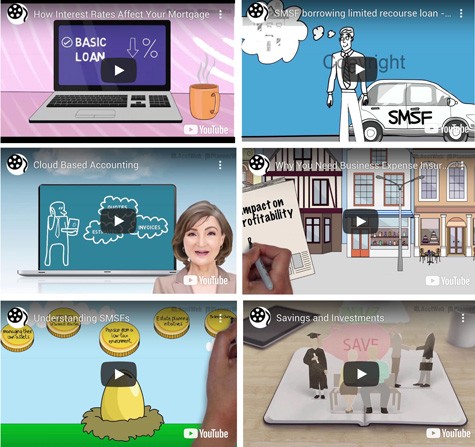
GDP by country since 1800
This animated chart is simply amazing. It's fascinating to see how the world has changed and is changing. Food for thought!!
Simply click on the image and see how things have changed but also how, in many ways, they've stayed the same.
15,000 tip-offs as ATO black economy hotline rings hot
Black economy tip-off calls to the ATO have breached the 15,000 mark in the three months since it launched its new tax integrity centre, with cash payments and income declaration among the biggest gripes.
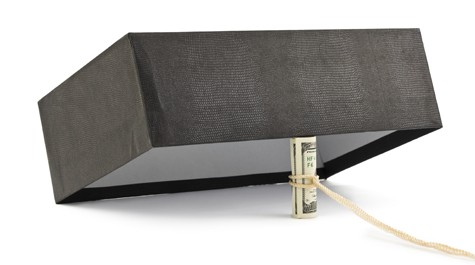
On 1 July, the ATO launched its new tax integrity centre, aimed at providing a single point of contact for reporting suspected or known illegal phoenix, tax evasion and black economy activity.
In its first quarter of operation, the tip-off centre has received 15,000 tip-offs, averaging 230 tip-offs a day.
The top categories of tip-offs include not declaring income; demanding cash from customers or paying workers cash in hand; lifestyles not matching a person’s income level; and not reporting sales.
Cafés and restaurants received the most attention, topping the list in terms of the total number of tip-offs received in the first quarter this year.
“We’re hearing loud and clear that people are sick and tired of this kind of dodgy behaviour. Running a small business can be a really tough gig, and when dishonest competitors are cheating the tax system by operating off the books, it’s really unfair and makes it even harder to succeed. It’s also effectively stealing from the community,” said ATO assistant commissioner Peter Holt.
“The proof is in the pudding. Our risk indicators tell us that there is a black economy problem in the café and restaurant industry and the fact that tip-offs about this industry top our list tells us that there is still more work to be done to protect honest café and restaurant owners and workers in this industry.
“Trading in cash and paying your workers in cash is perfectly legal but failing to report the income to the ATO and not paying your workers their entitlements like superannuation is not only illegal but also incredibly unfair,” he added.
“Regardless of what industry you’re in, if you’re cooking the books, your competitors and workers are probably aware of it. And they’re not hesitating to let us know about it.”
Apart from the hospitality industry, the ATO also received high volumes of tip-offs about black economy behaviour in the hairdressing and beauty, building and construction, and cleaning industries.
Tip-offs from New South Wales topped the ATO’s list, closely followed by Victoria and Queensland.
While tip-offs are private and can be anonymous, 53 per cent of people who provided a tip-off were happy to provide their contact details to the ATO.
“The fact that more and more people are willingly handing over their contact details when they give us a tip-off goes to show that the community has had enough of this kind of mischief. They want to help us uncover and deal with this behaviour,” Mr Holt said.
“A tip-off from the community could be the missing piece of the puzzle we need to successfully audit or prosecute someone who is illegally operating in the black economy, so we really value and rely on the community letting us know when something doesn’t add up.”
Jotham Lian
31 October 2019
accountantsdaily.com.au
What happens when interest rates hit the floor?
Amid challenges facing central banks in keeping the economy open for business, zero or negative benchmark interest rates are a real possibility. Let’s consider what that means for business.

What’s happening?
On 1 October, the Reserve Bank of Australia (RBA) announced another interest rate cut. It is the third cut within five months and brings the cash rate to 0.75 of a percentage point, the lowest level in Australian history. The RBA has indicated that it is willing to take extraordinary steps to boost the economy, decrease unemployment and push the inflation rate back within the target bands.
Expectations of further cuts in Australia could become a reality after the US Federal Reserve cut its benchmark rate by 25 basis points in September.
Negative interest rates might sound odd, but they have been seen previously in the central banks of Switzerland (’70s and 2014), Japan (early ’90s), Sweden (2009 and 2010), Denmark (2012) and the European Central Bank (2014).
What does it mean in theory?
A zero, or negative, interest rate would appear to be counterintuitive to core financial and economic principles. Theoretically, this could result in banks actually paying customers for borrowing from them.
What’s the real impact?
Sadly for customers, a negative benchmark rate does not mean free money or a paid-for mortgage. Generally, banks will include a zero, or minimum, interest rate floor clause in a debt facility to guarantee a minimum level of interest earned. This is even if the bank bill swap rate (BBSW) or other floating rates become negative.
However, what borrowers need to watch out for is interest rate swaps they may have used to lock in interest on their floating rate loans. Often, such swaps don’t have a similar floor.
In this situation, it’s possible that future cash flows for the loan and the interest rate swap will no longer match.
Critically, this means fixed loan rates might not actually be fixed: borrowers may actually end up paying more than their fixed rate.
We use the following scenarios to illustrate this effect.
|
Company borrows $1 million from Bank at a floating rate of BBSW + 2%. The loan has a floor so total interest cannot drop below 2%, even if BBSW was negative. To fix its interest rate, Company also purchases an interest rate swap to lock in a fixed rate of 4%. Under the swap, Company receives BBSW + 2% and pays 4% fixed. The swap has no floor. Scenario 1 – BBSW is 1%, so bank variable interest rate is 3% Scenario 2 – BBSW is -2%, so bank variable interest is 2% (because of the floor) |
Scenario 1 – Net outflow: $40,000
|
Scenario 1: |
Interest Rate Swap: Company pays |
Interest Rate Swap: Company receives |
Interest on debt: Company pays |
Net effect: Company pays |
|
Exposure to the floating rate is 100% hedged |
Fixed 4% under the terms of the Interest Rate Swap |
Variable 3%, comprising 1% BBSW + 2% fixed
|
Variable 3%, comprising 1% BBSW + 2% fixed |
Fixed 4% |
Scenario 2 – Net outflow: $60,000
|
Scenario 2: |
Interest Rate Swap: Company pays |
Interest Rate Swap: Company receives |
Interest on debt: Company pays |
Net effect: Company pays |
|
The floor limits the volatility of the loan which is not offset by the Interest Rate Swap. The hedging relationship is not effective |
Fixed 4% under the terms of the Interest Rate Swap |
0%, comprising -2% BBSW + 2% fixed
|
Variable 2%, comprising 0% BBSW (limited by the floor) + 2% fixed |
Total 6% interest, being fixed 4% AND 2% (i.e. interest on debt) |
In Scenario 2, Company may have thought it was locked into a fixed interest rate. However, because of the floor, their net interest is actually 6 per cent!
What might borrowers do?
In order to manage the exposure to negative interest rates in the situations above, borrowers can include interest rate floors along with swaps when entering into new debt agreements.
For existing swaps, borrowers could purchase a floor (by way of a purchased option) to try to manage interest rate exposures if benchmark rates did actually go negative.
What are the accounting implications?
Although rates have fallen to an all-time low, Australia has never actually had negative interest rates.
However, if the curve begins to turn, ineffectiveness may arise from hedging relationships which, in certain circumstances, require hedge accounting to be discontinued — with consequent significant potential profit and loss (P&L) statement volatility.
Depending on a company’s particular circumstances, the outcomes could be:
Continue hedge accounting but separately account for the floor interest
This means that:
- hedge accounting would not be precluded, but
- the floor derivative is marked to market through the P&L statement.
The financial instruments standard provides an example where an embedded floor on the interest rate on a debt contract is not separated, provided the floor is at or below the market rate of interest when the contract is issued. If the floor is above the market rate of interest when the contract is issued, then it should be separately accounted for (i.e. if it is “in the money”).
Separation of the floor does not mean hedge accounting necessarily fails. However, where separation is required, the floor is accounted for at fair value through the P&L statement.
Discontinue hedge accounting
If this occurs:
- hedge accounting is discontinued prospectively, and
- existing cash-flow hedge reserves remain and are recognised in the P&L statement in the normal course.
Whether hedge accounting can be achieved will depend on the circumstances. If there is a floor, which is not separated from the debt instrument, and there is no equivalent floor in the hedging instrument, ineffectiveness will result from the hedging relationship.
The extent of the disconnect between the floating rate and the floor could require discontinuation of hedge accounting where there is no longer an economic relationship between the hedged item and the hedging instrument; for example, where the variable rate is lower than the floor for a substantial period of the hedging relationship.
What can you do to prepare?
If your business is exposed to interest rate risk, regardless of whether you are a lender or borrower, it is important to be aware of the possibility of having a zero interest rate environment and what the accounting implications might be. Check your contracts. If you do have a floor, think about whether you need an additional option or swap to protect your interest profile.
Insights: David Waters, Manuel Kapsis, Fei Huang and John Ratna
PwC Australia
11 October 2019
Reported in the accountantsdaily.com.au
Director Penalty Notices (DPN)
Directors need to be more aware of the increased ATO scrutiny of company reporting and payment obligations.

The ATO has been quickly increasing its focus on business audits, its 'bob-in’ a business scheme, collecting outstanding tax liabilities, and its visits to regional business sites. This is a lot already but it's not all, the ATO is also increasing the amount of Director Penalty Notices (DPN).
What is a DPN?
A Director Penalty Notice (DPN) means the directors of a company can be pursued directly for outstanding Superannuation Guarantee Charges (SGC) and Pay as You Go (PAYG) liabilities. Directors are no longer protected by a company’s corporate structure.
Under what circumstances would a DPN be issued?
- Historical non-reporting;
- Significant ATO debt which remains unpaid;
- Suspicion of phoenix activity. Phoenix activity is defined by the ATO here.
Obviously the main ATO trigger points for issuing a DPN relate primarily to obligations that have been outstanding for some time, though the current length of an outstanding obligation will most likely be shortened in the future. Equally obvious is that phoenix activities are illegal.
Directors need to pay very close attention to their company’s reporting and payment obligations and your accountant is well placed to help. If you have any concerns, then don't hesitate to ask.
Being more focused on these issues may sound relatively simple but in larger companies the directors may not have direct oversight regarding the company’s tax compliance obligations. In such cases all key personnel must also be very aware of the greater ATO scrutiny, and act accordingly.
Nor are new directors exempt. If there is an SGC, PAYG and GST liability that remains unpaid and unreported within 3 months from the date of a new director’s appointment then they too become liable.
Directors only have 21 days from the date a Director Penalty Notice is issued to act and avoid personal liability.
AcctWeb
Single Touch Payroll (STP) reporting irregularities: ATO contacting businesses
The Australian Taxation Office it is currently emailing STP enabled employers who have either ceased reporting for over 45 days; or have submitted employees under multiple payroll or BMS IDs.

These reporting irregularities may cause their employees to see incorrect, incomplete or multiple entries in their income statements.
Any new system creates a learning curve for everyone – if you have made a mistake, the corrections can be made now, well before year end.
AcctWeb
Pension deeming rates cut from 1 July 2019
The Government has announced that it will lower the social security deeming rate from 1.75% to 1.0% for financial investments up to $51,800 for single pensioners and $86,200 for pensioner couples.

The upper deeming rate of 3.25% will be cut to 3.0% for balances over these amounts.
This deemed rate is probably higher than many pensions are earning on bank deposits. Under the new rates, age pensioners whose income is assessed using deeming will receive up to $40.50 a fortnight for couples, $1053 extra a year, and $31 a fortnight for singles, $804 a year.
The reduced deeming rates have been backdated to 1 July 2019. Any additional pension payment will flow through into pensioners' bank accounts from the end of September 2019 in line with the regular indexation of the pension.
AcctWeb
New ATO data-matching program – overseas movement data and HELP debt
The Australian Taxation Office will acquire overseas movement data from the Department of Home Affairs (DHA) for individuals with an existing HELP, VSL or TSL debt.

The data matching program will be conducted for next three financial years.
Those living and working overseas with a Higher Education Loan Program (HELP), Vocational Education and Training Student Loan (VSL) and/or Trade Support Loans (TSL) are required to update their contact details and submit an overseas travel notification if they have an intention to, or already reside overseas, for 183 days or more in any 12 months; and lodge their worldwide income or a non-lodgement advice.
AcctWeb
Employee entitlements, ‘wage theft’ and Fair Work: Why it’s time to be proactive
The Press Club. Tokyo Sushi. Ezard. These three restaurants are just a few of the big names widely reported to be embroiled in the Fair Work Ombudsman’s crackdown on underpayment of staff.

Its investigations have uncovered serious breaches of Fair Work legislation, affecting businesses across the hospitality, retail and dining sectors as well as many other industries.
In the case of George Colombaris, the celebrity chef has admitted to underpaying his workers by $7.83 million, and has been ordered to pay a $200,000 fine. With heightened media attention and a new focus from employees on whether they are getting a fair deal, it’s likely that many other high-profile names will soon feel the heat from Fair Work. And it’s not just monetary risks that these businesses face. The media has coined the new term “wage theft” — and the reputational damage for anyone accused of this is going to be significant.
We ask the question, why do businesses in these industries, as well as other industries that typically employ large numbers of shift or casual staff outside of the regular nine-to-five, find it so hard to pay their employees correctly, and what can they do to remedy this?
Paying workers fairly: What are the challenges?
Employers often don’t understand their obligations under Australia’s highly complex industry awards systems. For example, the Hospitality Industry (General) Award 2010 allows companies to work out how much an employee would be paid for a 38-hour week. They can then uplift that by 25 per cent to recognise overtime, and pay this amount to the employee on an annual basis, as long as actual pay and total hours worked are reconciled annually, to ensure that the employee has been fully compensated for the time they actually worked.
However, the problem comes because staff in industries such as hospitality work long hours that can change frequently. If a business doesn’t have an effective way of recording hours worked, or never goes back and checks how much overtime a staff member has completed, it is unlikely that it will be paying employees correctly. As such, while employers may take care to roster employees appropriately, employees could end up working 60-plus hours per week and not get paid correctly for this if a reconciliation is never performed by the employer. The media attention given to this issue is prompting staff to check their own wages, and when they find a breach, go to the unions, Fair Work Ombudsman and the press.
The issue is made more challenging because many businesses in these industries don’t have a large or sophisticated HR department or payroll function — this may reduce the capability of the business to correctly review contracts, awards and rates of pay or perform annual reconciliations for those on annualised salaries.
What are the risks to businesses in this area?
There is no doubt that businesses are obliged to pay their employees correctly, fully and appropriately, and should do so in a timely manner. To do anything else is grossly unfair to employees as well as to competitors who are doing the right thing and are disadvantaged as a result.
Fair Work has recognised that there’s an endemic problem with hospitality-related businesses, and is directing its investigations towards these industries. This poses significant risks for any business found to be breaching of their obligations, including:
- Reputational damage: “Wage theft” is not a term you want associated with your business, and the risk to business reputation is significant. The business’s ability to attract new customers and high-quality staff in the future will be impacted.
- Financial impact: Companies found to be breaching their obligations may have to pay fines as well as compensation to employees, which may grow as the press becomes even more negative. This is in addition to the clear requirement that they make good any historical underpayments to employees. Many hospitality businesses don’t operate on high margins at the best of times, so unexpected employee costs, together with monetary penalties, could have the potential to end operations altogether.
- Immigration restrictions: Many employees in the hospitality and retail industries (and many other industries) are in Australia on work visas. Any Fair Work investigation is likely to be referred to the Department of Immigration and Border Force, and vice versa. These bodies will conduct their own investigations into how a company is paying workers from abroad. This may lead to restrictions or bans on employing people from overseas as well as separate fines and additional adverse press coverage for breaching immigration law. Data sharing has become much more efficient among government organisations, meaning the Australian Taxation Office and other government departments may also become interested.
- Criminalisation: There has been genuine political interest in criminalising Fair Work Act breaches, and the government has indicated that it is considering drafting further legislation around this. If passed, business owners and directors may face criminal charges and potential prison time if they are found to be underpaying workers.
How can businesses stay compliant with Fair Work?
Firstly, if a business believes it may have underpaid workers or otherwise be in breach of the Fair Work Act, it must deal with the issue quickly and honestly. The owners must work out how much they’ve underpaid their staff and start to remediate. This is essentially their only choice — if Fair Work doesn’t believe the company is trying to remedy the situation, the case is likely to go to court.
Moving forward, the business may need to reshape its workforce or business model. The problem is that many such businesses operate on such low margins that, had they been paying their workers correctly, their viability may be called into question. For companies that have not yet discovered a breach but would like to be more proactive in this area, there are several steps they can take:
Develop a thorough understanding of the awards: There are complicated rules around roster patterns, rates for grades of employees, part-time versus full-time, number of shifts a staff member can work, how many days off they can have, and length of time given between shifts. Support from professionals, including employment lawyers, will likely be a good idea in this regard.
Create policies and procedures around time and attendance records: This is one of the most common errors we see at BDO. In retail there are often very basic paper timesheets, prone to manipulation and error, and without good sign-off and approval protocols. Even if a business has a digital solution, if there aren’t thorough procedures around when an employee says they’ve started their shift (versus when they simply arrive at the workplace), it’s hard to keep track of who’s working what hours and when.
Offer training: Make sure frontline employees and staff understand these formal policies and procedures to ensure compliance.
Check that annual salaries actually match up to time worked: Another common error we see is that businesses will calculate someone’s annual salary based on estimated hours under an award, but won’t go back and check it correlates with the time an employee has actually worked. This is made even more difficult when shifts are incorrectly recorded or an employer offers alternative arrangements such as time in lieu.
Audit periodically: Regular sample testing and independent checks are a must. This will ensure that employees are following time-recording processes correctly and that payroll teams are checking annual salaries against the hours staff members have actually worked.
Ben Renshaw, partner, BDO
27 September 2019
accountantsdaily.com.au
Latest Industry News

How Do I Write Legally Compliant Terms and Conditions for My Business?
Terms and conditions bind your customers only where they actively accept them, so a tick box at checkout holds...

Paid parental leave super contributions have started
From July 2026, the new Paid Parental Leave Superannuation Contribution (PPLSC) has started. From...

If the business is no longer profitable, and is unlikely to be profitable in the future, your best option may...

Check out the this visualization, which tracks the evolution of dietary calorie intake from 1930 to...

Taxpayer given 35% penalty for BAS recklessness
Following an application for a refund of nearly $94,000, the Administrative Review Tribunal has set aside an...

SMEs warned as ATO ramps up tax debt collection
One insolvency specialist has emphasised the importance of small businesses engaging their accountants to stay...

Does Your Small Business Need to Follow AML Privacy Rules?
Compliance with new anti-money laundering (AML) laws may subject your small business to additional privacy...

Don’t get caught out at tax time with your multiples jobs
Picking up a second job, holding multiple part-time roles, or doing gig work is now part of everyday life. But...

Global companies turn to cost-cutting amid ongoing inflation
Rising operating costs and persistent inflation are placing renewed pressure on businesses worldwide, despite...

Warning for early lodger this tax time!
The ATO has a clear message this year: slow down and get it right. Early lodgers are far more likely to make...

ATO no longer treating debt the same as during COVID
One expert has stressed the importance of tax agents reminding their clients that the ATO is no longer as...

The evolution of the world’s languages
Check out the evolution of the world's most spoken languages from 2500 BC to...
Latest Guests News

Newsletter Newslettter We are pleased to supply you with the latest edition of Client Alert, which...