- 234 Balaclava Road, Caulfield North VIC 3161
- contactus@guests.com.au
- (03) 9509 7033
ATO expands small business review pilot
‘Not interested in dragging disputes out’: The ATO has stopped short of making its small business independent review service a permanent feature as it expands and extends the pilot program until the end of the year.

The ATO’s independent review service trial for small businesses will now be extended to 31 December 2020 and expanded to include disputes involving GST, excise, luxury car tax (LCT), wine equalisation tax (WET) and fuel tax credits (FTC).
Launched by commissioner Chris Jordan on 1 July 2018, the pilot program had initially only considered disputes involving income tax audits and was set to run for only 12 months.
With 138 small businesses having taken up the offer since the pilot began, ATO deputy commissioner Scott Treatt said its early success had prompted the Tax Office to expand the pilot.
“Pleasingly, we’ve only received two objections from businesses that have been through our independent review pilot since it launched on 1 July 2018. This result demonstrates that our pilot program is working as intended for small business in that it’s helping to resolve disputes prior to matters reaching objection,” Mr Treatt told Accountants Daily.
“We proactively invite small businesses to take advantage of the service when we issue an audit finalisation letter. We’ve found that the service is helping us resolve disputes with small businesses earlier.
“Our officers will make every effort to resolve disputes as quickly as possible. We are not interested in dragging disputes out.”
The independent review process had been previously reserved for entities with a turnover greater than $250 million.
The pilot program will see eligible small businesses with an audit in progress be contacted by their audit case officer with the offer of a review before issuing assessments.
According to Mr Treatt, small businesses can expect an independent officer from outside its audit area to review the facts and technical merits of the ATO’s audit position.
The most common issues that small businesses have asked for a review into to date includes omitted cash income, usually due to inadequate record keeping; administrative penalties; deductibility of business expenses; and characterisation of payments to related individuals.
Disputes over superannuation, fringe benefits tax, fraud and evasion findings, and interest will not be considered by the independent review service at this stage.
Jotham Lian
28 February 2020
accountantsdaily.com.au
Risks when dating documents in 2020
Do you use the short form year when dating documents?

The risk is that formatting the date as DD/MM/YY leaves the year able to be altered by the adding of two digits after the ‘20’ to (fraudulently) post or pre-date the document.
It would be wiser, as a standard habit to always write ‘2020’ in full when dating documents. Doing so means the date cannot be altered or manipulated.
AcctWeb
Australian Taxation Office (ATO) debts may affect your credit rating
Businesses with tax debts need to be aware that the ATO will now be able to disclose the details of their tax debts to credit ratings agencies, which could potentially affect the ability of the business to obtain finance or refinance existing debt.

Generally, only businesses with an ABN and debts over $100,000 and that are not “effectively engaged” with the ATO will be affected. The ATO is planning a phased implementation which will consist of undertaking education efforts before it targets companies, followed by partnerships, trusts and sole traders.
The aim of the laws, according to the government, is to encourage more informed decision-making within the business community by making large overdue tax debts more visible, and to reduce the unfair advantage obtained by businesses that do not pay their tax on time.
As always, communication is the best action so working out a payment plan with ATO will mean you are “engaged” and should not be listed.
AcctWeb
SG amnesty bill passes Parliament
The long-awaited superannuation guarantee amnesty bill has now passed both houses, with employers set to get six months to disclose historical non-compliance before tougher penalties apply.

The Treasury Laws Amendment (Recovering Unpaid Superannuation) Bill 2019 has now been passed and is awaiting royal assent.
The SG amnesty provides for a one-off amnesty to encourage employers to self-correct historical SG non-compliance dating from 1 July 1992 to 31 March 2018.
An employer will not be able to benefit from the amnesty for SG shortfall relating to the quarter starting on 1 April 2018 or subsequent quarters.
It will allow employers to claim tax deductions for payments of SG charge or contributions made during the amnesty period to offset SG charge, as well as remove the administrative component and the Part 7 penalty that may otherwise apply in relation to SG non-compliance.
The amnesty period will start from 24 May 2018 and end six months from the date it receives royal assent.
The new legislation will also impose minimum penalties on employers who fail to come forward during the amnesty period by limiting the commissioner’s ability to remit penalties below 100 per cent of the amount of SG charge payable.
Around 7,000 employers have since come forward to voluntarily disclose historical unpaid super since the amnesty was first announced on 24 May 2018.
Treasury estimates an additional 7,000 employers will come forward during the six-month amnesty period, returning $230 million of superannuation to employees who may have otherwise completely missed out.
Assistant Minister for Superannuation, Financial Services and Financial Technology Jane Hume said the passing of the legislation should not be viewed as giving a free kick to employers who had been previously non-compliant.
“Employers will not be off the hook. To use the amnesty, they must still pay all that is owing to their employees, including the high rate of interest. However, the amnesty will make it easier for workers to secure the super they are owed by not hitting employers with the penalties usually associated with late payment,” said Ms Hume.
“If employers do not take advantage of the amnesty, they will now face significantly higher penalties when they are caught. In addition, throughout the amnesty period the ATO will still continue its usual audit and enforcement activity against employers for historical obligations they do not own up to voluntarily.
“We encourage employers to check they don’t owe outstanding super — and if they do, to take advantage of this once-only opportunity to set things right before much tougher penalties apply.”
Jotham Lian
24 February 2020
accountantsdaily.com.au
ATO flags most common SMSF return mistakes
The Australian Taxation Office has revealed the top five most frequent errors made in the submission of SMSF annual returns as well as how advisers can avoid them when lodging this year.

A bank account that isn’t unique to the SMSF
The ATO said there must be a bank account in the fund’s name to manage the SMSF operations and to accept contributions, rollovers of super and income from investments.
Further, it said the account must be separate from the trustees’ individual bank accounts and any related employers’ or advisers’ bank accounts.
“This will protect your fund’s assets and ensure super payments can be made to your SMSF,” the ATO said.
Providing an incorrect electronic service address (ESA)
The ATO said an ESA allows an SMSF to receive electronic remittance advice and contributions if it has members receiving super from non-related employers. Therefore, it’s not an email address or the contact details of the SMSF messaging provider.
“An ESA consists of alphanumeric characters with a combination of upper and lower-case characters and is case sensitive,” the Tax Office said.
Not valuing an SMSF’s assets at market value
The Tax Office noted that SMSF assets need to be calculated at market value as at 30 June to prepare the fund’s accounts, statements and SAR.
“If you follow our valuation guidelines, we’ll generally accept the valuation you provide,” the ATO said.
“Accurate asset valuation is important to ensure your SMSF retains its complying fund status. Penalties may apply for inaccurate valuations as these can have an impact on your members’ balances.”
Trying to lodge with zero assets
The ATO said an SMSF is not legally established until the fund has assets set aside for the benefit of members. As a result, the regulator said it won’t accept a SAR from an SMSF that has no assets unless the fund is being wound up.
“If this is your SMSF’s first year and you have no assets set aside for the benefit of members, you can ask us to either cancel your fund’s registration or flag the SMSF’s record as return not necessary (RNN),” it said.
Lodging an SAR without auditor details
An approved auditor examines an SMSF’s financial statements and assesses the fund’s compliance with super law, meaning an audit must be completed before your SAR can be lodged, according to the ATO.
“A SAR lodged without auditor’s details will be suspended and not recognised as a lodgment. This will impact the complying status of the fund until the SAR is lodged with the required information,” the ATO said.
“Appoint an auditor at least 45 days before your SAR is due to ensure the audit is completed in time to meet the lodgment date.”
Adrian Flores
26 February 2020
accountantsdaily.com.au
Data can be great stuff! – Australia
It might be dry old data but it's how you're county's going and it's used to make decisions that affect you every day.

Please click on the following link to see all this interesting information. The areas covered are:
- Overview
- Markets
- GDP
- Labour
- Prices
- Money
- Trade
- Government
- Business
- Consumer
- Housing
- Taxes
- Climate
Access all this data here.
tradingeconomics.com/australia
GST refunds for returned imported goods
A question many people ask relates to GST on online purchases. This article helps explain how it works plus there is a link to extra resources at the end.

When you purchase digital products or goods online from overseas with a customs value of A$1,000 or less (low value imported goods) you may notice GST:
- included in the advertised price
- added at the checkout
- included on your receipt or order confirmation
- included in your shipping and insurance costs.
Not all purchases from overseas include GST. For example, some overseas merchants may not be required to register for GST because they don't reach the A$75,000 GST registration threshold (in sales to Australia). Some goods may also be GST-free items, such as some food or medical supplies.
If you return low value imported goods, your overseas supplier should refund the amount paid including GST.
Contact your supplier if you believe GST has been incorrectly applied and request a refund of the GST charged.
Remember, registered tax agents and BAS agents can help you with your tax.
Find out about:
14k employers, $230m in super: Financial Services Minister defends proposed SG amnesty
Over 14,000 employers are set to come forward under the proposed SG amnesty, paying out a total of $230 million in unpaid superannuation to employees, according to the Financial Services Minister.

In an address to the Conexus Financial Superannuation Chair Forum, Assistant Minister for Superannuation, Financial Services and Financial Technology Jane Hume said Treasury estimates an additional 7,000 employers will come forward during the six-month amnesty period, adding to the 7,000 employers that have come forward to voluntarily disclose historical unpaid super since the measure was first announced.
The SG amnesty has been in legislative hell since the measure was first announced on 24 May 2018, with the 2018 version of the bill lapsing with the calling of the 2019 federal election.
Since then, the government has introduced a 2019 bill, with amendments to include an extended six-month amnesty period from the date it receives royal assent, as well as imposing minimum penalties on employers who fail to come forward during the amnesty period.
The bill passed the lower house late last year, with debate in the Senate set to resume when Parliament sits in February.
Ms Hume also took the opportunity to shoot down detractors of the proposed amnesty, arguing that it would help return $230 million of superannuation to employees who may have otherwise completely missed out.
“I know there are those who oppose an amnesty for employers and want us to take a strictly punitive approach. But just wielding the stick won’t encourage employers who want to set the past right to come forward,” Ms Hume said.
“In fact, it encourages them to hide.
“Let me be clear: the amnesty does not reduce employees’ entitlements by one cent, nor does it let employers off the hook.”
She added: “The only person getting less out of this arrangement is the federal government — we are waiving our entitlement to fees and penalties. And we’re doing it because we want to see workers get any superannuation they’re owed, paid in full, plus sizeable interest on top.
“Further, our bill proposes that employers who fail to come forward during the amnesty and who are later found to have historical SG non-compliance will face very heavy penalties.
“So, it’s carrot, and stick.”
Underpaid super ‘impossible in the future’
With Single Touch Payroll now fully rolled out to businesses of all sizes, giving the ATO “unprecedented level of visibility” over future superannuation compliance, Ms Hume said the proposed SG amnesty would help “clean up the past”.
“Now for the first time the ATO has ‘eyes in’ real-time visibility over all wage and salary payments of employers,” Ms Hume said.
“By matching this data with near real-time reporting of contributions received by funds, the ATO can now spot issues with superannuation compliance as they occur, and we’ve given them more resources to take timely action so that these issues don’t arise in the future.”
She added: “Undetected underpayment of workers’ entitlements to superannuation — whether intentional or inadvertent — will be almost impossible in the future.
“We can deal with the future via Single Touch Payroll. Let’s do our best to clean up the past, too, and make whole those employees who have missed out on what they are rightly owed.”
Jotham Lian
30 January 2020
accountantsdaily.com./au
There’s still time to move to Single Touch Payroll (STP)
It’s not too late to join the other 550,000 employers who are reporting through Single Touch Payroll (STP), but time is running out.
If you aren’t reporting through STP, you can start by:
- finding a software solution that’s right for you.
- asking for a concession. This could be reporting quarterly at the same time as your activity statement. Eligibility will depend on your circumstances.
- asking for more time if you're not ready.
We understand that it takes time to transition to STP, but there are a range of options to assist your transition. Watch our video of a small business owner's experience transitioning to STP.
If you have been affected by a natural disaster, there is additional support available and we will help you sort out your tax affairs later.
Remember, registered tax agents can help you with your tax.
Find out more about:
ATO
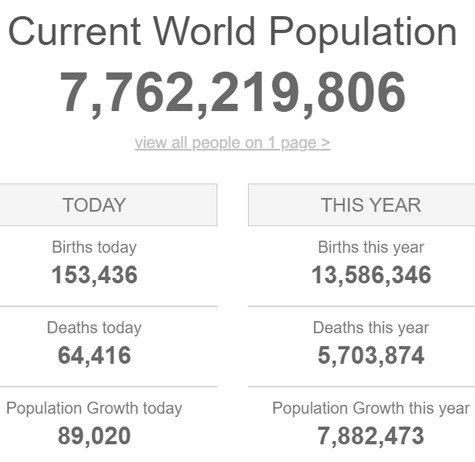
Real Time World Population Growth – Wow!!
Watch as the world population changes every second of the day or see where everyone is.

Knowing exactly what’s happening with the World’s population can be both intriguing and a bit scary at the same time. Just getting one’s head around the rate of increase and where all these people live is a daunting task. But given the issues facing the world today learning a bit more about all its peoples is worth knowing.
Click here to view the interactive information contained in the image below but also click here to see how all these people fit across all the countries of the world.
Latest Industry News

How Do I Write Legally Compliant Terms and Conditions for My Business?
Terms and conditions bind your customers only where they actively accept them, so a tick box at checkout holds...

Paid parental leave super contributions have started
From July 2026, the new Paid Parental Leave Superannuation Contribution (PPLSC) has started. From...

If the business is no longer profitable, and is unlikely to be profitable in the future, your best option may...

Check out the this visualization, which tracks the evolution of dietary calorie intake from 1930 to...

Taxpayer given 35% penalty for BAS recklessness
Following an application for a refund of nearly $94,000, the Administrative Review Tribunal has set aside an...

SMEs warned as ATO ramps up tax debt collection
One insolvency specialist has emphasised the importance of small businesses engaging their accountants to stay...

Does Your Small Business Need to Follow AML Privacy Rules?
Compliance with new anti-money laundering (AML) laws may subject your small business to additional privacy...

Don’t get caught out at tax time with your multiples jobs
Picking up a second job, holding multiple part-time roles, or doing gig work is now part of everyday life. But...

Global companies turn to cost-cutting amid ongoing inflation
Rising operating costs and persistent inflation are placing renewed pressure on businesses worldwide, despite...

Warning for early lodger this tax time!
The ATO has a clear message this year: slow down and get it right. Early lodgers are far more likely to make...

ATO no longer treating debt the same as during COVID
One expert has stressed the importance of tax agents reminding their clients that the ATO is no longer as...

The evolution of the world’s languages
Check out the evolution of the world's most spoken languages from 2500 BC to...
Latest Guests News

Newsletter Newslettter We are pleased to supply you with the latest edition of Client Alert, which...