- 234 Balaclava Road, Caulfield North VIC 3161
- contactus@guests.com.au
- (03) 9509 7033
More coronavirus support for landlords, commercial tenants

More state governments are pledging to support tenants and landlords through the coronavirus pandemic by reforming residential and commercial tenancy law.
South Australia and Western Australia have followed on from NSW and Victoria in announcing further stimulus measures to help their commercial tenants by easing the burden on landlords.
South Australia
SA has announced a further $50 million in stimulus measures, under which landlords will be offered a 25 per cent reduction on their 2019–20 land tax liability if they pass on the full benefit to their tenants impacted by COVID-19 restrictions.
According to the government, eligible landlords with an outstanding 2019–20 land tax liability will see any remaining land tax payable deferred for up to six months until around December.
Moreover, taxpayers who have already paid their 2019–20 land tax liability and are eligible for relief under this scheme will be issued with a 25 per cent land tax refund on eligible properties.
Delving into eligibility, the SA government said eligible landlords are those who can demonstrate that they have provided the “minimum level of rent relief” to tenants since 30 March, and/or they will provide such relief up to and including 30 October.
“This will be a powerful shot in the arm for local businesses and residential tenants who have been suffering a significant downturn in trade and income as a result of COVID-19 and the necessary restrictions imposed to help limit its spread,” the state’s treasurer, Rob Lucas, said.
“By helping landlords, we help their tenants — and, in turn, ensure our economy is best placed to bounce back more rapidly from this once-in-a-century crisis.”
The latest measure is specifically tailored to SME commercial tenants including gyms, restaurants, cafés, beauty salons and hairdressers.
Western Australia
Similarly, WA has slated $100 million in land tax relief grants to commercial landlords who reduce rent for small-business tenants impacted by COVID-19 as part of its latest $154.5 million relief package.
To be eligible, commercial landlords must provide rent relief that equates to a minimum of three months’ rent and freeze outgoings to small businesses that have suffered at least a 30 per cent reduction in turnover due to COVID-19.
Grants equivalent to 25 per cent of the landlord’s land tax bill for 2019–20 for the property in which an eligible tenant is provided relief will be paid to landlords.
The state explained that commercial rent relief grants will be administered through the Small Business Development Corporation, with applications opening on 1 May 2020.
Treasurer Ben Wyatt confirmed the grants will be available on a first-come, first-served basis to encourage landlords to negotiate early with tenants who are doing it tough as a result of COVID-19.
“We’ve opted to provide targeted assistance that supports both tenants and landlords of commercial and residential properties,” Mr Wyatt said.
The state’s newest measure complements the introduction of a six-month freeze on rent increases, the moratorium on evictions from 30 March 2020 and the $25 million small-business rent relief package announced last month.
Maja Garaca Djurdjevic
28 April 2020
mybusiness.com.au
ATO releases JobKeeper alternative test
The alternative decline in turnover test rules for the JobKeeper payment scheme has now been registered by the ATO.

The legislative instrument, Coronavirus Economic Response Package (Payments and Benefits) Alternative Decline in Turnover Test Rules 2020, has now been registered.
The alternative tests will only kick in if an entity cannot satisfy the basic decline in turnover test.
The explanatory statement notes that the alternative tests will only apply to seven circumstances.
These include where an entity commenced business after the relevant comparison period in 2019 or the business did not exist in the relevant comparison period and as a result there was no relevant comparison period in 2019.
It will also cover a circumstance where an entity acquired or disposed of part of their business after the relevant comparison period in 2019, and where an entity has restructured part or all of their business after the relevant comparison period in 2019.
Entities who had an increase in turnover by 50 per cent or more in the 12 months immediately before the applicable turnover test period, or 25 per cent or more in the six months immediately before the applicable turnover test period, or 12.5 per cent or more in the three months immediately before the applicable turnover test period, will also be covered.
The alternative test will also cover entities affected by a drought or other natural disaster in the relevant comparison period in 2019, and entities who have an irregular turnover that is not cyclical, such as what can occur in the building and construction sector.
A sole trader or a small partnership where the sole trader or one of the partners did not work for all or part of the relevant comparison period because they were sick, injured or on leave during the relevant comparison period, and those circumstances affects the turnover of the sole trader or partnership, will also be covered.
Each of the seven circumstances has its own alternative test that is detailed in the legislative instrument.
“The commissioner cannot determine an alternative decline in turnover test in all circumstances,” said the explanatory statement.
“It is only in those circumstances where there is an event or circumstance, be it internal or external to an entity, that is outside the usual business setting for entities of that class which results in the relevant comparison period in 2019 not being appropriate for the purpose of an entity in the class of entities satisfying the decline in turnover test.”
Jotham Lian
24 April 2020
smsfadviser.com
ATO extends initial JobKeeper payment deadline
Employers looking to enrol for the first two JobKeeper fortnights have now been granted a further extension of time to enrol and pay employees.
The ATO has now announced an extension of time for employers who wish to enrol for the first two JobKeeper fortnights to 31 May, an extension from 30 April.
Crucially, for the first two fortnights that run from 30 March to 12 April, and 13 April to 26 April, the ATO will now accept the late payments of the minimum $1,500 per fortnight as long as they are paid by 8 May.
“This means that you can make two fortnightly payments of at least $1,500 per fortnight by 8 May, or a combined payment of at least $3,000,” said the ATO in an update on Monday.
Speaking to Accountants Daily, the Institute of Public Accountants general manager of technical policy Tony Greco said the payment extension was particularly welcome, considering how the previous deadline of 30 April was hard for employers to meet.
“The onus was on the employer to make the payment and then hope the employee is eligible, so they are taking a leap of faith and if they didn’t make the payment, they wouldn’t get the reimbursement,” Mr Greco said.
“If this date is not met, then the employer will lose the JobKeeper reimbursement and, more importantly, their employees may also be denied the benefit of the first two fortnight payments which will be an unnecessary loss assuming both the employer and employee are eligible.”
The extension in time to meet the wage condition comes after the ATO registered the alternative tests late last week and the Treasurer revealing that further changes would be made to the JobKeeper rules.

Assistant Treasurer Michael Sukkar said the extension would help the 500,000 businesses that have now enrolled for the JobKeeper scheme pay more than 3 million employees in time.
“This extension allows businesses further time to consider their circumstances and remove any cash-flow pressures arising from financing arrangements that have not been finalised,” Mr Sukkar said.
“Importantly, this extension does not negate the obligation on businesses to ensure they continue to pay eligible employees $1,500 in each JobKeeper fortnight.
“Businesses have until 31 May 2020 to formally enrol to claim JobKeeper payments. However, the sooner an employer pays their staff for April and enrols, the sooner the ATO can reimburse them the JobKeeper payments.”
With the major banks now stepping up with dedicated JobKeeper hotlines to provide bridging finance to businesses ahead of the ATO’s reimbursement, Mr Greco said it was pleasing to see the Tax Office adopt a flexible approach to give employers more time to meet the first payment date.
“There are a lot of dates flying around and this could be lost in translation,” he said.
“It is a very simple message, but I think everyone is working at a rate of knots that simple messages have just been lost.”
The ATO’s updated guidance on enrolment date and payment date can be viewed here.
Jotham Lian
27 April 2020
accountantsdaily.com.au
Boosting cash flow – ATO
Beginning the April 29 2020 BAS based payments began to flow from the ATO to small businesses across Australia.

While the circumstances are horrific, Covid-19, part of the Federal Government's relief package is to provide a very welcome and much needed cash flow boost. These payments have begun with the April payment being the first of three
An overview of all aspects of this scheme can be read here.
ATO
Our website, your resources

Coronavirus resources have been added to the many others we supply our clients. Resources such as many latest news articles, educational videos (updated recently), client portals, calculators, and stock prices. You have 24/7 access to all these tools and resources. Any question, simply ask. *
Covid-19 updates. We have added an article to our latest news that is regularly updated with Federal and State government resources and tools so you don’t have to find them yourselves and perhaps miss something important.
Latest news articles. 7-9 individual articles every month, though 13-15 in March, and all chosen for their relevance. Our website is a great place to stay informed.
Educational videos on accounting topics. All are relevant, interesting, educational and interesting. Videos that are changed three times a year to ensure you and your family are able to lean about many issues related financial issues and topics.
Calculators. A good range of calculators to help you better understand and manage your personal and family financial issues. Four of the more popular are: Pay calculator, Budget Calculator, Loan Calculator, and Super Calculator
Client portals. Portals are quite common on many sites and can be used to store your data, pay bills, log onto investment systems.
Ask us a question at any time. If you have a question on any related topic then don’t hesitate to use a form on our site to ask.
Your information is private and confidential and should be treated that way. Using Secure File Transfer means your information is encrypted when sent in either direction over the Internet.
Many sites also have a message window feature that displays messages of interest or that cover topics and deadlines you should be aware of.
* Not all are on every website.
Your Accountant
Jobkeeper Fraud warning
AFP teams up with ATO, Treasury in COVID-19 tax fraud taskforce.
The Treasury has confirmed that it will be working with the ATO and an Australian Federal Police taskforce in investigating any cases of fraud related to the government’s COVID-19 stimulus measures.
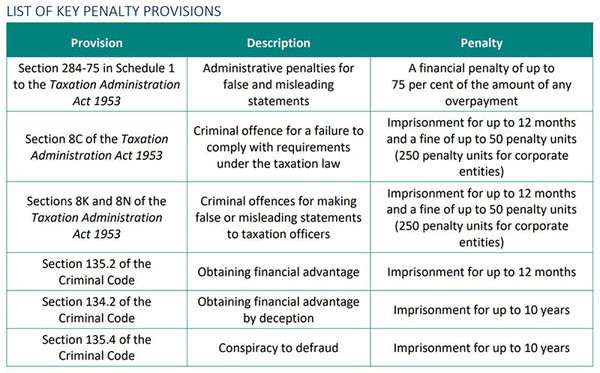
Fronting a Senate inquiry into the government’s response to COVID-19, Treasury Deputy Secretary Jenny Wilkinson confirmed that her department has been involved in discussions with a fraud taskforce established by the Department of Home Affairs.
“I am aware there is a fraud taskforce which is sitting within the Department of Home Affairs and I know the Australian Federal Police are involved in that taskforce and it is also the case that the ATO and Services Australia are involved in those discussions,” Ms Wilkinson said.
The Treasury’s confirmation comes after Home Affairs Minister Peter Dutton had warned businesses that any attempt to fraudulently access stimulus measures, including the JobKeeper payment, would be dealt with swiftly by the new AFP taskforce.
“Those people need to hear a very clear message: now more than ever, you are likely to be caught,” Mr Dutton told 2GB radio.
“If people do the wrong thing, they can expect a search warrant to be executed by the AFP and they can expect their assets to be frozen.
“With those people who claim with good intent but have done the wrong thing, they will have to repay that money, but the criminals who exploit the system, the technology that we’ve got now to look at algorithms, look at transfers, to look at money diverted to different shelf companies — those people will be under a lot of scrutiny. They should think twice about what they’re doing.”
The ATO has been unequivocal about fraudulent schemes, warning that it will pursue action against business and agents that engage in such arrangements.
The Tax Office has listed out a number of schemes that may be used to artificially create or inflate an entitlement to the cash-flow boost, and will also begin applying scrutiny to arrangements that help an entity satisfy the turnover test to qualify for the JobKeeper payment.
“Integrity rules are in place to deny or reduce an entitlement to JobKeeper payments if schemes are contrived to ensure payment conditions are satisfied, such as temporarily reducing or deferring turnover. Exceeding your turnover predictions by itself does not trigger these integrity rules,” the ATO said.
“Our compliance focus will be particularly directed towards schemes where there has not been a genuine fall in turnover in substance, but arrangements are contrived to ensure the turnover test is satisfied.”
Jotham Lian
28 April 2020
accountantsdaily.com.au
ATO clarifies COVID-19 rent relief concerns
The Australian Taxation Office has responded to widespread concerns on whether SMSF landlords providing rent relief to tenants due to the financial impacts of the novel coronavirus is a contravention of the SIS Act.

The national cabinet has considered issues relating to commercial tenancies as well as residential tenancies.
“The most significant of those is that state and territories will be moving to put a moratorium on evictions of persons as a result of financial distress if they are unable to meet their commitments,” Mr Morrison said.
“And so there will be a moratorium on evictions for the next six months under those rental arrangements.”
The industry has been seeking clarity from the ATO around whether SMSF landlords can legally provide rent relief to tenants as a result of the impacts of COVID-19.
In response, the ATO has sought to allay concerns from SMSF trustees around whether charging a tenant rent that is less than market value contravenes the SIS Act, and whether it would take action given the impacts of COVID-19.
The ATO’s response is as follows:
- “Some landlords are giving their tenants a reduction in or waiver of rent because of the financial impacts of COVID-19 and we understand that you may wish to do so as well.
- “Our compliance approach for the 2019–20 and 2020–21 financial years is that we will not take action where an SMSF gives a tenant — who is also a related party — a temporary rent reduction during this period.”
SMSF administrator SuperConcepts backed the ATO announcement, saying it has been inundated with calls and emails from concerned clients who have an SMSF which owns a business premise that is being leased to a related party.
“SuperConcepts fully supports this relief measure which provides certainty and much-needed relief for a growing number of SMSFs that own a business premise, and have been caught in the economic turmoil caused by COVID-19,” said SuperConcepts general manager of technical education services Peter Burgess.
Interpreting the ATO concession
SMSF law firms have also come out with their interpretations of the ATO’s concession for landlords.
According to CGW Lawyers partner Clint Jackson, the only requirement of the ATO’s concession is that the rent reduction must be temporary.
“Given the current business challenges, the ATO’s position is that there is no need for the rent reduction provided to be justified by market evidence (the SMSF can determine the reduction in its absolute discretion),” Mr Jackson said.
“The ATO’s concession does not apply to any other lease incentives or relief — just a ‘temporary rent reduction’.”
Mr Jackson said that while the ATO concession is “extremely broad”, it is also important that landlords not abuse the concession.
“This rent reduction should be reasonable and measured to the COVID-19 impact suffered by the tenant. Best practice is that it is consistent with the approach taken by arm’s-length landlords,” he said.
“The rent reduction agreed to by the SMSF should be properly documented, as this is an amendment to the lease terms.
“It is likely that SMSF auditors will be required to report any rent reductions, although the exact parameters of what will be reported in relation any rent reductions are still being determined.”
However, Daniel Butler and Bryce Figot of DBA Lawyers said that while the ATO will not actively seek out cases where an SMSF gives a related-party tenant a temporary rent reduction during the remainder of FY2020 or FY2021, the usual position for such practical approaches previously issued by the ATO is that if it does come across contraventions from other sources through its usual data detections, reviews or auditor contravention reports (ACR), it will usually apply the legislation in the normal manner.
“In short, SMSF trustees should not rely on the ATO’s non-binding practical guidance above, given the substantial downside consequences and given these situations may be legitimately resolved with appropriate action as outlined below,” said Mr Butler and Mr Figot.
“We do understand, however, that some SMSF trustees or businesses may not have the time or the funding to obtain proper advice and work through the appropriate steps to soundly position themselves to minimise future risk that will simply rely on the ATO practical approach at their own risk.”
Further, Mr Butler and Mr Figot said the ATO website does not provide any express relief for an SMSF that owns property via an interposed unit trust, such as a non-geared unit trust (NGUT).
“Once a contravention of one of the criteria relating to a NGUT is triggered under reg 13.22D of SISR, the trust is ‘forever’ tainted and the SMSF must dispose of its units in that unit trust to comply with the SISR,” they said.
“In particular, if the lease is not legally enforceable or if rent owing by a related-party tenant accrues and constitutes a loan under the lease, the unit trust will cease to comply with the criteria in division 13.3A of SISR.”
Adrian Flores
30 March 2020
smsfadviser.com
Banks to defer small-business loan repayments for 6 months
Small businesses will be allowed to defer loan repayments for six months under new emergency measures announced by the Australian Banking Association.

Australian Banking Association chief executive Anna Bligh said the relief package is expected to apply to $100 billion of existing small-business loans and said it could put “as much as $8 billion back into the pockets of small businesses as they battle through these difficult times”.
“This is a multibillion-dollar lifeline for small businesses when they need it most, to help keep the doors open and keep people in jobs,” Ms Bligh said.
The ABA’s announcement comes after the Reserve Bank announced an emergency cash rate cut to a record low of 0.25 of a percentage point.
The central bank also announced it would set up a $90 billion term funding facility for banks to specifically support their small-business clients.
According to Ms Bligh, the banks will put in place a fast-tracked approval process.
“Small businesses can rest assured that if they need help, they will get it. Banks are already reaching out to their customers to offer assistance, and packages will start rolling out in full on Monday,” she said.
‘“While this is first and foremost a health crisis, this pandemic has begun to have serious impacts across the economy, with small businesses beginning to feel the devastating effects.
“Small businesses are the most vulnerable part of economy and present the most pressing need for assistance in the economy today.”
Ms Bligh has advised that any small business who has not already been contacted should contact their bank to apply.
Jotham Lian
20 March 2020
accountantsdaily.com.au
COVID-19: Early Childhood Education and Care Relief Package
From Monday 6 April additional support for Early Childhood Education and Child Care Services and their families.

On 2 April 2020, the Australian Government announced the new Early Childhood Education and Care Relief Package. From Monday 6 April 2020 weekly payments will be made directly to early childhood education and care services in lieu of the Child Care Subsidy and the Additional Child Care Subsidy, to help them keep their doors open and employees in their jobs.
Payments will be made until the end of the 2019-20 financial year and families will not be charged fees during this time. These payments will complement the JobKeeper Payment announced by the Prime Minister on 30 March 2020.
Early childhood education and child care services do not need to apply for the payments, they will be paid automatically.
In addition, up to and including 5 April 2020, services can now waive gap fees for families due to the impact of COVID-19. This can go back as far as 23 March 2020 and is in addition to changes already announced..
For more information:
- Department of Education, Skills and employment COVID-19 page.
- Information for early childhood education and care providers and services – PDF
Source: education.gov.au
Now I’m working from home, what can I claim?

As more people are now working from home many are wondering what can and can’t be claimed and what records they need to keep. The following information, plus some tools and fact sheets, will help but your accountant and financial planner can help you the most with this question.
What tax deductions can you claim?
If you work from home, you can claim the work-related proportions of household costs such as:
- Heating, cooling and lighting bills
- Costs of cleaning your home working area
- Depreciation of home office furniture and fittings
- Depreciation of office equipment and computers
- Costs of repairing home office equipment, furniture and furnishings
- Small capital items such as furniture and computer equipment costing less than $300 can be written off in full immediately (they don’t need to be depreciated)
- Computer consumables (like printer ink) and stationery
- Phone (mobile and/or landline) and internet expenses
Ideally, you should have a specific room set aside as a home office. If you are using a room with a dual purpose (e.g. dining room), or a room shared with others (e.g. lounge room) you can only claim the expenses for the hours you had exclusive use of the area.
How do you claim?
You can use either of these methods:
Diary method/actual running expenses
Keep a diary to work out how much of your household running expenses relate to doing work in your home office. The diary needs to detail the time you spend in the home office, compared with other users of the home office. Keep your diary record for a representative four-week period. The ‘work-use proportion’ can then be used to determine your work-related claim, for whatever period of time they are required by the Government or Employer regulation to work from home. Of the two methods this usually produces the larger deduction, but the record-keeping requirements are more stringent.
It may well be that you are already working from home from time to time but that the amount of remote working will spike over the next few weeks or months. If that’s the case, keep a separate diary for the period of your ‘corona-induced’ home working to justify the larger claim for this period – but don’t try to apply this larger work-related proportion to the whole year!
ATO rate per hour method
Alternatively, you can use a fixed rate of 52 cents per hour for home office expenses for heating, cooling, lighting and the decline in value of furniture, instead of keeping details of actual costs. You just need to keep a record of the number of hours you use the home office and multiply that by 52 cents per hour.
In addition to claiming 52 cents per hour, you can also make a separate claim for:
- phone and internet expenses;
- computer consumables and stationery; and
- depreciation of computers or other equipment.
Finally, a word of warning: it is quite common for people to have insufficient documentation to support a home office claim, particularly around the proportionate split between business use and personal use so be sure to keep records.
The ATO have calculators (at present only the 2018/19 is available) available to assist you with calculating these deductions and links below for more information.
- Home / Office Expenses – Information
- Home / Office Expenses – Calculator (2018-19 only at this stage)
Based on ATO information and resources.
Latest Industry News

How Do I Write Legally Compliant Terms and Conditions for My Business?
Terms and conditions bind your customers only where they actively accept them, so a tick box at checkout holds...

Paid parental leave super contributions have started
From July 2026, the new Paid Parental Leave Superannuation Contribution (PPLSC) has started. From...

If the business is no longer profitable, and is unlikely to be profitable in the future, your best option may...

Check out the this visualization, which tracks the evolution of dietary calorie intake from 1930 to...

Taxpayer given 35% penalty for BAS recklessness
Following an application for a refund of nearly $94,000, the Administrative Review Tribunal has set aside an...

SMEs warned as ATO ramps up tax debt collection
One insolvency specialist has emphasised the importance of small businesses engaging their accountants to stay...

Does Your Small Business Need to Follow AML Privacy Rules?
Compliance with new anti-money laundering (AML) laws may subject your small business to additional privacy...

Don’t get caught out at tax time with your multiples jobs
Picking up a second job, holding multiple part-time roles, or doing gig work is now part of everyday life. But...

Global companies turn to cost-cutting amid ongoing inflation
Rising operating costs and persistent inflation are placing renewed pressure on businesses worldwide, despite...

Warning for early lodger this tax time!
The ATO has a clear message this year: slow down and get it right. Early lodgers are far more likely to make...

ATO no longer treating debt the same as during COVID
One expert has stressed the importance of tax agents reminding their clients that the ATO is no longer as...

The evolution of the world’s languages
Check out the evolution of the world's most spoken languages from 2500 BC to...
Latest Guests News

Newsletter Newslettter We are pleased to supply you with the latest edition of Client Alert, which...