- 234 Balaclava Road, Caulfield North VIC 3161
- contactus@guests.com.au
- (03) 9509 7033
How Australians are taking advantage of income tax cuts
New research has offered insight into how Australians intend to save the gains generated from income tax cuts rolled out in this year’s federal budget.

Colonial First State (CFS) has surveyed 2,000 Australians to determine their tax-saving intentions following changes to personal income tax announced in the budget on 6 October.
As part of the measures to personal income tax, Treasurer Josh Frydenberg declared tax cuts worth nearly $30 billion would be made available to more than 11 million individual taxpayers two years earlier than previously legislated.
Stage 2 of the Personal Income Tax Plan, legislated to apply from 1 July 2022, will now take effect on 1 July 2020. The upper threshold of the 19 per cent tax bracket will increase from $37,000 to $45,000, and the upper threshold of the 32.5 per cent tax bracket will increase from $90,000 to $120,000.
Further, low- to middle-income earners will receive additional support through an increase in the low-income tax offset (LITO) from 1 July 2020 from $445 to $700 as well as access to the low and middle-income tax offset (LMITO) for 2020–21.
According to the research by CFS, the majority of Australians intend to put the cut to personal income tax towards their savings. Sixty-six per cent of those surveyed aged between 18 and 24 said they planned to save some or all of the tax cut, versus 57 per cent of Australians overall.
Of the 22 per cent of Australians who intend to spend their tax cut, 33 per cent said they are going to put it towards essentials such as bills, groceries and insurance.
Almost one in five indicated that they plan to use their tax cut to reduce their mortgage, and 16 per cent will use it to invest in the stock market.
A further 11 per cent of Australians said they plan to use their tax saving to pay off high-interest debt such as credit card and buy now, pay later accounts.
Meanwhile, just 6 per cent of those surveyed indicated that topping up their super or retirement savings was a priority. This is despite 16 per cent of respondents having withdrawn super as part of the government’s early release of super scheme.
“For many Australians hit hard by the coronavirus-led recession, the personal income tax cuts brought forward by the government in this year’s federal budget have been well received, alongside a range of other measures, as much-needed support,” said CFS general manager Kelly Power.
“We know that a lot of Australians have been doing it tough and the focus for many has been on navigating the current uncertainty. As we begin to emerge on the other side of the pandemic, with infection rates falling and the economy restarting, it’s important to start thinking about the future, including protecting and rebuilding wealth.
“Whether Australians decide to save or spend, it’s about being savvy about what you use the extra cash for. A little can go a long way, and if used wisely, the income tax cuts can provide an additional boost to your overall financial position.”
Emma Ryan
01 December 2020
accountantsdaily.com.au
Small-business coronavirus grants set to be income tax-free under new bill
A new bill that ensures state and territory grants issued in response to the coronavirus pandemic are not subject to income tax has now been introduced.

Treasury Laws Amendment (2020 Measures No. 5) Bill 2020 has now been introduced in Parliament, following the government’s announcement that small and medium business grants announced on or after 13 September will be non-assessable non-exempt income.
The bill will amend the income tax law to make payments received by eligible businesses under certain grant programs administered by a state or territory non-assessable non-exempt income so that these payments are not subject to income tax by the Commonwealth.
Only entities with an aggregated turnover of less than $50 million will be eligible for the concessional tax treatment.
Eligibility will also require that the payment must be made under a grant program that is declared by the Minister to be eligible and is, in effect, responding to the economic impacts of the coronavirus pandemic.
The grant program must be first publicly announced on or after 13 September and directed at supporting businesses subject to certain restrictions regarding their operations.
“The concessional tax treatment ensures that eligible businesses obtain an additional boost to their cash flow, further supporting their economic recovery,” said the explanatory memorandum.
“This is because, in addition to the payments not being subject to income tax (by being treated as non-assessable non-exempt income), businesses will continue to be able to claim deductions for eligible expenses made with the grant payments.”
The bill was first introduced in the House of Representatives on Wednesday and has yet to pass both houses.
The concessionary measure was first revealed by Prime Minister Scott Morrison following Victoria’s $3 billion Business Resilience Package.
Jotham Lian
12 November 2020
accountantsdaily.com.au
ATO extends JobKeeper deadlines ahead of Christmas
JobKeeper deadlines for the second extension period have now been extended by the ATO ahead of the festive season.

Completion of the December business monthly declaration, for employers to be reimbursed for payments between 23 November 2020 and 3 January 2021, has also been extended from the usual 14th of each month to 28 January 2021.
To account for the New Year weekend, the Tax Office will also allow employers to meet the wage condition for payments between 21 December and 3 January 2021 by 4 January 2021.
From 4 January, the second extension period for JobKeeper will kick in, reducing payment rates to $1,000 per fortnight for those on the tier 1 rate and $650 per fortnight for those on tier 2.
Entities will be required to demonstrate that their actual GST turnover has declined by the requisite shortfall for the December 2020 quarter, with the ATO to make the new decline in turnover form available on its systems from 4 January.
New employers enrolling for the first time, and existing employers, will be required to submit the decline in turnover form by 31 January.
Employers will also be given until 31 January 2021 to meet the wage condition for fortnights starting on 4 January and 18 January 2021.
JobKeeper figures
The new dates come as statistics released by the government show that 450,000 businesses stopped accessing JobKeeper after eligibility was tightened at the end of September.
The number of Australian workers on JobKeeper also fell from 3.6 million recipients at the height of the program to 1.5 million by the end of November.
Around 86 per cent of workers are now on the tier 1 payment of $1,200 per fortnight, with around 14 per cent on the tier 2 payment of $750 per fortnight.
Treasurer Josh Frydenberg said the lower-than-forecast take-up of JobKeeper was evidence that economic recovery was well underway in Australia.
Jotham Lian
01 December 2020
accountantsdaily.com.au
Super, death, and taxes
An interesting finding in the federal government's Retirement Income Review report is that many Australians are dying with the majority of the wealth they had when they retired.

Having enough superannuation to enjoy a financially comfortable lifestyle in retirement is the aspiration of most Australians.
As the super system continues to mature, and with the benefit of compounding investment returns, average retirement savings balances are rising.
But an interesting finding in the federal government's just-released Retirement Income Review final report is that many Australians are dying with the majority of the wealth they had when they retired.
Concerned about outliving their superannuation savings, the report found that the majority of retirees tend to spend less rather than use financial products to better manage their longevity risk.
In other words, rather than wanting to spend up, many retirees are keen to watch their savings balance grow.
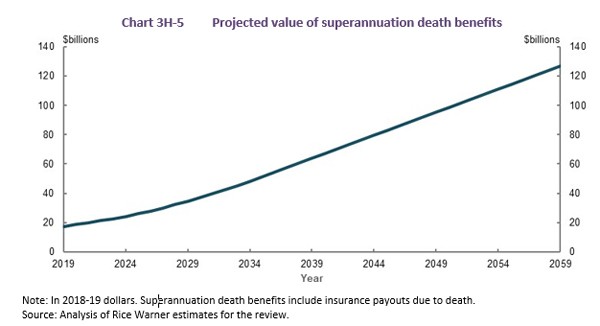
And that's pointing towards a huge blow-out in the payment of super death benefits, which actuarial firm Rice Warner projects in the Retirement Income Review report will rise from the current level of around $17 billion per annum to just under $130 billion by 2059.
Projected value of superannuation death benefits
Unintended consequences
When there's superannuation still left over at the end of your life, it's most commonly inherited by your surviving spouse or children, or bequeathed to other nominated beneficiaries.
If you don't have a spouse, and intend to leave your super to your adult children, there may be serious tax consequences for them.
It all comes down to whether your beneficiaries are entitled to access your super funds tax free or not after you're deceased.
So, having an understanding of the tax rules around super death benefits is extremely useful. With proper estate planning before you die, it may be possible to reduce your after-death super tax liabilities.
The tax rules around super death benefits
While there is no formal inheritance tax in Australia, super death benefits are taxed in some cases.
Essentially, superannuation can only be passed on tax-free when it is left to a spouse or dependant children under the age of 18.
A death benefit dependant, as determined by the Tax Act, can also include de factos, former spouses, those with whom you have shared an interdependency relationship immediately prior to death, and others who were financially dependent on you just before you died.
Beneficiaries who fall outside of these parameters, such as adult children, are often caught up in the ATO's tax dragnet.
Superannuation benefits are generally comprised of both taxable and tax-free funds, based on the nature of contributions that have been made over time.
Those contributions made by your employer at the concessional tax rate of 15 per cent form part of the taxable component, while after-tax contributions made by you separately as non-concessional contributions make up the tax-free component.
It's the taxable component – usually where the bulk of an individual's super funds reside – that will carry the tax liability for any adult children receiving your super payout on your death.
Avoiding an after-death tax experience
Transferring super wealth is a non-issue from a tax perspective if you have a spouse or dependant children to leave it to.
If you don't, there are ways to reduce your potential super tax burden for non-dependent beneficiaries.
One of them is through the use of what's known as a super recontribution strategy.
If you've reached an age where you can legally access your funds, this enables you to draw out the taxable component of your super as a lump sum and then recontribute it back into your super fund in the form of after-tax contributions.
Any taxable super withdrawn will be liable for tax at your marginal tax rate, however if you are aged over 60 and have stopped working (are retired) then your marginal tax rate is effectively zero.
Current laws allow individuals to contribute up to $100,000 per financial year as non-concessional (tax-paid) contributions, or up to $300,000 in one year using what's known as the three-year bring forward rule.
Keep in mind however that there are restrictions on personal super contributions for those aged 67 and above.
Using a recontribution strategy can effectively reduce or eliminate the taxable portion of your super, meaning non-dependant beneficiaries of your super may not have to pay any tax if it's received as a lump sum after your death.
Careful planning
When you're looking at who you want to leave your super to, it's very important you consider things carefully as some proper planning needs to be done.
Without planning there could be some unexpected and significant taxes bestowed upon your heirs, which could be exacerbated if any life insurance payout from your super fund is made to someone who is not a spouse or dependant.
To discuss your estate planning needs, including around your super death benefits and potential tax liabilities, it's important to consult a licensed financial adviser.
By Tony Kaye
Senior Personal Finance Writer
Vanguard Australia
01 Dec, 2020
JobMaker hiring credit given green light despite ongoing concerns
A Senate committee has recommended that the JobMaker hiring credit legislation be passed, despite concerns over its narrow eligibility and lack of protection for older workers.

ATO details and outline of this program
General
Under the draft rules, an entity may receive up to $200 per week for each eligible additional employee aged 16 to 29 years, and up to $100 per week for each eligible additional employee aged 30 to 35 years.
To be eligible, the employee will need to have worked for a minimum of 20 hours per week, averaged over a quarter, and received the JobSeeker payment, Youth Allowance (other) or Parenting Payment for at least one month out of the three months prior to when they are hired.
Employers cannot be receiving JobKeeper payments at the same time and must also meet a number of eligibility conditions, including being registered for pay-as-you-go (PAYG) withholding, holding an Australian business number (ABN), being up to date with their tax lodgement obligations, and reporting through Single Touch Payroll (STP).
Labor senators believe the hiring credit is likely to favour firms that have done well, or were less hard-hit during the pandemic, and is unlikely to support the 450,000 jobs that the government has put a claim to.
Concerns over the lack of protection for workers above 35 were also put forward to the Senate committee, with submissions noting that some employers may replace existing workers with subsidised workers.
“COSBOA has seen no evidence to show, in the current labour market conditions, that wage subsidies are not needed for unemployed people over the age of 35,” said the Council of Small Business Organisations Australia.
“The focus on younger workers may result in unintended negative consequences for recently unemployed mature-aged workers.”
The Australian Council of Trade Unions also believes that “many Australians aged 35+ have also experienced significant economic shocks, with more likely to occur in 2021 when many of this cohort who are currently relying on JobKeeper are likely to see that support end”.
The Senate committee, however, recommended that the bill be passed, noting that most of the submissions provided to the inquiry had given their in-principle support.
“Given the status of unemployment as a result of the pandemic — and in particular the status of youth unemployment — the committee recommends that bill be passed,” said economic legislation committee chair Senator Slade Brockman.
“While submitters and witnesses raised concerns about the possible abuse of the scheme, and the potential for older workers to be disadvantaged, it is clear that protections do exist within the already established laws passed in response to the pandemic and the pre-existing laws and processes that govern the ATO’s operations.”
Cameron Micallef
10 November 2020
accountantsdaily.com.au
Victorian State Budget Overview 2020 – 2021
On Tuesday 24 November, the Victorian Treasurer, Tim Pallas announced the 2020-21 budget, detailing a number of measures focused on creating jobs, supporting families and helping small to medium businesses.

Recognising the key role a business led recovery must play in steering Victoria towards growth into 2021 and beyond, the budget has a strong focus on growing jobs, stimulating trade and boosting innovation and investment across the state.
Measures to keep business direct and indirect costs low are a feature of the budget.
In the wake of the devastating impact the bushfires at the start of the year and the impact of COVID-19, the 2020-21 budget provides a major boost to Victorian business confidence and activity at a time when it is most needed.
On the downside the spending commitments of the government will push net debt to almost $155 billion by 2023 – 24.
The key announcements in the government’s budget include:
- An investment of $5.3 billion in social and affordable housing
- $49 billion on major infrastructure projects including significant new rail and transport construction.
- $1.9 billion for construction of new buildings for schools
- A new stamp duty discount for properties with a value not exceeding $1million aimed at boosting property development.
- Payroll tax concessions
A further breakdown of the Victorian State Budget for 2020-21 is below:
Businesses
Deferred payroll tax repayments for small and medium businesses
- Businesses that deferred their payroll tax for 2020-21 as part of the Government’s response to the coronavirus pandemic will be able to repay the deferred liabilities in quarterly instalments over the 2021-22 financial year.
Annual payments of payroll tax
- From 1 July 2021, employers will be able to pay payroll tax annually if their annual Victorian payroll tax liabilities are less than $1 million.
New payroll jobs tax credit
- A payroll tax credit will be introduced to encourage small and medium-sized businesses to re-employ staff, restore staff hours and hire additional staff
- Businesses with annual Australian group wages of less than $10 million will receive a non-refundable payroll tax credit of 10 cents for every dollar of Victorian wages paid in 2020-21 and 2021-22 above the previous year’s wage.
Breakthrough Victoria Fund
- The Government will contribute $2 billion over the next 10 years to drive research and innovation in the medical research, health and life-sciences, agri-food, advanced manufacturing, clean energy and digital technologies industries.
Housing/Land
Land tax payment deferral
- Landowners that have at least one non-residential property and total taxable landholdings below $1 million, can access a deferral of their 2020 land tax liability until 31 March 2021
- Residential landlords who provide eligible tenants with rent relief consistent with the principles of the Support to Landlords and Tenants package, may receive a 25 per cent reduction on the property’s 2021 land tax, with any outstanding amounts able to be deferred until 30 November 2021.
Vacant residential land tax
- 2021 vacant residential land tax liabilities that arise due to property vacancies in 2020 will be waived.
Discount for build-to-rent projects
- From 1 January 2022, there will be a 50% land tax discount and an exemption from the Absentee Owner Surcharge for eligible new developments until 2040.
Extended Regional First Home Owner Grant
- The $20,000 First Home Owner Grant for people buying or building a new home in Regional Victoria has been extended to apply to contracts of sale entered into up until 30 June 2021.
Land tax exemption for certain not-for-profit clubs
- From 1 January 2021, a land tax exemption will apply for land owned and occupied by clubs that provide for the social, cultural, recreational, literary or educational interests of their members. This replaces the concessional rate that currently applies to these clubs.
Stamp duty waiver for residential property transactions
- A 50% reduction of stamp duty (excluding any Foreign Purchaser Additional Duty) will apply for new residential dwellings with a dutiable value of up to $1 million and 25% reduction for existing residential dwellings ( also up to $1 million) for contracts entered into from 25 November to 30 June 2021.
Concession for commercial and industrial properties in Regional Victoria
- A 50% stamp duty concession will apply for commercial and industrial property transactions in Regional Victoria for contracts entered into from 1 January 2020.
If you have further questions about your eligibility to access the above, please call us to discuss your specific circumstances.
Your Accountant
2020 is coming to an end. Phew!!
Some fireworks and a great Advent Calendar to help you celebrate. On behalf of all our staff we wish our clients and their families a Merry Christmas, a Happy New Year and a great holiday period.

Our annual Advent Calendar.
Come back each day and click on the next date for another inspirational quote or poem from some of the greatest writers and poets.
(Please click on the image to open the Advent Calendar and then click on a date)

$120m in JobKeeper clawed back by ATO, new compliance areas highlighted
About $120 million in JobKeeper payments have been recovered by the ATO due to businesses making deliberate or reckless mistakes, as fresh guidance on its JobKeeper extension compliance focus lands.

Fronting a Senate estimates hearing on Tuesday, ATO second commissioner Jeremy Hirschhorn said $200 million in payments had been stopped permanently, with another $100 million under review.
“We have also stopped future claims of another $350 million,” Mr Hirschhorn said.
“This is where we’ve found someone was ineligible and chopped off their future claims.”
Of the $69 billion that has since been paid out since JobKeeper began in late March, $120 million has now been clawed back.
Mr Hirschhorn told senators this was consistent with its approach in only pursuing overpayments that were not deemed to be honest mistakes made by businesses.
“We generally only claw back where there has been a deliberate or reckless mistake,” Mr Hirschhorn said.
“Where there has been an honest mistake, particularly early on, and particularly where the employer has claimed in good faith, passed it on to the employee in good faith and has not financially benefited, we made the decision to let those go but just made sure they didn’t get future claims.”
Focus areas for JobKeeper 2.0
With the JobKeeper extension now in place, the ATO has announced it will focus its compliance approach on two new areas, namely the actual decline in turnover test and the incorrect claiming of the higher-tier rate.
For the actual decline in turnover test, the ATO will pay close attention to irregularities in an entity’s current GST turnover in the September 2020 or December 2020 quarters, and any unusual amendments to their business activity statements which inflate their sales for the relevant comparison periods.
The ATO will particularly monitor businesses that omit sales from their reporting, or delay or alter the recognition of sales from normal practices.
If selected for a review, businesses will be asked to provide documentation including sales and trading records, sales contracts or customer correspondence, invoices issued and bank statements.
On the higher-tier payment rate front, the Tax Office may seek to understand how a business has assessed an individual has met the 80-hour threshold and ask for documentation as evidence.
Suitable documentation includes the declaration of the business participant; employment records, such as payroll data or time sheets and other attendance records; employment contracts; business diaries; appointment books and logbooks; records of store trading hours; hours billed; invoices issued; or records prepared for another business or statutory purposes.
These focus areas will be additional to its ongoing areas of concern since the JobKeeper payment began, including failing to meet the wage condition, claiming for more than one business participant by disguising them as employees, or claiming for individuals who are not eligible business participants.
View the ATO’s latest guidance on its JobKeeper compliance focus areas here.
Jotham Lian
28 October 2020
accountantsdaily.com.au
‘Follow the spirt of the law’, warns ATO
The Australia Taxation Office has cautioned businesses against taking advantage of the government’s most recent expanded asset write-off scheme and the new loss carry-back provision.

Full expensing of plant and equipment and the ability to carry back losses are two measures introduced in the budget with the aim of encouraging businesses to invest and accelerate economic growth after the COVID-19 crisis.
But speaking at an event hosted by the Australian Financial Review, ATO second commissioner Jeremy Hirschhorn expressed his concern over businesses turning to “artificial mechanisms” to take advantage of these measures.
“These measures should be embraced, but for the purpose for which they were introduced. Invest in new plant, upgrade your facilities, claim a tax offset and reinvest the money in your business and jobs!” Mr Hirschhorn said.
He also advised financial officers to do the right thing and refrain from artificially shifting profits and losses around their group to access the loss carry-back.
“At a more granular level as CFOs, make sure your business analysts are including these tax cash flow advantages in your DCF models, in conjunction with your heads of tax making appropriate variations to your tax instalments to bring home that cash flow advantage,” Mr Hirschhorn said.
“Similarly, accessing the loss carry-back to support executive bonuses, increased dividends or to repatriate cash to offshore related parties is likely to be viewed poorly by the community.”
Speaking about the “weighty” responsibility entrusted on the business community to recover the post-COVID economy, Mr Hirschhorn urged businesses to “follow the tax law, but also follow the spirit of the law”.
“I suspect the community will have even less sympathy for companies seen to be exploiting loopholes.”
Mr Hirschhorn further urged entities to consider the optics of “making a statement in your annual report noting that the pandemic has not substantially impacted the operations of your business while at the same time collecting hundreds of millions of dollars in stimulus”.
“You have been entrusted by the government with leading the economic recovery with a range of stimulus measures,” he said.
“With this comes increased expectations around corporate behaviour including tax. There is an opportunity to rise to these expectations and increase the community’s trust in large organisations.”
Maja Garaca Djurdjevic
02 November 2020
accountantsdaily.com.au
Employers cautioned over ‘hard and fast’ decline in turnover eligibility
Accountants assisting clients with the JobKeeper extension have been urged to pay close attention to the actual decline in turnover test, with the ATO unable to offer leeway for those who come just shy of the requirements.

With JobKeeper now requiring entities to satisfy the new actual decline in turnover test, rather than the projected decline in turnover test used earlier in the program, the ATO will be required to follow the strict letter of the law in ensuring the requisite percentage declines are satisfied.
“[In JobKeeper 1], the legislation didn’t require the actual turnover to decline, so we saw a lot of organisations make a projection in a very difficult environment… and a lot of those projections didn’t pan out and that’s fine,” said ATO assistant commissioner Sandra Farhat on a recent ChangeGPS webinar.
“But moving into the extension, that is the test; the test is an actual decline.
“There is really no discretion in relation to decline in turnover, so there is no ability for the ATO to say, ‘Well, you were close, just not close enough, but we’ll let you through’ — the 30 per cent is a hard and fast legislative requirement.
“It is a significant change from a projected decline in turnover to an actual decline in turnover.”
The approach is a shift from the “sympathetic and understanding” stance that the ATO committed to earlier in the year when queried on how it would police the projected decline in turnover estimates.
ATO second commissioner Jeremy Hirschhorn told a Senate inquiry in May that the ATO would not nitpick turnover estimates that fell just short of the requirements because the law had merely required entities to make a reasonable estimate.
“If it ultimately turns out that the estimate was overly pessimistic and a business only went down 29 per cent, instead of an estimated 35 per cent, that is OK; what the legislation requires is a reasonable estimate,” Mr Hirschhorn said earlier this year.
Clawing back JobKeeper payments
The ATO’s confirmation of its new position comes as it releases fresh guidance on how it will manage JobKeeper payments that were incorrectly paid out.
For payments that were made because of an honest mistake, the ATO will not seek to recover these payments.
The facts and circumstances of each case will be considered, including whether the mistake was made earlier in JobKeeper when there was less public guidance.
Entities that did not take reasonable steps to check their eligibility will not be considered as having made an honest mistake.
Where payments will need to be repaid, the Tax Office will write to the entity to inform it of the reasons for clawing back the payments, how much needs to be repaid, and how repayments can be made.
Objections will be considered, while payment plans will be made available to those who aren’t able to pay on time.
The ATO also notes that it will generally not impose administrative penalties for JobKeeper overpayments that were the result of a mistake.
However, administrative penalties will apply if there is evidence of deliberate actions to obtain JobKeeper payments that an entity would not have otherwise been entitled to.
Jotham Lian
23 October 2020
accountantsdaily.com.au
Latest Industry News

How Do I Write Legally Compliant Terms and Conditions for My Business?
Terms and conditions bind your customers only where they actively accept them, so a tick box at checkout holds...

Paid parental leave super contributions have started
From July 2026, the new Paid Parental Leave Superannuation Contribution (PPLSC) has started. From...

If the business is no longer profitable, and is unlikely to be profitable in the future, your best option may...

Check out the this visualization, which tracks the evolution of dietary calorie intake from 1930 to...

Taxpayer given 35% penalty for BAS recklessness
Following an application for a refund of nearly $94,000, the Administrative Review Tribunal has set aside an...

SMEs warned as ATO ramps up tax debt collection
One insolvency specialist has emphasised the importance of small businesses engaging their accountants to stay...

Does Your Small Business Need to Follow AML Privacy Rules?
Compliance with new anti-money laundering (AML) laws may subject your small business to additional privacy...

Don’t get caught out at tax time with your multiples jobs
Picking up a second job, holding multiple part-time roles, or doing gig work is now part of everyday life. But...

Global companies turn to cost-cutting amid ongoing inflation
Rising operating costs and persistent inflation are placing renewed pressure on businesses worldwide, despite...

Warning for early lodger this tax time!
The ATO has a clear message this year: slow down and get it right. Early lodgers are far more likely to make...

ATO no longer treating debt the same as during COVID
One expert has stressed the importance of tax agents reminding their clients that the ATO is no longer as...

The evolution of the world’s languages
Check out the evolution of the world's most spoken languages from 2500 BC to...
Latest Guests News

Newsletter Newslettter We are pleased to supply you with the latest edition of Client Alert, which...