- 234 Balaclava Road, Caulfield North VIC 3161
- contactus@guests.com.au
- (03) 9509 7033
ATO figures reveal final 2022 DPN tally
After a slow start in May, figures show how the office went up through the gears with director penalty notices.
.
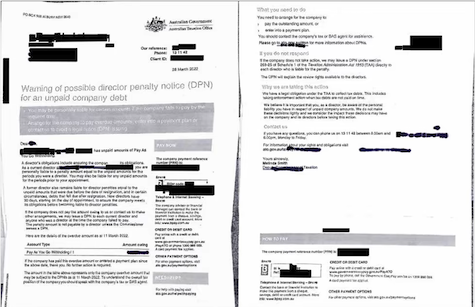
The ATO accelerated up through the gears on debt collection in 2022 to issue a total of almost 18,500 director penalty notices, figures released yesterday reveal.
The office also unsheathed a fresh weapon in its armoury by disclosing the tax debts of almost 500 businesses to credit referral agencies for amounts of $100,000 and above.
The final figures show that more than one in three directors failed to act after an April mail blitz by the ATO warned 52,000 directors about debts involving 30,000 companies.
By August, the ATO had issued 7,000 DPNs and was dispatching them at the rate of 120 a day. For the final five months of the year, it was also referring about 20 businesses a day to credit agencies after sending warning letters to more than 29,000.
The ATO said its debt recovery campaign, suspended during the pandemic, had been a success.
“We’ve seen an encouraging response to our letter campaigns, with a significant level of clients making payments or entering payment plans,” an ATO spokesperson said.
“The value of debt owed by clients at the start of the campaigns was $17.3 billion. As a result of these two campaigns, over $714 million has already been paid in full and a further $5.4 billion is now actively managed under payment arrangements.
“For those that have not responded we have progressed to issuing DPNs and disclosing the tax debt information of eligible businesses.
“In the 2022 calendar year, we issued almost 18,500 DPNs to individual directors in respect of more than 13,500 companies for unpaid GST, income tax withholding, and superannuation guarantee charge.
“In relation to Disclosure of Business Tax Debt, we disclosed nearly 500 businesses in 2022 to credit reporting agencies.”
The result of the ATO campaign also showed up in final insolvency figures for 2022, released by ASIC.
They revealed 4,806 total appointments over companies for the second half of 2022, a rise of 51 per cent of the corresponding period in the previous year.
Philip King
19 January 2023
accountantsdaily.com.au
ATO issues fresh warning on illegal early access schemes
With illegal early access schemes on the rise, the Tax Office has issued a fact sheet warning super members about the promoters of these schemes.

.
In a recent update, the ATO warned superannuation members to be wary of anyone known as promotors who want to help set up an SMSF for the purposes of illegally accessing super.
The ATO said it’s important that anyone running an SMSF is aware that accessing super can be illegal at times.
“As a trustee of a SMSF it is your responsibility to ensure that if you are accessing your super early, you are doing this within super laws,” the ATO cautioned.
The ATO has recently released a fact sheet, Accessing your super may be illegal, which highlights what SMSF trustees need to know about accessing their super and what to do if they are approached by a promotor.
The fact sheet warned that some promotors may say they can help individuals set up an SMSF in order to access their super for reasons such as paying off your credit card, buying a house or to go on a holiday when this is actually illegal.
“These people will often charge you a lot of money, tell you to transfer some or all your super from your existing super fund to the SMSF and tell you that you can use as much as you need for personal expenses,” the fact sheet warned.
The ATO also warned there is the risk of identity theft with these kinds of schemes.
“These promoters may also ask for your personal information. If you give it to them, they can steal your identity. With your personal information, they can steal your super for themselves,” the ATO warned.
The ATO advised anyone contacted by one of these promotors to contact the ATO on 13 10 20 straight away to get advice.
“Do not agree to anything and do not sign any documents or give them your personal details,” it stated.
“Don’t access your super before you retire unless you meet one of the conditions that makes it legal to access your super and receive relevant approval.”
The ATO reminded SMSF trustees that most people can only access their super when they retire and turn 60 or when they turn 65, otherwise it’s illegal.
Last year, ATO assistant commissioner SMSF risk and strategy, Justin Micale, warned that the ATO was seeing an increasing number of trustees taking advantage of their direct access to their superannuation bank account and using these savings to pay for business debts, holidays, renovations and new cars.
Mr Micale said the ATO was stepping up its focus on licensed and unlicensed promoters of illegal early access schemes.
“This behaviour is unacceptable particularly as we know promoters often target people who are in vulnerable communities, under financial pressure and with low financial and super literacy,” he said.
Miranda Brownlee
23 January 2023
smsfadviser.com
smsfadviser.com
100A ruling leaves trust decisions haunted by ‘uncertainty’
The ATO fails to resolve the key question of what constitutes “ordinary family and commercial dealing”, tax professionals say.

.
Uncertainty will haunt trust distribution decisions next June because the ATO’s final ruling on s100A fails to resolve the key issue of what constitutes an “ordinary family or commercial dealing” and the likely result will be an additional tax burden on small family business, tax professionals say.
Final ruling TR 2022/4 released last week has quickly attracted critics for its lack of substantive changes to the draft published in February despite an extended consultation period and many detailed submissions.
Head of tax at the Institute of Financial Professionals Australia Phillip London said how “ordinary family dealing” applied to an adult beneficiary would need to be tested in law to get clarity.
“Why is the instance of a young adult beneficiary deciding to leave their trust entitlement in the family business as working capital for the foreseeable future not an ordinary family dealing? Should not assets generated by a family business be utilised for the benefit of that family?” he asked.
“There is nothing artificial or contrived about these things, nor do they involve any unnecessary complexity.
“Rather than conduct test cases in respect of section 100A on highly complex matters such as Guardian and Blood, the tax professional is looking for certainty on the relatively straightforward matter of a distribution to an adult beneficiary. It is this the ATO should be focusing their attention on in a litigation program.”
John Jeffreys of John Jeffreys Tax said the additional examples in TR 2022/4 “raise more problems than they answer” and cited example 2, which involves the “cultural practice” of a grandparent (“Azra”) giving gifts to younger family members.
“The example says, ‘This cultural practice is relevant in considering whether transactions that involve Azra gifting money to her grandchildren out of funds from a trust distribution she has received have been entered into in the course of ordinary family or commercial dealing.’
“This statement by the ATO is not good enough. The ATO could say that this is an ordinary family dealing, but there is no clear statement that such a gift is an ordinary family dealing. It is just ‘relevant’ in considering whether section 100A applies.
“Why cannot the ATO make the clear statement that such an ordinary family occurrence is ordinary family dealing? But it does not do this! It clearly leaves open the question of whether Azra is deemed not to be (and never to have been) presently entitled to her trust distribution. Why? Because she gave a Christmas present to her grandchildren! There is no reason for the ATO to leave the taxpaying community with such uncertainty about such a common occurrence.”
BDO tax technical national leader Lance Cunningham said the ATO had disregarded comments made in the Guardian case, which awaits an appeal decision, that indicate that the term “ordinary” is in contradistinction to the term “extraordinary”.
“This has been interpreted by some commentators to indicate that a dealing will be ordinary if it does not contain any elements of artificiality,” he said. “However, in the final ruling the ATO has maintained its view that this is not the correct interpretation of the judge’s comments in the Guardian case. The ATO also says that these comments on ordinary family dealings were orbiter and not presidential as the case was decided on the basis that there was not a reimbursement agreement, i.e. it did not turn on the question of whether the arrangement was an ordinary family or commercial dealing.”
Mr Jeffreys said the uncertainty that remained would slow down the distribution decision process in the run-up to 30 June next year.
“More advice will need to be taken and more consideration of distribution decisions made,” he said.
“It would be useful for accountants to form good working relationships with skilled trust lawyers so that the trust income distribution process can flow smoothly. It maybe that some trust deeds will need to be amended. Also, accountants may want lawyers to draft trust distribution minutes.
“I expect that lawyers will begin to draft sets of documents (that they will sell) to assist trustees and accountants to deal with the challenges of these new rulings.”
Mr London said the net result would run contrary to pledges made during the May election campaign.
“We are just seven months out from a federal election that saw both major parties committing not to increase the tax burden on small business. The application of these guidelines will likely impose an additional tax burden on small family business where the Tax Commissioner applies their terms.”
Philip King
13 December 2022
accountantsdaily.com.au
Raids stop $33m in tax avoidance, ATO claims
Charges are pending following an operation with the Australian Federal Police (AFP) that uncovered 70 sales systems using suppression technology.

.
The ATO has stopped an estimated $33 million in tax avoidance after raids on dozens of retailers suspected of using electronic sales suppression tools (ESST).
Conducted with the AFP, the raids recovered 70 point-of-sales systems suspected of using ESST and charges were pending, the ATO said.
The operation was part of a global effort by the Joint Chiefs of Global Tax Enforcement (J5) with the search and seizure action coordinated with similar raids in the US and UK.
ATO deputy commissioner and J5 chief John Ford said: “These dodgy sales suppression tools allow retailers to keep a separate set of books and launder the money in one transaction.
“They conceal and transfer this income anonymously, sometimes offshore.”
Mr Ford said a point of sale system with ESST could change a fine dining experience to read like a fast food snack.
“So what might happen is that the customer orders a $60 steak and a $100 bottle of wine and the ESS tool then puts it through the point-of-sale system as a $10 bowl of chips and a $4 bottle of soft drink,” he said.
“Adding ESST to your point of sale system is a deliberate and underhanded act designed purely to under-report income and avoid tax obligations.”
The ATO said the raids of 35 separate premises nationwide suspected of using ESST had prevented tax avoidance of around $33 million, and investigations with the AFP were ongoing.
Mr Ford said businesses using or promoting this technology were effectively stealing from the Australian community and international co-operation meant thieves could not avoid detection.
“Through the international collaboration, we have access to a global network of intelligence analysts and investigators — it’s only a matter of time before you’re caught by us, or one of our partners,” said Mr Ford.
“We’ve seen ESSTs appear in hardware connected to the point of sales system, cloud-based software, and capability built directly into the software.”
The ATO encouraged businesses using ESST to come forward voluntarily as those that do could be provided with a reduction in penalties.
Josh Needs
13 December 2022
accountantsdaily.com.au
Downsizer age reduction now in force
With the eligibility age for downsizer contributions now age 55, the SMSF Association has highlighted some important considerations for younger clients looking to use the measure.

.
With Treasury Laws Amendment (2022 Measures No. 2) Bill 2022 receiving royal assent in mid-December last year, the eligibility age for making downsizer contributions has now been reduced to age 55 as of 1 January this year. The eligibility age was previously 60.
This means that eligible individuals aged 55 years and older can now choose to make a downsizer contribution into their super fund of up to $300,000 per person or $600,000 per couple, from the proceeds of selling their home.
Speaking to SMSF Adviser, SMSF Association deputy chief executive, Peter Burgess, said while the downsizer contributions measure has been a popular measure so far, it remains to be seen what the take-up will be among those under age 60.
Ms Burgess said it’s important that younger clients looking to use this measure are aware that there is only one opportunity to use it.
“For some clients it may be best to wait until they have another opportunity to use it later in life,” he explained.
Given that a downsizer contribution counts against an individual’s total super balance, Mr Burgess warned that making one of these contributions may impact a client’s ability to make contributions in the future.
“So, the timing around when you make a downsizer contribution is very important,” he cautioned.
Where a client is below the age of 65, Colonial First State senior technical manager, Tim Sanderson, previously warned that advisers and their clients also need to carefully consider the preservation age with these contributions.
“They won’t have access to the funds till after they meet a condition of release such as retirement which may not be until age 65,” Mr Sanderson said in a FirstTech podcast.
“You need to be very careful when considering whether or not they may need access to the funds because they may not be able to for up to 10 years.”
Advisers should also consider how much cash the client has to contribute to super and whether making a downsizer contribution is actually a viable strategy, he said.
“For many people, utilising the bring-forward rule and contributing up to $330,000 may be sufficient and allows clients to save their once off ability to make a downsizer contribution for the future,” he explained.
“On the other hand, if a couple has a lot of cash available, it may be advantageous to make a downsizer contribution in addition to a non-concessional contribution. This can be particularly tax effective for individuals who are still working and on a higher marginal tax rate.”
Miranda Brownlee
01 January 2023
smsfadviser.com
ATO plans publicity campaign for final Work From Home guidance
More demanding record-keeping requirements in the November draft have been in place since 1 January.

The ATO is just days away from publishing its final guidance on work from home (WFH) expense deductions and said it plans a publicity campaign to alert taxpayers to the changes, which have already taken effect.
The tax industry gave the November draft guidance, which proposed substantial changes to the fixed rate method, a harsh reception with criticism of the “opaque” calculations behind the revised fixed rate of 67c and the “demanding” record-keeping requirements.
Under PCG 2022/D4, the more stringent record-keeping regime began on January 1 and many taxpayers are thought to be unaware of the changes.
The ATO said it was finalising the WFH rules after consultation with the tax industry and would launch a publicity campaign at the same time.
“We will be undertaking a range of communications through various channels that will coincide with the publication of the final PCG later this month,” the Tax Office said.
“Communication after publication of the final PCG will be ongoing and continue into the period for lodgement of 2023 income tax returns.
“We are developing supporting materials, including web content and a fact sheet to assist taxpayers and their advisers.”
The ATO failed to say whether it would postpone the tighter record requirements and believed tax agents would want to help communicate the changes.
“We expect that many tax professionals will have their own preferences for how they like to communicate with their clients, and our information and publications will be available to be used by tax professionals to meet these needs,” it continued.
“We acknowledge and appreciate the important role played by tax professionals and industry associations in development of the revised fixed rate for working from home deductions. Many have been involved in our consultation processes and have supported the development of the guidance materials.”
The initial response from the tax industry last November was damning, with the director of tax communications at H&R Block Mark Chapman one of the sternest critics. He said the PCG gave most people Hobson’s choice when it came to work-from-home deductions.
“Claiming ‘actual costs’ isn’t feasible for many taxpayers — the record-keeping obligations are just too high,” he said. “Therefore for millions of people, they will be forced to claim the 67c an hour fixed rate — which could result in a lower deduction and increased paperwork.”
He said the ATO revisions looked sensible “on the face of it” but short changed taxpayers and imposed fresh obligations.
“The amount that can be claimed is low and the compliance obligations are high — the taxpayer not only needs to keep a record of times spent working from home, but also there is a need to keep an invoice/receipt for each of the additional costs, such as an electricity bill. This is new — it never used to be necessary using either of the old fixed rate methods.”
CPA Australia raised the issue in its budget submission and said the fixed rate method required legislation.
“The ATO’s revised fixed rate for WFH expenses is an administrative method and cannot be used as a valid approach at objection where the Commissioner must apply the general principles,” it said.
“To improve certainty and clarity for the ATO and taxpayers, a legislated fixed rate method for WFH expenses should be introduced. This should be similar to the cents per kilometre method for motor vehicle expenses.
“This measure should also address the current uncertainty about the ability to deduct WFH expenses without a dedicated space, absent the revised fixed rate.”
The ATO said the consultation process had resulted in updates to the final PCG and it is understood that a compendium of comments received would also be published.
By Philip King
06 February 2023
accountantsdaily.com.au
Auditor flags knowledge gaps with loans and financial assistance amongst SMSFs.
Loans to members and financial assistance continues to be the most commonly reported type of contravention based on ATO statistics.

Speaking in a recent Accurium webinar, SMSF specialist auditor Frank La Spada noted that loans to members and financial assistance continues to be the most commonly reported type of contravention based on ATO statistics.
Mr La Spada said this is also the case for his firm where loans to members account for more than a third of its reported contraventions.
Section 65 of the Superannuation Industry (Supervision) Act 1993 (SIS Act), he reminded practitioners, prohibits trustees from lending money or providing financial assistance to a member of the fund or a relative of a member.
Mr La Spada said it’s important to be aware that where this does occur, it will be an automatic breach of section 65.
One of the key issues is this area, he said, is that some SMSF professionals and trustees don’t have a thorough understanding of what the definition of a relative is in relation to Section 65.
“We see firms that aren’t really across the definition of a relative. The definition is very broad and includes parents, grandparents, brother, sister, uncle, aunt. It doesn’t include cousins.”
Knowledge of the relatives of a member is therefore critical, he said.
“If you’re aware of that, you’re then going to know when the fund is in breach of the Act.”
Understanding the definition of a loan or financial assistance is equally important, he said.
“A loan is an advancement of money and the loan is considered to have occurred at the time the amount is paid,” he noted.
“Financial assistance is using the resources of the SMSF to give any other form of financial assistance. In other words, anything other than lending money.”
Determining exactly what financial assistance is can be more difficult, he noted.
“The problem that we see is that some firms just aren’t aware of the financial assistance occurring in the first place and then the fund will go to audit where it gets queried and the [practitioner is left] a little blindsided.”
Some examples of financial assistance breaches, he said, include giving a gift of an SMSF asset to a member or relative of a member, selling an SMSF asset for less than its market value to a member or relative of a member and purchasing an asset for greater than its market value from a member or relative of a member.
It can also include forgiving a debt owed to the SMSF by a member or relative of a member or releasing a member or relative or a member from a financial obligation owed to the SMSF, including where the amount is not yet due and payable, he added.
“SMSFR 2008/1 is a really important ruling that provides a range of different examples and case studies of what exactly financial assistance is and what is a loan to a member.”
By Miranda Brownlee
06 February 2023
smsfadviser.com
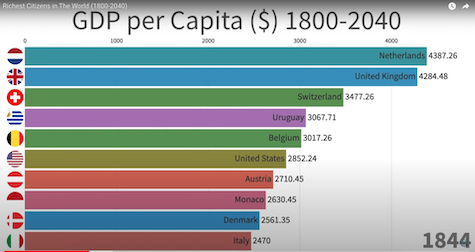
Countries with the highest GDP per capita between 1800-2040
Check out 240 years of countries with the highest GDPs per capita
About the working from home safety and wellbeing checklist
You and your business can still be held responsible for injuries that happen in the home while carrying out work-related duties.

.
So, just as you audit your workplace for OHS issues, you must audit any home workspace used by you or your employees.
In most instances employees can do their own home OHS checks to make sure their workspace complies with the guidelines you set.
Provide all remote-working staff with a copy of this checklist so they can assess their workspaces and fix any potential issues before they start.
business.vic.gov.au
Tips for small business owners
We see common behaviours among small businesses that get their tax right. These tips will help you to pay the right tax.

.
Seek advice and support
A tax professional can help keep you on track and avoid costly mistakes.
Make sure you:
- choose a tax agent or BAS agent who is registered with the Tax Practitioners BoardExternal Link or a reputable bookkeeper
- keep your tax professional in the loop – regular contact will help them understand your business and give you the right advice
- talk to your tax professional or come to us if you’re unsure of something or considering making changes to your business.
Check your business structure
Unnecessarily complex business structures can overcomplicate tax
obligations. Talk to your tax agent to ensure your business structure suits
the needs of your business.
Keep good records
Keeping good records is essential and will make it easier to report to us:
- Talk to your software provider or tax professional to check that your record keeping processes meet current requirements.
- Make sure you conduct regular reconciliation processes by cross-checking figures with your bank statements and source documents (for example, till tapes, tax invoices and receipts).
- Use suitable digital systems to run your business, such as point of sale software, accounting systems and mobile apps. These products can save you time and help you report accurately.
Get your income and expenses right
Ensure what you report is accurate:
- Report all your business income, even if it has been paid in cash, or into a private account. We use data matching and benchmarking to help us identify hidden activities.
- The figures you report need to be exact – so keep up to date records from the start and don't try and ‘guestimate’ after the event.
- Make sure your deductions relate to your business, and that you have the required evidence to support your claims.
Latest Industry News

How Do I Write Legally Compliant Terms and Conditions for My Business?
Terms and conditions bind your customers only where they actively accept them, so a tick box at checkout holds...

Paid parental leave super contributions have started
From July 2026, the new Paid Parental Leave Superannuation Contribution (PPLSC) has started. From...

If the business is no longer profitable, and is unlikely to be profitable in the future, your best option may...

Check out the this visualization, which tracks the evolution of dietary calorie intake from 1930 to...

Taxpayer given 35% penalty for BAS recklessness
Following an application for a refund of nearly $94,000, the Administrative Review Tribunal has set aside an...

SMEs warned as ATO ramps up tax debt collection
One insolvency specialist has emphasised the importance of small businesses engaging their accountants to stay...

Does Your Small Business Need to Follow AML Privacy Rules?
Compliance with new anti-money laundering (AML) laws may subject your small business to additional privacy...

Don’t get caught out at tax time with your multiples jobs
Picking up a second job, holding multiple part-time roles, or doing gig work is now part of everyday life. But...

Global companies turn to cost-cutting amid ongoing inflation
Rising operating costs and persistent inflation are placing renewed pressure on businesses worldwide, despite...

Warning for early lodger this tax time!
The ATO has a clear message this year: slow down and get it right. Early lodgers are far more likely to make...

ATO no longer treating debt the same as during COVID
One expert has stressed the importance of tax agents reminding their clients that the ATO is no longer as...

The evolution of the world’s languages
Check out the evolution of the world's most spoken languages from 2500 BC to...
Latest Guests News

Newsletter Newslettter We are pleased to supply you with the latest edition of Client Alert, which...