- 234 Balaclava Road, Caulfield North VIC 3161
- contactus@guests.com.au
- (03) 9509 7033
WORKING FROM HOME EXPENSES FOR 2023
If you performed some of your work from your home office during the 2022-2023 financial year, you may be able to claim a deduction for the costs you incurred, even if the space you used is not set aside solely for work-related purposes.

.
CHANGES FOR 2023
To be eligible to claim a deduction for working from home expenses, you must:
- incur additional running expenses as a result of working from home
- be working from home to fulfil your employment duties, not just completing minimal tasks
- keep records at the time you work to prove you incur the cost.
To calculate your working-from-home expenses, you can use the revised fixed rate method or the actual cost method.
REVISED FIXED RATE METHOD
The revised fixed rate method allows you to claim 67 cents per hour you work from home for the expenses listed below. You no longer require a dedicated home office to use this method.
Expenses included in the revised fixed rate are:
- data and internet
- mobile and home phone usage
- electricity and gas
- computer consumables (e.g. printer ink)
- stationery.
You can’t claim a separate deduction for any of the expenses the revised fixed rate includes.
You can claim a separate deduction for:
- the decline in value of assets used while working from home, such as computers and office furniture
- the repairs and maintenance of these assets
- cleaning (only if you have a dedicated home office).
ACTUAL COST METHOD
The actual cost method allows you to claim a deduction for the actual expenses you incur as a result of working from home.
You may be able to claim a deduction for each of the expenses you incur, such as:
- data and internet
- mobile and home phone usage
- electricity and gas
- computer consumables (e.g. printer ink)
- stationery
- the decline in value of assets used while working from home, such as computers and office furniture, as well as any maintenance and repairs of these items
- cleaning (only if you have a dedicated home office).
The actual cost method requires detailed calculations and records. For example, you will need to know and have records of the cost per unit of electricity and the average units used per hour.
These shortcut arrangements do not prohibit people from making a working-from-home claim under existing arrangements, where you calculate all or part of your running expenses.
The ATO will review the special arrangement for the next financial year as the COVID-19 situation progresses.
RECORD KEEPING CHECKLIST
Revised Fixed Rate Method
You will need the following records:
- a record of all the hours you work from home for the entire year (e.g. a timesheet, roster, diary or similar document)
- evidence you paid for the expenses covered by the revised fixed rate method (for example, if you use your phone and electricity when you work from home, keep one bill for each of these expenses).
You will also need records for items you claim as a separate deduction.
From 1 July 2022 to 28 February 2023, the ATO accept a record which represents the total number of hours worked from home (for example a 4 week diary).
From 1 March 2023 onwards, a record of all the hours you worked from home is required.
Actual Cost Method
You will need to keep a record for every expense you claim.
Also, you need the following evidence to show you have incurred additional running expenses:
- receipts, bills or invoices which show the supplier, amount of the expense, nature of the goods, date it was paid and the date of the document
- evidence of your personal and work-related use of the items or services you buy and use.
You can work out your work-related expenses using records for the entire year or over a 4-week period that represents your work use – for example, using a diary or itemised bill.
Decline in Value of Assets and Equipment
You will need records for depreciating assets, that show:
- when and where you buy the item and its cost
- when you started using the item for a work-related purpose
- how you work out your percentage of work-related use, such as a diary that shows the purpose of and use of the item for work
- either:
- a copy of the Commissioner’s Determination of Effective Life you use to work out the decline in value.
- how you work out the effective life if you don’t use the Commissioner’s determination.
- which method you choose to work out the decline in value
OCCUPANCY EXPENSES
Claims for occupancy expenses are allowed only if the home is used as a place of business. Occupancy expenses include rent, mortgage interest, water rates, repairs, house insurance premiums.
The claim can be made as an apportionment of total expenses incurred on a floor area basis.
Warning: Being able to claim theses expenses may affect your ‘main residence exemption’ for capital gains tax purposes if you sell your house in the future.
WHEN IS A HOME A PLACE OF BUSINESS?
The following factors, none of which is necessarily conclusive on its own, may indicate whether, or not, an area set aside has the characteristics of a place of business:
- the area is clearly identifiable as a place of business
- the area is not readily suitable or adaptable for use for private or domestic purposes in association with the home generally
- the area is used exclusively, or almost exclusively, for carrying on a business, or
- the area is used regularly for client or customer visits.
If you use your home to carry out income-producing activities as a matter of convenience, you are not entitled to a deduction for occupancy expenses. It would be rare for an employee to be able to claim occupancy expenses.
Things you can do in our digital office
Our website includes a number of tools and resource that will help us work more closely as well as help you find information needed to keep on top of tax and superannuation issues and changes.

We have always tried to provide resources through our website to help us better cover your tax and superannuation needs. Another aim is to provide one place where you can find information, news and tools that are relevant to your needs. Also, if you have a question then you can use the form and just ask.
Educational videos month videos cover
-
How Interest Rates Affect Your Loans
-
Why Choose an Accountant
-
Cup Of Advice – Inheritance
-
Cloud Based Accounting
-
Planning To Succeed
-
Understanding Estate Planning
Latest news articles. 7-9 articles are added every month and all chosen for their relevance. Our website is a great place to stay informed.
Calculators. A good range of calculators to help you better understand and manage your personal and family financial issues. Four of the more popular are: Compound interest calculator; Pay calculator; Budget Calculator; Loan Calculator, and Super Calculator
Client portals. Portals are quite common on many sites and can be used to store your data, pay bills, log onto investment systems, and more.
Ask us a question at any time. If you have a question on any related topic then don’t hesitate to use a form on our site to ask.
Your information is private and confidential and should be treated that way. Our website includes high levels of security (via SSL certificates) to ensure what you enter stays just between you and us.
Many sites also have a message window feature that displays messages of interest or that cover topics and deadlines you should be aware of.
* Not all are on every website.
Key Considerations When Sharing Personal Information with Overseas Contractors
Engaging overseas contractors can be an effective way for businesses to respond to their business needs. However, while there are many advantages to hiring overseas contractors, you must consider this against legal risks, such as the risk of sharing the personal information of Australian individuals with overseas parties.

.
This article considers how you can comply with your privacy obligations under the Australian Privacy Principles outlined in the Privacy Act 1988 (Cth) when disclosing information with overseas contractors.
Are You an APP Entity?
Before sharing information with an overseas contractor, you must determine if you are an APP entity. This distinction is important because if an APP entity shares information overseas and that overseas party breaches the APPs, that breach will be taken to be a breach by the APP entity itself.
For example, suppose your business generates more than $3 million in annual turnover. In that case, it will likely be considered an APP entity and will have obligations under the Privacy Act, including concerning the disclosure of personal information overseas.
Sharing Information With Overseas Contractors
Suppose you are an APP entity. If so, let us explore several precautionary measures you can take when sharing information with your overseas contractors.
1. Privacy Policy
Before sharing information with any third party (including overseas contractors), you should review the terms of your privacy policy to ensure that you have informed your customers that you will share their personal information with overseas contractors.
If you have yet to inform customers of this intended use, you can update your privacy policy and provide notice of this to your customers. You should aim to give your customers at least 30 days’ notice before the privacy policy comes into effect. Accordingly, this will allow your customers to inform you of any issues with your intended use of their personal information before you disclose it.
2. Risk Mitigation
As a best practice, you should only share information essential for your overseas contractors to be able to deliver the services.
When engaging an overseas contractor, consider the following questions.
1. Whether the volume of information you are sharing with the contractor is necessary to enable them to perform the services?
- Tip: As a rule, do not provide the contractor with more personal information than is necessary. The more information you share, the higher the risk of individuals using data in a way that breaches the APPs.
2. What is the nature of the information?
- Tip: You should consider the nature of the information, and whether it is personal or sensitive information. Sensitive data requires a higher level of confidentiality due to its delicate nature.
3. How much access does the contractor have to my existing databases?
- Tip: Ensure that you only provide access to the databases that the contractor needs to perform their services. All other access should be limited or subject to your approval.
3. Contractual Terms
You should ensure that the terms of your contractor agreement impose strong privacy obligations on the contractor, particularly concerning any personal information they receive or have access to during the term.
You can include clauses addressing the following:
- an acknowledgement by the contractor that you are required to comply with the APPs;
- a warranty that the contractor will not breach the APPs;
- an indemnity by the overseas contractor if it breaches the APPs (for example, by disclosing personal information to an unauthorised party); and
- a data breach response plan that includes a straightforward process for reporting a data breach.
Saya Hussain
April 18
legalvision.com.au
Summary of Superannuation Issues and Recent Changes
Recent Issues and changes that could effect you

.
Concessional contributions cap: The annual concessional contributions cap is currently $27,500 per person effective from 1 July 2021.
Making catch-up concessional contributions: From 1 July 2018, a person with an account balance of less than $500,000 is able to make “catch up” concessional contributions by using any unused portion of their concessional contributions cap from the previous five consecutive years.
Division 293 tax: The income threshold after which an additional 15% of tax (making an effective contributions tax rate of 30%) was imposed on the contributions of “high income” earners is currently $250,000.
Spouse contributions: People who make contributions for their spouse are able to claim a tax offset up to $540 per annum (at the rate of 18% up to a maximum of $3,000) where their spouse earns below $37,000.
Non-concessional Contributions (After Tax Contributions):
- The standard annual non-concessional contributions cap is currently $110,000 effective from 1 July 2021.
- If a member’s super balance is above the superannuation balance cap at 30 June in a year currently $1.7m (increased to $1.9m from 1 July 2023), the member is not eligible to make non-concessional contributions in the following year.
- The three year bring forward rule is applied to enable after tax contributions up to three times the standard annual non-concessional cap, i.e. of contributions of up to $330,000 will be permitted at any time if under age 75.
- If a member’s super balance is close to the balance cap amount at 30 June being $1.7m ($1.9m from 1 July 2023) the member is only able to bring forward the $110,000 annual cap for the number of years that would take the member’s balance to the cap amount.
Individuals with super balances at or above the balance cap are only able to increase their overall super balance via concessional contributions and investment growth.
PENSIONS
Retirement phase transfer limits: From 1 July 2017, the total amount a member can “transfer into the retirement phase” was limited to $1,600,000. This was increased to $1,700,000 from 1 July 2021 and to $1,900,000 from 1 July 2023. Earnings arising from a pension account, which cause the account to exceed the cap, may be retained in the “retirement phase” account, but pension payments deducted cannot be replenished. Given this, a strategy of taking out only the minimum amount from pension accounts with supplementary additional amounts being withdrawn from accumulation accounts or withdrawn as commutations from the “retirement phase” accounts should be considered.
MARKET VALUATONS AS AT END OF FINANCIAL YEAR
Current market valuations of all assets were required to be incorporated into the Financial Statements. Valuations for listed investments are readily available. Valuation of unlisted investments, including property investments are required to be arranged as at 30 June 2023, and for following years.
In respect of property investments, the ATO valuation guidelines are not definitive, however it is recommended that at least two valuations from a real estate agent or one from an independent sworn valuer is obtained.
EVENT BASED REPORTING FOR SMSF’S
Self-managed super funds (SMSFs) are subject to a reporting regime relating to the transfer balance cap and event-based reporting framework.
The transfer balance account report (TBAR) is a separate form from the SMSF annual return (SAR). The TBAR enables the ATO to record and track an individual's balance for both their transfer balance cap and total superannuation balance cap.
From 1 July 2023, TBAR’s are required to be lodged for all Funds on a quarterly basis.
RECENT CHANGES TO SUPERANNAUTION
No Work Test
If you are under age 75, from 1 July 2022 you do not have to satisfy the work test in
order to make or receive non-concessional super contributions and salary sacrificed
contributions.
Super Guarantee increase
The rate of super guarantee payable by employers increases from 10.5% to 11.0% of employee wages from 1 July 2023.
Downsize your home and add to your super
From 1 January 2023, people aged 55 or over can make contributions into their super account of up to $300,000 ($600,000 for a couple) using the proceeds from the sale of their main residence. Although these ‘downsizer’ contributions are considered non-concessional (after-tax) contributions, they are in addition to any voluntary contributions made under the current non-concessional contributions cap ($110,000 in 2022/23).
Covid-19 Superannuation Changes
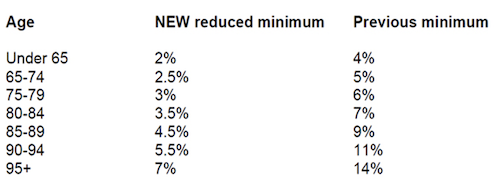
Pension Reductions
There is currently a reduction to minimum pension payments for the 2020/21, 2021/22 and
2022/23 financial years, of 50%, reducing minimum percentages to :
SMSF Investment Strategies
The ATO’s requirements
The guidance and requirements from the ATO are summarized as follows:
Extent of Diversification
The ATO have advised that trustees should consider including in the strategy the extent to which the fund investments are diverse and the risks which could apply from a lack of diversification.
Tailored and specific
The ATO has advised that an investment strategy permitting a range of investments, for all investment categories, of 0-100 % would generally not be acceptable, as it would indicate a lack of proper consideration by the trustee.
They advise that the trustees should consider the personal circumstances of each member and explain how the investment strategy meets the retirement objectives of each member.
Investment strategy compliance
To ensure a fund’s investment strategy meets the requirements of the ATO, it is
recommended that the trustee :
- have a current investment strategy in place;
- review it regularly (at least annually), and in doing so :
- document the personal circumstances of the members including their ages,
- retirement plans, likely future contributions and employment status;
- SUP795830
- consider the likely risk and return of the assets invested in;
- consider the liquidity and cash-flow requirements of the fund;
- consider the ability of the trustee to discharge the liabilities of the fund;
- consider the degree of diversification of the assets invested in; and
- consider whether insurance should be held for the members.
Proposed Super Changes
Pay Day Superannuation
It has been announced that from 1 July 2026, employers will be required to pay their employees’ super at the same time as their salary and wages.
The start date will provide employers, super funds, payroll providers and other parts of the superannuation system with sufficient time to prepare for the change. This measure is not yet law.
Additional 15% tax on earnings where member balances are in excess of $3m.
The proposal is effectively an additional 15% tax on “earnings” on balances (excluding the first $3m), calculated as described below. It is proposed that tax will be able to paid by the Fund, or by the member personally.
The proposed method of calculation is controversial as it includes taxing unrealised capital gains and a negative result is only available to be carried forward.
The proposed start date is 1 July, 2025, and after the next deferral election, so there’s a lot of water to go under the bridge.
Based upon published information, the tax calculation methodology is summarised as follows :
- Closing member balances (CMB) + any withdrawals for the year – any net contributions for year, less opening balance (OB) = earnings (E).
- Percentage of earnings (POE) = CMB less $3m/CMB
- Tax = POE * E * 15%.
Top 50 Greatest Inventions in History
Check out the greatest inventions in human history.

Low productivity threatens inflation outlook, RBA warns
The RBA expects that inflation will return to target in mid 2025 but rising unit labour unit costs presents a significant risk for inflation.

.
The Reserve Bank of Australia is taking a balanced course back to three per cent inflation but has major concerns about low productivity levels driving up unit labour costs, RBA governor Dr Philip Lowe has said.
“Unit labour costs is the difference between wages growth and productivity growth. Wages growth is around 3.75 per cent. Historically, that hasn’t been a problem, that would have been a good number,” Dr Philip Lowe.
However, with productivity growth at a standstill this has led to higher unit labour costs within Australia.
“Over the past three years there has been no increase in the average output produced per hour worked in Australia. There has been no productivity growth for three years,” said Dr Lowe speaking at a Senate Economics Legislation Committee this week.
“So we’ve got wages growth at 3.75 per cent and no productivity growth and that’s an issue I’ve been drawing attention. It’s a problem for the country and an its a problem for the inflation outlook at all.”
Other central banks are facing similar issues with the growth of unit labour costs, according to the Reserve Bank.
“It’s a problem. If you’ve got labour cost growth at 3.5 to 4 per cent. Then it's hard to have 2.5 per cent inflation,” he stated.
“The best solution to this is uplifting productivity growth.”
Dr Lowe said the RBA’s next decision on the cash rate target will depend not only on unit labour costs, but the global economy, inflation expectations and consumer spending.
With many businesses operating in survival mode rather than growth mode during the pandemic, this may have led to a slow down in investment, he said.
“We also saw disruptions were you couldn’t get investment goods and you couldn’t get people. All of those things hurt productivity growth during the pandemic. That’s now behind us so perhaps now we’ll see productivity growth pick up,” he said.
“If there's no productivity growth, then it's hard to have increase in real wages. That's the reality we really have to face.”
Inflation forecast to return to target range in mid-2025
The Reserve Bank is expecting the headline inflation rate to return to 3 per cent by mid-2025.
Dr Lowe said while this is a bit later than other countries, the RBA has consciously made the decision to have a “slower glide path back to target”.
“We want to preserve some of the gains in the labour market that have been achieved,” he said.
“Australia has not reached full employment in four decades and we’ve finally got there. This is one of the positive legacies of the pandemic. Youth unemployment is the lowest it’s been in decades and people have the opportunity to get more hours of work. Getting a job is the easiest it’s been in 50 years.
The RBA will still pursue a course back to 3 per cent inflation but it will be a balance course, said Dr Lowe.
A rebound in inflation for April raises risk of rate hike
The ABS’ Monthly CPI Indicator rose to 6.8 per cent year on year in April from 6.3 per cent year on year in March.
“This was stronger than market expectations for a rise to 6.4,” said AMP chief economist Shane Oliver.
“The Monthly CPI Indicator partly reflects the dropping out of the April 2022 drop in fuel prices due the halving of fuel excise and a 7 per cent rise in April in holiday travel and accommodation which looks to be seasonal due to Easter and school holidays.”
The ABS data showed that new dwelling purchase costs and household furnishing and equipment inflation are continuing to slow but rent inflation is continuing to accelerate and electricity inflation at 15.2 per cent year on year is set to rise further from July.
Dr Oliver said the trend in inflation still remains down.
“Given this along with falling real retail sales and signs of a rising trend in unemployment our base case remains for the RBA to keep rates on hold next week,” he said.
“However, with inflation still very high and upside risks to wages flowing from the upcoming minimum wage increase, the still tight jobs market and faster public sector wages growth the risk of another rate hike is now very high.”
01 June 2023
Miranda Brownlee
accountingtimes.com.au
ATO acts against foreign worker exploitation
The multi-agency operation found documents that allegedly showed the employment of unlawful non-citizens.

.
In a joint operation with several agencies, the ATO has cracked down on foreign worker exploitation after a raid at an ACT home uncovered identity documents and cash.
The operation was run by the Australian Border Force and the ATO as part of the Serious Financial Crime Taskforce (SFCT) with assistance from ACT policing, the AFP, and the Australian Criminal Intelligence Commission (ACIC).
The SFCT targets individuals and businesses suspected of using illegal debt evasion within the construction industry.
The search warrant was executed at the ACT property and revealed identity and financial documents which allegedly showed the employment of unlawful non-citizens and exploitation of foreign workers, along with $82,000 in cash.
ATO deputy commissioner and SFCT chief John Ford said individuals who take part in financial crime activities were often complicit in larger unlawful actions.
“These criminals are motivated by financial gain and their activities rob the Australian public of revenue to support essential services such as health and education,” said Mr Ford.
“This action demonstrates that the SFCT agencies will work together on operational activity that will ultimately bring criminals to account.”
ABF commander of special investigations Penny Spies said the action sent a clear method that the organisation would continue to work side by side to stamp out the illegal practices.
“Dishonest employers in the construction industry often pay workers in cash, meaning employees miss out on entitlements including superannuation,” said Ms Spies. “All workers deserve fair pay and fair treatment.”
“We will continue to disrupt those who seek to exploit foreign workers here in Australia and they will be brought to justice.”
“We will continue to target criminals who want to profit by engaging in visa and migration fraud, money laundering, tax evasion and foreign worker exploitation.”
ACT policing criminal investigations detective Matt Innes said joint operations such as the one carried out had continued to prove effective.
“The information sharing and joint response activity seen in this operation has once again disrupted those who seek to profit from illegal activities they consider victimless,” said Mr Innes.
“The reality is that the workers and the Australian people through unpaid taxation are the victims when this time of illegal activity occurs.”
Josh Needs
31 May 2023
accountantsdaily.com.au
Legal Considerations Around Recording Customers Who Enter My Business
As a business, you may consider installing video surveillance on your premises to discourage theft or ensure the safety of your customers and personnel. However, your business may suffer significant legal implications if you do not adhere to legal requirements around filming or recording customers that enter your store.

.
This article explains the legal requirements around the use of optical surveillance devices. Additionally, it considers the potential consequences of breaching customers’ privacy, as demonstrated by the 7-Eleven case.
Is it Legal to Record Customers Who Enter My Business?
There are certain situations where it is not illegal to collect the personal information of individuals. This includes collecting their images or identity information. Installing optical surveillance devices, such as CCTV, which collect videos or images of customers that enter your business is legal. However, if you elect to record customers through these devices, you must comply with certain laws.
Restrictions
The Privacy Act 1998 (‘Privacy Act’) applies to personal information and governs how businesses can handle their customers’ personal information. The Act will apply to a business if the business:
- has an annual turnover of over $3 million;
- provides a health service, or holds health information;
- is a contractor for the Commonwealth government; or
- trades in personal information (e.g. sells personal information to other parties).
Such businesses will be ‘APP entities’ that must comply with the provisions of the Privacy Act.
Suppose your business is covered under the law. Then any personal information that you collect through your surveillance devices must comply with the Australian Privacy Principles under the Act, which require you to:
- inform customers that you may capture their images before recording takes place. For example, you may post clear signage at the entrance of and throughout your premises, and install cameras in clearly visible locations on your premises to ensure adequate notification to customers that they may be under surveillance;
- ensure that any personal information recorded is stored securely, and either destroyed or de-identified when you no longer require the information. For example, you may delete CCTV footage of customers every month; and
- only use or disclose the information recorded for the primary collection purpose, for example, to seek action against a person who committed theft on your premises (or for a secondary purpose if an exemption applies).
May Preedeesanit
May 11
legalvision.com.au
2023 Year End Tax Planning Guide
Key Tax Time Strategies

.
1. Delay deriving assessable income
One effective strategy is to delay deriving your income until after June 30, 2023 by:
a. Delaying the timing of the derivation of Income until after June 30.
b. Timing of raising invoices for incomplete work (Businesses)
This can only be done when this strategy will not adversely affect your cash flow. Please note, not banking amounts received before June 30 until after June 30 does NOT qualify because the income is deemed to have been earned when the money is received, or the goods or services are provided (depending on whether you are on a cash or accruals basis of accounting).
- Cash Basis Income – Some income is taxable on a cash receipts basis rather than on an accrual basis (e.g. rental income or interest income in certain cases).
- Consider delaying your invoices to customers until after July 1, which will push the derivation of the income into the next financial year and defer the tax payable on that income. If you operate on the cash basis of accounting, you simply need to delay receiving the money from your customers until after June 30.
- Lump Sum Amounts – Where a lump sum is likely to be received close to the end of a financial year, you should consider whether this amount (or part thereof) can be delayed or spread over future periods.
2. Bringing forward deductible expenses or losses
Prepayment of Expenses – In some circumstances, Small Businesses (SBE) and individuals who derive passive type income (such as rental income and dividends) should consider pre-paying expenses prior to 30 June 2023. A tax deduction can be brought forward into this financial year for expenses like:
- Employee Superannuation Payments including the 10.5% Superannuation Guarantee Contributions for the June 2023 quarter (any such payment has to be received by the Superannuation Fund by June 30).
- Superannuation for Business Owners, Directors and Associated Persons.
- Wages, bonuses, commissions, and allowances
- Contractor Payments
- Travel and accommodation expenses
- Trade creditors
- Rent for July 2023 (and possibly future additional months)
- Insurances including Income Protection Insurance
- Printing, Stationery and Office Supplies
- Advertising including Directory Listings
- Utility Expenses – Telephone, Electricity & Gas
- Motor Vehicle Expenses – Registration and Insurance
- Accounting Fees
- Subscriptions and Memberships to Professional Associations and Trade Journals
- Repairs and Maintenance to Investment Properties
- Self Education Costs
- Home Office Expenses – deductible gift recipient.
- Donations to Deductible Gift Recipient organizations
- If appropriate, consider prepaying any deductible investment loan interest. This could include interest payments on an investment loan for either an investment or commercial property or an investment portfolio you hold.
A deduction for prepaid expenses will generally be allowed where the payment is made before 30 June 2023 for services to be rendered within a 12-month period.
Capital Gains/Losses
– Note that the contract date (not the settlement date) is often the key sale date for capital gains tax purposes, and when it comes to the sale of an asset that triggers a capital gain or capital loss, you need to consider your overall investment strategy when making the decision to sell. Here are some important points regarding the management of capital gains and capital losses on sale of your assets from a tax planning perspective:
1. If appropriate, consider deferring the sale of an asset with an expected capital gain (and applicable capital gains tax liability) until it has been held for 12 months or longer. By doing so, you could reduce your personal income tax. For example, if you hold an asset for under 12 months, any capital gain you make may be assessed in its entirety upon the sale of that asset.
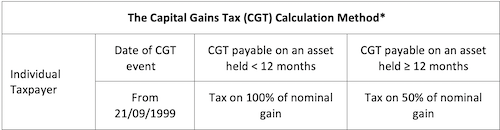
2. * A capital gain will be assessable in the financial year it is crystallised.
3. If appropriate, consider deferring the sale of an asset with an expected capital gain (and applicable capital gains tax liability) to a future financial year. By doing this, you could help reduce your personal income tax for the current financial year. This could also be of benefit if, for example, you expect that your income will be lower in future financial years compared to the current financial year.
4. If appropriate, consider offsetting a crystallised capital gain with an existing capital loss (carried forward or otherwise) or bringing forward the sale of an asset currently sitting at a loss. By doing this, you could reduce your personal income tax for the current financial year. Note that a capital loss can only be used to offset a capital gain.
Accounts Payable (Creditors)
– If you operate on an accruals basis and services have been provided to your business, ensure that you have an invoice dated June 30, 2023 or before, so you can take up the expense in your accounts for the year ended 30th June 2023.
Obligations that need to be considered in relation to the end of financial year.
If you use a Motor Vehicle in producing your income you may need to:
- Record Motor Vehicle Odometer readings at 30 June 2023
- Prepare a log book for 12 continuous weeks if your existing one is more than 5 years old.
If you are in business or earn your income through a Company or Trust:
Employer Compulsory Superannuation Obligations:
The deadline for employers to pay Superannuation Guarantee Contributions for the 2022/23 financial year is the 28 July 2023. However, if you want to claim a tax deduction in the 2022/23 tax year the super fund (or Small Business Superannuation Clearing House) must receive the contributions by 30 June 2023. Avoid making contributions at the last minute because processing delays could deny you a significant tax deduction in this financial year.
- For Private Company – Div 7A Loans – Business owners who have borrowed funds from their company in prior years must ensure that the appropriate principal and interest loan repayments are made by 30 June 2023.
- Trustee Resolutions – ensure that the Trustee Resolutions on how the income from the trust is distributed to the beneficiaries are prepared and signed before June 30, 2023 for all Discretionary (“Family”) Trusts.
- Preparation of Stock Count Working Papers at June 30, 2023.
- Preparation and reconciliation of Employee PAYG Payment Summaries (formerly known as Group Certificates). Note you are not required to supply your employees with payment summaries for amounts you have reported and finalised through Single Touch Payroll.
From 1 July 2023:
The compulsory Super Guarantee Contribution rate increases from 10.5 % to 11% from July 1, 2023.
Company Tax Rates For Small Business
- The company tax rate for base rate entities with less than $50 million turnover was 25% for the 2021/22 year. This rate will remain at 25% for 2022/23 income year. A base rate entity is a company that both has an aggregated turnover less than the aggregated turnover threshold and 80% or less of their assessable income is base rate entity passive income.
Other Tax effective Strategies For Businesses
THE FOLLOWING SHOULD ALSO BE CONSIDERED
- Stock Valuation Options – Review your Stock on Hand and Work in Progress listings before June 30 to ensure that it is valued at the lower of Cost or Net Realisable Value. Any stock that is carried at a value higher than you could realise on sale (after all costs associated with the sale) should be written down to that Net Realisable Value in your stock records.
- Write-Off Bad Debts – If you operate on an accruals basis of accounting (as distinct from a cash basis) you should write-off bad debts from your debtors listing before June 30. A bad debt is an amount that is owed to you that you consider is uncollectable or not economically feasible to pursue collection. Unless these debts are physically recorded as a ‘bad debt’ in your system before 30th June 2023, a deduction will not be allowable in the current financial year.
- Repairs and Maintenance Costs – Where possible and cash flow allows, consider bringing these repairs forward to before June 30. If you don’t understand the distinction between a repair and a capital improvement please consult with us because some capital improvements may not be tax-deductible in the current year and could be claimable over a number of years as depreciation.
- Obsolete Plant and Equipment – should be scrapped or decommissioned prior to June 30, 2023 to enable the book value to be claimed as a tax deduction.
- Use of a Bucket Company to receive distributions from your Discretionary Trust
Superannuation Tax Planning Opportunities
INCREASE IN SUPER GUARANTEE CONTRIBUTION RATE. From July 1, 2023 the compulsory Super Guarantee Contribution rate increases from 10.5 % to 11%.
The maximum super contribution base used to determine the maximum limit on any individual employee's earnings base for each quarter of 2022/22 is $58,920 and for 2022/23 is $60,220 per quarter. You do not have to provide the minimum support for the part of earnings above this limit.
CONCESSIONAL CONTRIBUTION CAP OF $27,500 FOR EVERYONE
The tax-deductible superannuation contribution limit or cap is $27,500 for all individuals regardless of their age for the 2022/23 financial year.
- If eligible and appropriate, consider making the most of your 2022/23 financial year annual concessional contributions cap with a concessional contribution. Note that other contributions such as employer Superannuation Guarantee Contributions (SGC) and salary sacrifice contributions will have already used up part of your concessional contributions cap. If your total superannuation balance as at June 30, 2022 was less than $500,000 you may be in a position to carry-forward unused concessional caps starting from the 2018/19 financial year. Members can access their unused concessional contributions caps on a rolling basis for five years and amounts carried forward that have not been used after five years will expire. The 2019/20 financial year was the first year in which you could access unused concessional contribution and by making a concessional contribution to your super, you could reduce your personal income tax for this financial year and provide for your future retirement.

Non-Concessional Contributions Cap
- If eligible and appropriate, consider utilizing all or part of your 2022/23 financial year annual non-concessional contributions cap by making a non-concessional contribution. If you are not currently in a non-concessional contributions bring forward period, consider whether you may be in a position to ‘bring-forward’ your non-concessional contributions caps for the 2023/24 and 2024/25 financial years, and contribute up to $330,000 for the 2022/23 financial year.
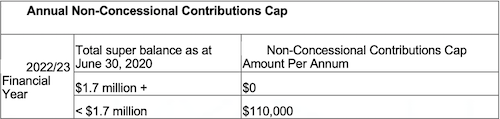
- A non-concessional contribution generally refers to an after-tax contribution that isn’t (or can’t be) claimed as a tax deduction by the contributor, e.g. personal contributions not claimed as a tax deduction and spouse contributions (for the recipient).
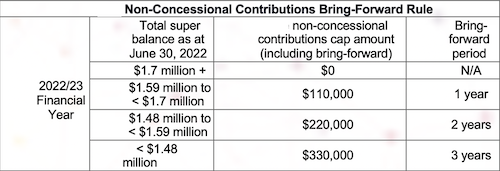
- The advantage of making the maximum tax-deductible superannuation contribution before June 30, 2023 is that superannuation contributions are taxed at between 15% and 30%, compared to personal tax rates of between 32.5% and 45% (plus 2% Medicare levy) for an individual taxpayer earning over $45,000. Typically, self-employed individuals and those who earn their income primarily from passive sources like investments make their super contributions close to the end of the financial year to claim a tax deduction. However, individuals who are employees may also use this strategy and those who might want to take advantage of this opportunity would typically include individuals:
- who work for an employer that does not permit salary sacrifice,
- who work for an employer that does enable salary sacrifice (but it is not disadvantageous due to a reduction in entitlements), and
- who are salary sacrificing but want to make a top-up contribution to utilise their full concessional contributions cap.
GOVERNMENT CO-CONTRIBUTION TO YOUR SUPERANNUATION
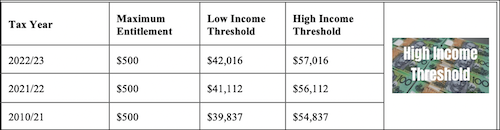
The Government co-contribution is designed to boost the superannuation savings of low and middle-income earners who earn at least 10% of their income from employment or running a business. If your income is within the thresholds listed in the table below and you make a ‘non-concessional contribution’ to your superannuation, you may be eligible for a Government co-contribution of up to $500. To be eligible you must be under 71 years of age as at June 30, 2022. In 2022/23, the maximum co-contribution is available if you contribute $1,000 and earn $42,016 or less. A lower amount may be received if you contribute less than $1,000 and/or earn between $42,016 and $57,016.
SALARY SACRIFICE TO SUPERANNUATION
If your marginal tax rate is 19% or more, salary sacrificing can be an effective way to boost your superannuation and also reduce your tax. By putting pre-tax salary into superannuation instead of having it taxed at your marginal tax rate you may save tax. This can be particularly beneficial for employees approaching retirement age.
Immediate Write-Off for Individuals Small Business Assets
Temporary Full Expensing allows businesses to claim an immediate deduction for the business portion of the cost of an asset being eligible plant, equipment and motor vehicles in the year it is first used or installed ready for use for a taxable purpose. For the 2022-23 income year, a business can claim an immediate deduction for the business portion of the cost of:
- Eligible new assets first held, first used or installed and ready for use for a taxable purpose between 7.30pm AEDT on 6 October 2020 and 30 June 2023.
- Eligible second-hand assets for businesses with aggregated turnover under $50 million – eligible depreciating assets using the simplified depreciation rules (only for small businesses with aggregated turnover of less than $10 million and less than $2 million for previous income years) and the balance of their small business pool.
If you are a small business entity that chooses to use the simplified depreciation rules, temporary full expensing rules apply with some modifications.
You cannot opt out of temporary full expensing for assets that the simplified depreciation rules apply to. You must immediately deduct the business portion of the asset’s cost for assets you start to hold, and first use (or have installed ready for use) for a taxable purpose from 7.30pm (AEDT) on 6 October 2020 to 30 June 2023. You don’t add these assets to your small business pool.
You may also deduct the balance of the small business pool at the end of an income year ending between 6 October 2020 and 30 June 2023.
Here are some key points to consider:
- For the instant asset write-off the asset can be new or second-hand.
- To be eligible, the asset must be purchased by a business turning over less than $50m or $500 million after 12th March 2020.
- The amount must be under $150,000 (depending on date of purchase – it could be $30K or $25K or $20K) exclusive of GST (i.e. $165,000, $33K, $27.5K or $22K including GST)
- If you borrow to purchase the asset, the asset is still eligible.
- The asset must be installed and ready to use by the deadline.
- To claim the write off on a motor vehicle you will need to have a valid log book and claim only that percentage of the cost as an immediate write off.
- If you purchase a car for your business, the instant asset write-off is limited to the business portion of the car limit of $64,741 for the 2022/23 income tax year.
- Any attempt to manipulate invoices etc. will attract the ATO's use of the anti-avoidance rules, thereby eliminating the write off.
- If your business has a small profit or even a loss, the write off will be of little or no benefit in the current year (losses are not refundable but can be carried forward to the next year).
- Building structural improvements are not eligible for the instant write-off.
- If your business is not a ‘Small Business Entity’ you will need to depreciate all assets purchased over $1,000. Any assets purchased for $1,000 or less can be written off immediately.
Accelerated Depreciation Deductions
Newly-acquired depreciating assets valued at more than $30,000 (or $150,000 post 12th March 2020) and not applied to the instant asset write-off deduction can be added to the general business pool. As part of the backing business incentive, an accelerated depreciation deduction of 57.5 percent for the business portion of the new depreciating asset applies for the cost of an asset on installation from 12th March 2020 to 30th June 2023 and existing depreciation rules apply (15 per cent for the first year and 30 per cent for subsequent years) to the balance of the asset’s cost and for subsequent years. There is no limit to the cost of a qualifying depreciating asset eligible for this concession, but the asset must be new and not second-hand.
Key points from the 2023-24 Federal Budget
Federal Budgets can involve a lot of content. The following are a quick summary of the main issues. The other related article has more detail.

Budget surplus expected
The first surplus in a number of years. A $4.2 billion surplus is predicted for the 2022-2023 financial year.
Small business asset write-off
Current rules apply until the 30th June 2023 so action before then may be prudent for your business. One-year small business instant asset write-off for assets up to $20k.
Small Business Energy Incentive
One-year Small Business Energy Incentive to switch to efficient energy sources such as electricity.
Household Energy Upgrade Fund
The move to solar and other energy saving systems is given a shove orward. $1.3 billion Household Energy Upgrade Fund for home upgrades that save energy.
Boost to cyber skills
This should be a program that all small businesses get involved in. Cyber security is one of the most misunderstood issues within this business group. $23.4 million “Cyber Wardens” program to boost cyber skills in small businesses.
Minimum tax for multinationals
15 per cent global minimum tax and a domestic minimum tax from 1 January 2024 for multinational groups with global turnover of $1.2 billion or more.
Superannuation tax
Future earnings on super balances over $3 million will be taxed at an additional 15 per cent from 1 July 2025. From 15% to 30%.
Change to super guarantee contributions
This change is expected to make a big difference to the efficiency of many small businesses. Employers will be required to pay compulsory super guarantee contributions on payday rather than quarterly (from 1 July 2026).
Push towards net zero
Another authority! Establishment of a national Net Zero Authority.
Increased bulk-billing incentive
Perhaps giving medical practitioners more would be better but $3.5 billion over five years to increase the bulk-billing incentive for general practitioners.
Aged care workers wage increase
$11.3 billion wage increase for aged care workers.
More welfare support
Targeted relief for vulnerable members of the community – including JobSeeker recipients and Commonwealth Rent Assistance.
AcctWeb
Latest Industry News

How Do I Write Legally Compliant Terms and Conditions for My Business?
Terms and conditions bind your customers only where they actively accept them, so a tick box at checkout holds...

Paid parental leave super contributions have started
From July 2026, the new Paid Parental Leave Superannuation Contribution (PPLSC) has started. From...

If the business is no longer profitable, and is unlikely to be profitable in the future, your best option may...
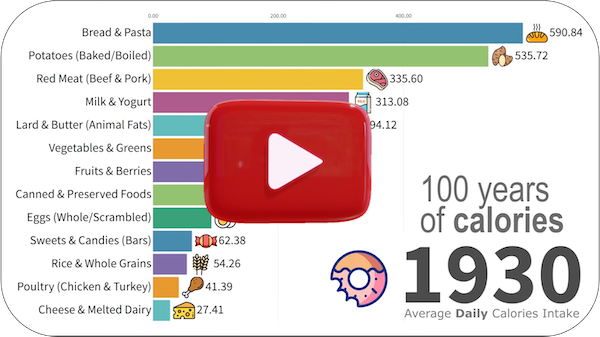
Check out the this visualization, which tracks the evolution of dietary calorie intake from 1930 to...

Taxpayer given 35% penalty for BAS recklessness
Following an application for a refund of nearly $94,000, the Administrative Review Tribunal has set aside an...

SMEs warned as ATO ramps up tax debt collection
One insolvency specialist has emphasised the importance of small businesses engaging their accountants to stay...

Does Your Small Business Need to Follow AML Privacy Rules?
Compliance with new anti-money laundering (AML) laws may subject your small business to additional privacy...

Don’t get caught out at tax time with your multiples jobs
Picking up a second job, holding multiple part-time roles, or doing gig work is now part of everyday life. But...

Global companies turn to cost-cutting amid ongoing inflation
Rising operating costs and persistent inflation are placing renewed pressure on businesses worldwide, despite...

Warning for early lodger this tax time!
The ATO has a clear message this year: slow down and get it right. Early lodgers are far more likely to make...

ATO no longer treating debt the same as during COVID
One expert has stressed the importance of tax agents reminding their clients that the ATO is no longer as...

The evolution of the world’s languages
Check out the evolution of the world's most spoken languages from 2500 BC to...
Latest Guests News

Newsletter Newslettter We are pleased to supply you with the latest edition of Client Alert, which...