- 234 Balaclava Road, Caulfield North VIC 3161
- contactus@guests.com.au
- (03) 9509 7033
Budget breakdown – Federal Government Analysis
The 2024 Federal Budget is broken down into these five PDFs. Click on each to read more.

.
Easing cost-of-living pressures
Building more homes for Australians
Investing in a Future Made in Australia
Strengthening Medicare and the care economy
Broadening opportunity and advancing equality
Medicare levy surcharge OR basic health insurance ?
Do the sums for your circumstances

.
Many Australians are paying the Medicare levy surcharge through their tax returns, when they could be buying private hospital insurance for about the same cost.
Taking out even a basic level of hospital cover, can be a cost-effective way to avoid the Medicare levy surcharge. And it could be of benefit in time of medical need.
People without private hospital cover earning more than $97,000 pay at least 1% extra annual tax via the surcharge, while those earning more than $150,000 pay 1.5% more.
It is worthwhile calculating the amount of surcharge you would pay versus the cost of private health insurance for basic hospital cover.
Some health policies cost little more than $1,050 annually. Extras cover does not affect the surcharge.
2024 Year End Tax Planning Guide (Part 1)
In May and June, we will add two articles to our website that help you plan and take action before the end of the 2023-24 financial year. Both Part 1 and 2 will cover the following, though Part I focuses on key strategies to manage your tax bill. All are worth dedicating time to review and think about how your business can organize your affairs in these ways.

.
Areas of tax planning to be considered:
- Key Tax Minimisation Strategies.
- Round Up of Other Year End Tax Issues.
- Other Tax Effective Strategies for Businesses to Consider.
- Superannuation Tax Planning Opportunities.
- Immediate Write Off & Temporary Full Expensing for Individual Small Business Assets.
Key Tax Minimisation Strategies
Delay Deriving Assessable Income
One effective strategy is to delay deriving your income until after June 30, 2024. Consider the following:
a. Delaying the Timing of the Derivation of Income until after June 30.
b. Timing of Raising Invoices for Incomplete Work (Businesses)
This tactic needs thought as it can adversely affect your cash flow and lead to issues better left alone. Invoices raised before 1-7-2024 are income in this financial year. Please note, not banking amounts received before June 30 until after June 30 do NOT qualify because the income is deemed to have been earned when the money is received, or the goods or services are provided (depending on whether you are on a cash or accruals basis of accounting).
· Cash Basis Income – Some income is taxable on a cash receipts basis rather than on an accruals basis (e.g. rental income or interest income in certain cases). You should consider whether some income can be deferred.
· Consider delaying your invoices to customers until after July 1 which will push the generation of the income into the next financial year and defer the tax payable on it. If you operate on a cash basis, you simply need to delay receiving the money from your customers until after June 30.
· Lump Sum Amounts – Where a lump sum is likely to be received close to the end of a financial year, you should consider whether this amount (or part thereof) can be delayed or spread over future periods.
2. Bringing Forward Deductible Expenses or Losses
Prepayment of Expenses
In some circumstances, small businesses and individuals who derive passive type income (such as rental income and dividends) should consider pre-paying expenses prior to 30 June 2024. A tax deduction can be brought forward into this financial year for expenses like:
- Employee Superannuation Payments including the 11% Superannuation Guarantee Contributions for the June 2024 quarter (any such contribution MUST be received by the Superannuation Fund by June 30, 2024 if a tax deduction is to be claimed).
- Superannuation for Business Owners, Directors, and Associated Persons.
- Wages, bonuses, commissions, and allowances.
- Contractor Payments.
- Travel and accommodation expenses.
- Trade creditors.
- Rent for July 2024 (and possibly future additional months – speak to your accountant to see if this is possible in your case).
- Insurances including Income Protection Insurance.
- Printing, Stationery and Office Supplies.
- All forms of advertising and promotion.
- Utility Expenses – Telephone, Electricity & Power.
- Motor Vehicle Expenses – Registration and Insurance.
- Accounting Fees.
- Subscriptions and Memberships to Professional Associations and Trade Journals.
- Repairs and Maintenance to Investment Properties.
- Self Education Costs.
- Home Office Expenses – desk, chair, computers etc. This area of expenses has changed significantly in recent years. Speak to your accountant about your situation.
- Donations to deductible gift recipient organisations.
- If appropriate, consider prepaying any deductible investment loan interest. This could include interest payments on an investment loan for either an investment or commercial property or an investment portfolio you hold.
A deduction for prepaid expenses will generally be allowed where the payment is made before 30 June 2024 for services to be rendered within a 12-month period. While this strategy can be effective for businesses operating on a cash basis (not accruals basis).
Superannuation Contributions – some low or middle-income earners who make personal (after-tax) contributions to a superannuation fund may be entitled to the government co-contribution. The amount of government co-contribution will depend on your income and how much you contribute.
Capital Gains/Losses – Note that the contract date (not the settlement date) is usually the key sale date for capital gains tax purposes. Here are several important points regarding the management of capital gains and capital losses on a sale of your assets from a tax planning perspective:
i. If possible, consider deferring the sale of an asset with an expected capital gain (and applicable capital gains tax liability) until it has been held for 12 months or longer. By doing so, you could reduce your personal income tax. For example, if you hold an asset for under 12 months, any capital gain you make may be assessed in its entirety upon the sale of that asset.
|
The Capital Gains Tax (CGT) Calculation Method* |
|||
|
Individual Taxpayer |
Date of CGT event |
CGT payable on an asset held < 12 months |
CGT payable on an asset held ≥ 12 months |
|
From 21/09/1999 |
Tax on 100% of nominal gain |
Tax on 50% of nominal gain |
|
ii. * A capital gain will be assessable in the financial year that it’s realised.
iii. If possible, consider deferring the sale of an asset with an expected capital gain (and applicable capital gains tax liability) to a future financial year. By doing so, you could help reduce your personal income tax for the current financial year. This could also be of benefit if, for example, you expect that your income will be lower in future financial years compared to the current financial year.
iv. If appropriate, consider offsetting a realised capital gain with an existing capital loss (carried forward or otherwise) or bringing forward the sale of an asset currently sitting at a loss. By doing so, you could reduce your personal income tax in this financial year. Note that a capital loss can only be used to offset a capital gain.
Accounts Payable (Creditors) – If you operate on an accruals basis and services have been provided to your business, ensure that you have an invoice dated June 30, 2023, or before so you can take up the expense in you accounts for the year ended 30th June 2023.
Please do not hesitate in contacting us if you have any questions on the above or other tax related matter.
Oldest Buildings in the World.
Check out the oldest Buildings in the World.
.
.
.
.
.
.
.
.
.
.
.
.
.
.
.
.
..

‘Renewed concerns’ about economy sees consumer sentiment dip: Westpac
Consumers remain deeply pessimistic about the near-term outlook for the economy despite signs of improvement last month, says the major bank.
.

The Westpac Consumer Sentiment Index fell 1.8 per cent to 84.4 in March with concerns still worried about the outlook for the economy.
Westpac said while there were promising signs last month that the consumer gloom that has dominated the past two years was beginning to lift, the March survey indicates that progress is “slow at best”.
“Consumers are still deeply pessimistic and becoming more concerned about the economy’s near-term outlook,” the Westpac Consumer Sentiment report stated.
The index indicated renewed concerns about the economic outlook.
Four of the five sub-indexes recorded declines in March, with the biggest move being a 4.5 per cent fall in the economic outlook.
The next biggest decline was the next 12 months sub-index which offset just over half of the gain from February.
“Assessments of family finances and ‘time to buy a major household item’ also retraced some of their February gains, with all still well below long run average levels despite some modest net improvement over the last six months,” Westpac said.
“The only positive was around the ‘economic outlook, next 5 years’ sub-index which edged up 1.1 per cent to be at 94, slightly above the long run average of 92.”
The major bank said responses to the survey suggest that sentiment made a sharp turnaround following the RBA decision.
“Sentiment amongst those surveyed prior to the decision came in at a much stronger 94.9 compared to 79.3 amongst those surveyed post-decision – almost identical to the swing recorded in February,” the report said.
“The implication is that while few would have been expecting rates to be cut, many consumers may have been hoping for a more positive message on inflation and the interest rate outlook.
“However, the RBA Governor was still not ruling out the possibility of further rate rises following the March meeting.”
Westpac Group senior economist Matthew Hassan said the RBA’s commentary looks to be tempering consumer expectations for interest rates as well, with fears of rate hikes easing but few expecting rate cuts any time soon.
The Westpac-Melbourne Institute Mortgage Rate Expectations Index, which tracks consumer expectations for variable mortgage rates over the next 12 months, dipped 0.5 per cent to 120.9.
“The mix of responses shows 40 per cent of consumers are still bracing for rate increases, 22 per cent expect no change, 22 per cent expect declines and 15 per cent simply “don’t know,” said Hassan.
Hassan said consumers remain relatively comfortable about the outlook for jobs, however.
“The Westpac-Melbourne Institute Unemployment Expectations Index rose slightly, by 1 per cent, in February but at 128.1 is still in line with the long run average of 129,” he said.
“Readings remain consistent with a softening in labour market conditions rather than a sharp rise in job losses.”
Housing-related sentiment improved slightly overall for the month with another lift in assessments of time to buy and price expectations holding at optimistic levels.
Miranda Brownlee
27 March 2024
accountantsdaily.com.au
A comprehensive list of guides to industry specific tax deductions.
The following is a list the ATO has compiled that is tailored to occupations and industries.

.
Use the table below to access either:
- the complete occupation or industry guide including income, expenses, record keeping and examples
- select the link in the left column of the table
- read the content online
- the PDF summary of common work-related expenses for your occupation or industry, you can
- select the link in the right column of the table to open the PDF
- you can download as a PDF.
UNDERPERFORMING EMPLOYEES: WHEN CAN YOU TERMINATE?
Terminating an underperforming employee requires caution. Employers must follow fair procedures to avoid legal issues such as unfair dismissal claims.

.
Firing an employee hastily or without proper procedures can lead to uncomfortable situations and damage the company's reputation. Regrettably, sometimes, management pressure means making uninformed decisions that open the company to risk.
Poor performance is perpetuated because employees are often unaware of their subpar performance, and their managers, for various reasons, fail to effectively address the situation by delaying action.
This article goes through the performance process, offering hints and tips for HR to support businesses in creating high-performing organisations while mitigating risk.
HOW HR CAN SUPPORT BUSINESSES
As trusted advisors, HR leaders often face the dilemma of doing the right thing while businesses prioritise expediency and cost-cutting measures, usually encouraged by senior management.
In certain circumstances, swift termination of an employee's employment can be advantageous, especially when immediate and decisive action aligns with the company's best interests. This approach may be driven by the perception that the business risks associated with retaining an employee outweigh the potential legal consequences employers might encounter by acting promptly.
However, this 'swift' approach should be the exception, not the norm. It is an essential reminder that high-performing organisations consistently engage in constructive discussions with their employees regarding their performance. They establish well-defined goals, offer feedback, and provide support to maximise employee productivity. In cases of underperformance, these organisations promptly take appropriate and sensitive measures to address the issue.
STEPS TO ADDRESS EMPLOYEE PERFORMANCE
1. Identify and assess the underperformance
- Write down examples of problematic behaviours or actions.
- Assess the seriousness, duration, and impact of the problem.
- Organise a meeting with the employee to discuss the issue.
2. Meet with the employee
- Describe the problem clearly and give specific examples of where they are not meeting expectations
- Explain the impact on the business, co-workers, and the employee's work.
3. Agree on a solution
- Explore ideas and suggest ways to fix the problem.
- Reinforce the value of the employee's role.
- Record the agreed actions in a performance improvement plan.
4. Monitor and review performance
- Follow through with the support offered and regularly check in.
- Have a follow-up meeting to review progress.
- Update the performance improvement plan as needed.
- Acknowledge the employee's progress and focus on remaining improvements.
DISMISSING AN EMPLOYEE FOR UNDERPERFORMANCE
If performance doesn't improve and a written warning has been issued, sometimes a dismissal is the next step. Termination of employment is a significant step that requires a valid reason related to the employee's capacity or conduct.
Employers must follow a fair performance management and dismissal process and avoid harsh, unjust, or unreasonable circumstances. Fairness is crucial, especially during termination, and employees should be provided with reasons for dismissal and an opportunity to respond.
Before dismissing an employee, employers should have taken the following steps:
- ensuring that the purpose of performance meetings has been communicated in advance and allowing the employee adequate time to prepare
- informing the employee of their right to have a support person present
- clearly outlining the expected performance level and required improvements.
- providing clear warnings about the need for performance improvement
- granting reasonable time and support to enhance performance
- expressing the possibility of dismissal if performance does not improve.
Before dismissing an employee, the employer must provide written reasons for considering dismissal and allow the employee a reasonable opportunity to respond. Any response from the employee must be considered before making a termination decision. Failure to follow these steps can result in a successful unfair dismissal claim against the employer.
Note: Businesses with fewer than 15 employees are subject to specific dismissal rules that differ from those applicable to larger organisations. During the first 12 months of employment, small business employees cannot claim unfair dismissal. However, if an employee is dismissed after this period and the employer has complied with the Small Business Fair Dismissal Code, the dismissal will be deemed fair.
Access the Small Business Fair Dismissal Code and checklist.
KEY LESSONS
Terminating an underperforming employee is a valid reason for termination. However, employers must follow specific steps to avoid landing in hot water. Some key takeaways are:
- Immediate Communication: If performance concerns arise, promptly address them with the employee through transparent and open communication.
- Documentation: Utilise tools like performance improvement plans. Document all conversations regarding performance, informal or formal, and maintain records of any written warnings given to the employee. This documentation can significantly benefit the organisation if an unfair dismissal claim arises.
- Procedural fairness: Ensure that any implemented performance management process adheres to the principles of procedural fairness.
Catherine Ngo
Content writer, presenter and podcaster
mybusiness.com.au
THE 2025 FINANCIAL YEAR TAX & SUPER CHANGES YOU NEED TO KNOW!
The new financial year is fast approaching and so are a number of changes to superannuation contribution amounts and the individual tax rates. These changes are outlined below, as is some information on how you may be able to work with these changes when managing your tax affairs during 2024-25.

.
Superannuation
From 1 July 2024, the amount you can contribute to super will increase.
The amount you can contribute to superannuation will increase on 1 July 2024 from $27,500 to $30,000 for concessional super contributions and from $110,000 to $120,000 for non-concessional contributions.
For those with the disposable income to contribute, superannuation can be very attractive with a 15% tax rate on concessional super contributions and potentially tax-free withdrawals when you retire. For business owners who might have had an exceptional year or sold their business, it's an opportunity to get more into super. However, the timing of contributions will be important to maximise outcomes.
If you know you will have a capital gains tax liability in a particular year, you may be able to use ‘catch up’ contributions to make a larger than usual contribution and use the tax deduction to help offset your capital gain tax bill. But, this strategy will only work if you meet the eligibility criteria to make catch up contributions and you lodge a Notice of intent to claim or vary a deduction for personal super contributions, with your super fund.
Using the bring forward rule
This topic has been touched on in previous articles but the ‘bring forward rule’ enables you to bring forward up to 2 years’ worth of future non-concessional contributions into the year you make the contribution – this is assuming your total superannuation balance enables you to make the contribution and you are under age 75.
If you utilise the bring forward rule before 30 June 2024, the maximum that can be contributed is $330,000. However, if you wait to trigger the bring forward until on or after 1 July 2024, then the maximum that can be contributed under this rule is $360,000.
‘Catch up’ contributions
If your super balance is below $500,000 prior to 30 June, and you want to quickly increase the amount you hold in super, you can utilise any unused concessional super contributions amounts from the last 5 years.
For example, a taxpayer has only been using $15,000 of the concessional super cap for the last few years. The super balance at 30 June 2023 was $300,000, so this person is well within the limit to make catch up contributions.
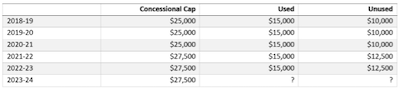
This person could access their $27,500 concessional cap for 2023-24 plus the unused $55,000 from the prior 5 financial years.
However, if the unused amount from 2018-19 is not used by 30 June 2024, the $10,000 will no longer be available.
Taxation
As we all know, the revised stage 3 tax cuts have passed Parliament and will come into effect on 1 July 2024. The following table outlines what the rates currently are and what they will be from the 2025 financial year.
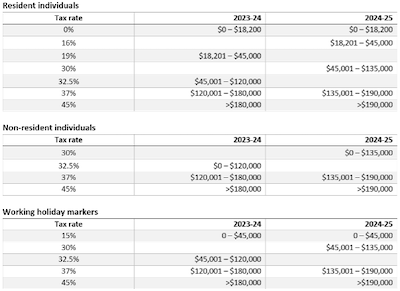
Salary sacrifice agreements should be checked before the new tax rates come into effect to ensure they will continue to produce the result you are after.
Be sure to contact us if you have any concerns or questions.
Small business benchmarks
The ATO has developed quite a number of benchmarks to help small businesses develop an idea of their performance compared to similar businesses in the same industry.

.
The link below takes you to the A-Z list of benchmarks and covers a large number of small businesses. Such a comparison can be a very helpful when looking for ways to improve your business’s profitability and productivity.
Call us if you have any questions.
A-Z list of benchmarks.
ATO’s debts on hold campaign prompts new IGTO guidance
New guidance has been released on best practice principles for debt notifications in response to the re-activation of old debts by the ATO.

.
The Inspector-General of Taxation Ombudsman, Commonwealth Ombudsman and ACT Ombudsman have published a report advising government agencies about how to tell people they owe money to the government.
The report has been issued off the back of community concerns that were raised last year regarding the ATO’s approach to debt collection.
The ATO issued tens of thousands of letters both to tax agents and individuals in 2023, advising them that previous debts on hold that had been written off as “uneconomic to pursue” would be revived and offset against clients’ tax refunds or credits.
The report explained that notifications about debt to individuals can be a “worrying, traumatic and confusing experience” and can negatively affect people’s wellbeing.
“The impact of being told you owe the government a debt can be increased if the debt is unknown, it’s old, it’s unexpected, or if there is limited information about the reasons for the debt, who to contact for more information or how to challenge the debt, who to contact for more information or how to challenge the debt,” the report stated.
It acknowledged that while agencies must act and are expected to act per the law, they are also obliged to help people and act in the best interests of the Australian community.
“While the law may require agencies to take certain action, agencies are also responsible for determining how they take that action in a way that minimises distress to affected and impacted people,” the guidance stated.
Inspector-General and Taxation Ombudsman, Karen Payne, said the ATO was told by the Australian National Audit Office in 2023 that it needed to review its practice concerning debts classed as “uneconomical to pursue” which is what led the Tax Office to send out letters advising of the debts.
“Now, that didn’t necessarily mean that you should write to all taxpayers telling them that they owe these uneconomical to pursue debts, particularly where the ATO’s own online systems hadn’t caught up. So these [debts] looked invisible frankly to taxpayers,” Payne said, speaking to Accountants Daily.
“What the professional bodies said when they met with the ATO as part of their stewardship group was ‘Well, if you think this is a good idea, then you should tell people what debts they owe, including debts that are on pause, but don’t do that until it can be seen on your system’.
“[However], before the systems were updated to let people know what the debts were, so they could at least marry up what the communication was saying, the Tax Office was writing to people saying you owe these debts including debts of 20 cents. So the whole communication was handled poorly, frankly.”
Commonwealth Ombudsman Iain Anderson said the ATO was previously issued with a report back in 2009 before the IGTO office was established.
“The report contained a recommendation that the ATO should provide further information to taxpayers when the debt is raised including the source of the debt, how much interest has been charged and why it is be raised and how to obtain further information,” the Commonwealth Ombudsman said.
“They agreed or partially agreed to all the recommendations in that report.
“It’s been disappointing that they haven’t done that this time around.”
The Commonwealth Ombudsman said the issues raised in the report are relevant to a whole range of government departments, beyond just the ATO.
“A lot of government departments need to chase debts and a lot of them have issues with how well they communicate with people,” he stated.
“They need to stake steps to put people at the centre of how they do things.”
Individuals need to know what a debt is, where it has come from, particularly where the department is chasing down an old debt, said Anderson.
“The first thing someone does when they get a letter from a government agency saying that they owe money is what have I done? Have I missed something? That’s where an apology really comes in or an explanation to say where the debt comes from and why it’s now being pursued,” he stated.
It is also important that individuals are properly informed so that they can pursue remedies such as contesting the debt, he added.
“Communicating clearly goes beyond chasing debt, it’s something that government agencies need to get much better at.”
The IGTO said that one of the most concerning scenarios concerning debts previously on hold is that taxpayers have limited opportunity to enter payment arrangements.
Payne explained that where the taxpayer has entered into a payment arrangement with the ATO, the Commissioner of Taxation does have the discretion not to automatically offset the debt against the refund.
“The key issue here is that if you’ve got one of these uneconomical to pursue debts and you don’t know that you owe the debt and it is not visible on the ATO’s systems that you owe the debt, then you’re not going to be thinking about entering into a payment arrangement because you don’t even know you have it,” she stated.
“So what we would encourage the Tax Office to think about is that prior to doing the automatic offsetting, tell people that they owe the debt, see if they need to enter into some kind of payment arrangement or payment instalments so that they can at least take the benefit of the discretion that the Commissioner has not to automatically offset these debts.”
Miranda Brownlee
26 March 2024
accountantsdaily.com.au
Latest Industry News

How Do I Write Legally Compliant Terms and Conditions for My Business?
Terms and conditions bind your customers only where they actively accept them, so a tick box at checkout holds...

Paid parental leave super contributions have started
From July 2026, the new Paid Parental Leave Superannuation Contribution (PPLSC) has started. From...

If the business is no longer profitable, and is unlikely to be profitable in the future, your best option may...
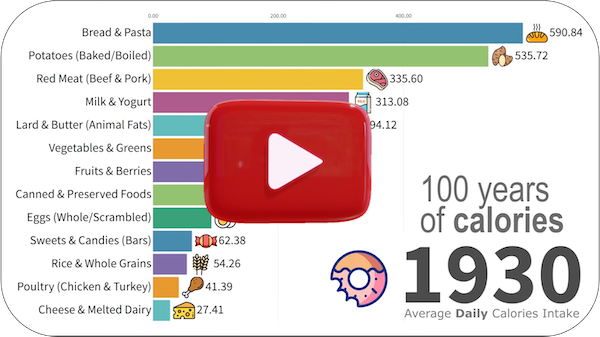
Check out the this visualization, which tracks the evolution of dietary calorie intake from 1930 to...

Taxpayer given 35% penalty for BAS recklessness
Following an application for a refund of nearly $94,000, the Administrative Review Tribunal has set aside an...

SMEs warned as ATO ramps up tax debt collection
One insolvency specialist has emphasised the importance of small businesses engaging their accountants to stay...

Does Your Small Business Need to Follow AML Privacy Rules?
Compliance with new anti-money laundering (AML) laws may subject your small business to additional privacy...

Don’t get caught out at tax time with your multiples jobs
Picking up a second job, holding multiple part-time roles, or doing gig work is now part of everyday life. But...

Global companies turn to cost-cutting amid ongoing inflation
Rising operating costs and persistent inflation are placing renewed pressure on businesses worldwide, despite...

Warning for early lodger this tax time!
The ATO has a clear message this year: slow down and get it right. Early lodgers are far more likely to make...

ATO no longer treating debt the same as during COVID
One expert has stressed the importance of tax agents reminding their clients that the ATO is no longer as...

The evolution of the world’s languages
Check out the evolution of the world's most spoken languages from 2500 BC to...
Latest Guests News

Newsletter Newslettter We are pleased to supply you with the latest edition of Client Alert, which...