- 234 Balaclava Road, Caulfield North VIC 3161
- contactus@guests.com.au
- (03) 9509 7033
Small business decries ‘unfair’ payday super changes
The seven-day payment window and closure of the ATO’s clearing house are expected to disproportionately impact smaller employers.

.
Small business groups are pushing back on the government’s payday super plan, warning the increased requirements will be “overwhelming” and result in employers being unfairly penalised for delays outside their control.
According to design details released by the Treasury on Wednesday, businesses will be given a seven-day window for payday contributions to arrive in employees’ super funds before they face daily interest charges.
The government also announced it would close the ATO’s Small Business Superannuation Clearing House, currently used by some 250,000 employers across the country.
In a joint statement, Treasurer Jim Chalmers and Assistant Treasurer Stephen Jones said the changes, set to apply from July 2026, would incentivise employers to quickly disclose and rectify missed payments.
“[The changes will] increase the severity of consequences for employers that deliberately or repeatedly do the wrong thing,” they said.
But bodies such as the Council of Small Business Organisations of Australia, the Institute of Public Accountants, Institute of Certified Bookkeepers and the Australian Chamber of Commerce and Industry criticised the plan and said the government failed to consider the impacts on small businesses.
Payroll software, management costs to increase
COSBOA chief executive Luke Achterstraat said moving from quarterly to weekly pay cycles was an “overwhelming ask, particularly for small businesses already struggling with tight margins”.
“Employers will be required to make up to 13 times as many payments, handle up to 13 times as many transactions, and ultimately incur up to 13 times the cost to ensure super reaches their employees accounts,” Achterstraat said.
“In the current economic climate, the focus should be on supporting small businesses, not increasing their administrative and financial burdens.”
Small businesses would also face higher subscription costs as payroll software companies charged more to reflect the demands of payday super, according to IPA senior tax adviser Tony Greco.
Closure of ATO clearing house opposed
The IPA also opposed the government’s decision to retire the Super Clearing House, warning small businesses using the service would be forced to find costly alternatives.
The ATO-managed service is free for small businesses and exempts them from the general interest charge that applies when money is delayed in reaching employees’ accounts.
“If they use an alternative clearing house they are at the mercy of the system if something goes wrong in any of the back-office processing,” Greco said.
“We will be urging the government to seriously think about having a replacement facility and rethink its closure entirely.”
‘Unfair’ 7-day rule
With the ATO's Super Clearing House set to close, the groups also pushed back against the proposed seven-day rule for super contributions to arrive in employees’ accounts.
Employers failing to meet the deadline would be charged interest each day on a compounding basis. The general interest charge is currently 11.36 per cent.
COSBOA called the rule “unfair”, and ICB executive director Matthew Addison said employers who made prompt payments should not be held responsible for processing delays.
“Employers should not be penalised as long as they made the payment on payday,” Addison said.
“If clearing houses, super funds, and employees can’t facilitate the payment within seven days, why is the employer held responsible for actions or lack of action by others?”
The ACCI said that while it supported the idea behind aligning super to wages, it was concerned small businesses lacked the support and resources to comply by the 2026 deadline.
“We are concerned the government has not given enough consideration to the pressures small businesses are facing right now,” chief executive Andrew McKellar said.
The ATO estimates that unpaid super totalled $3.6 billion in 2020–21.
The government said work on payday super’s design would progress through the second half of 2024 ahead of draft legislation being released for consultation.
Christine Chen
20 September 2024
accountantsdaily.com.au
What are the government’s intentions with negative gearing?
Both the Treasurer and the Prime Minister have confirmed that Treasury is exploring changes to the contentious policy.

.
In a move reminiscent of 2019, both Jim Chalmers and Anthony Albanese confirmed on Wednesday that Treasury officials are working on options to scale back negative gearing and capital gains tax, with the Treasurer insisting the review is “not unusual”.
“Treasury looks at all kinds of Treasury options all of the time. It is not unusual for the public service and, in my case, my department … to examine issues that are being speculated about in the public or in the Parliament. That is how a good public service operates,” Chalmers said.
He stressed that, while the review isn’t part of the government's current housing agenda, he wouldn’t dismiss the possibility of it being included down the line.
Prime Minister Anthony Albanese, however, downplayed reports that the government commissioned Treasury modelling on changes to negative gearing and capital gains tax, stating he values Treasury’s advice and supports it exploring a range of policy ideas.
But while he scoffed at a question about negative gearing in an ABC interview just last week, speaking to the ABC Radio on Wednesday, the PM said: “The department, like all departments, looks at various things at various times.”
“That's what Treasury do. We respect the public service. Lots of people look at lots of things, but it's certainly not our policy,” the PM added.
Although he denied being the one who requested Treasury to explore potential changes, he stated that he is unaware if Treasurer Chalmers did so.
“I don't know because I'm not the Treasurer. And the Treasurer is on his way to China as we speak,” the PM said.
“What we have done is to concentrate on our Homes for Australia plan. What I can say is, at no level of the government has there been a debate about anything other than getting our Homes for Australia plan through. And those meetings include, obviously, in our Cabinet, and those processes include, obviously, the Treasurer and other Ministers as well. What we're concentrating on is delivering the Homes for Australia plan, some of which is caught up in the Senate, because we know that the key to housing policy is lifting supply, and that has been our concentration.”
Meanwhile shadow treasurer, Angus Taylor, is convinced Labor is “hard at it”, confirming on Wednesday that there are no circumstances under which the Coalition would support any reforms to negative gearing.
“We don’t support a tax on housing that will reduce the supply of housing and increase the cost of housing. In a cost-of-living crisis, the idea that a tax on housing is the way to solve a cost-of-living crisis where the biggest pain being felt by most Australian households is the cost of housing, is just extraordinary. Only this Treasurer and this Prime Minister could think that is the answer to this problem,” Taylor said.
The debate over negative gearing seems to resurface every three years in the run-up to elections, with many attributing Bill Shorten’s loss in the 2019 federal election to the policy’s unpopularity.
In February, Treasurer Jim Chalmers firmly stated that the government was not considering any changes to negative gearing. Fast forward to September, and it seems the government is now open to the possibility of adjustments, possibly spurred by mounting pressure from the Greens to tackle housing affordability.
Namely, two key elements of the government’s housing policy – a tax incentive for private developers to build rent-capped apartments and a subsidy scheme for first home buyers – are stalled in the Senate due to a lack of support from both the Greens and the Coalition, with the Greens demanding changes to negative gearing and capital gains tax in exchange for their backing.
Speaking to Sky News back in February, amid similar pressure from the Greens, Chalmers said regarding potential changes to negative gearing: “That’s not something that we’re proposing, not something that we are considering, not something that we are working up.”
At the same time, Taylor told ABC’s Insiders that the opposition is aware the government is contemplating changes to the policy.
AMP’s chief economist, Shane Oliver, previously argued that any changes to negative gearing could create distortions in the market, potentially exacerbating property affordability issues by reducing the supply of rental properties.
Capital gains, on the other hand, Oliver admitted, is potentially excessive and could use a revision.
“There is a case to consider removing the capital gains tax discount and return to the pre-1999 approach of adjusting capital gains for price inflation,” he said earlier this year.
Back in 2019, Labor proposed to halve the 50 per cent capital gains tax deduction and limit negative gearing to new properties only.
Maja Garaca Djurdjevic
September 26 2024
smsfadviser.com
6 steps to create a mentally healthy and vibrant workplace
It’s estimated we spend a third of our life at work. It may even be more if you run your own small business. From working overtime during the week to catching up on paperwork on the weekend, having enough time to get everything done is a challenge for most small businesses.

.
So, it’s easy to understand why you might not feel like you have the time to think about your own wellbeing let alone the wellbeing of your employees or your co-workers. However, understanding how the people in your business are coping with both life and work pressures is just as important as paying your suppliers every week or doing a stocktake.
45% of Australians experience a mental health problem at least once in their lifetime.
In 2022, 52% of serious mental stress claims in Australia were because of work-related issues. These issues included harassment, bullying, work pressure and occupational violence.
Poor workplace wellbeing affects workers’ mental health and productivity, costing our economy up to $22.5 billion a year. Asking a colleague ‘R U OK?’ may begin a conversation that not only helps them but also helps build a healthy workplace.
This year, R U OK? Day is on Thursday 12 September 2024. The day serves as a reminder that asking, ‘are you ok’ any day of the year is important to the mental health and wellbeing of those around you.
One way to improve workplace wellbeing, safety, and performance is to use Dr Martin Seligman’s (2012) PERMAH framework. This evidence-based model highlights 6 factors that help us feel good and perform well at work. Workplace culture can be improved by prioritising these 6 elements.
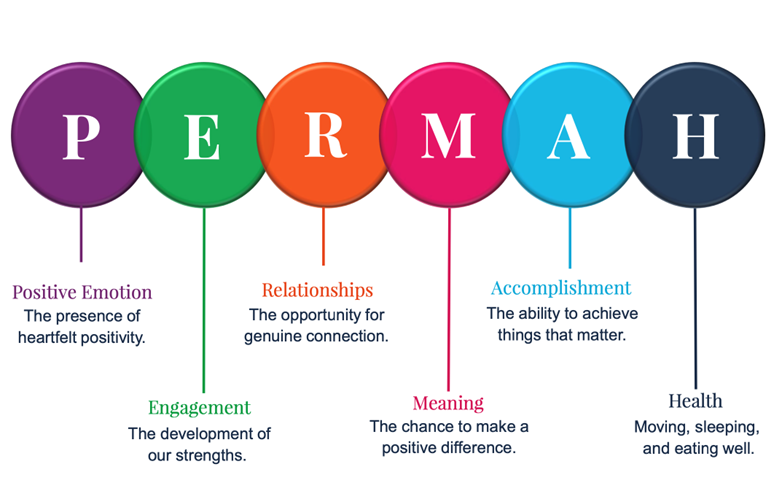
1. Positive emotions: ‘AMP’ up your understanding of stress
A healthy workplace is not absent of stress, but it is one where people know how to manage it. Stress is natural, especially if you run your own small business. Often, it’s our body’s way of trying to alert us that something we care about is at stake.
By noticing the signs of stress in yourself and your employees, Associate Professor of Psychology at Standford University Dr Alia Crum, found we can harness our body’s stress responses to help us meet life with the energy and courage we need to deal with whatever is at stake.
You can help your workplace ‘AMP’ up an understanding of stress by encouraging your people to:
Be Aware when they feel stressed, that their body is trying to get their attention by making them feel uncomfortable (sweaty hands, racing heart, tight jaw or hunched shoulders).
Find Meaning for these feelings by asking them what's happening that's important and may not be going the way they want.
Prioritise Conversations and/or actions that can positively impact the outcome of what's unfolding. Remember, tiny steps can have a mighty impact because they motivate people to move forward with confidence.
Whether you’re a sole trader or run a small team, understanding the signs of stress can help keep you and your employees in a positive frame of mind. Sometimes stress can’t be avoided, but we can manage how that stress affects us and do things to help reduce it.
2. Engagement: give strength-focused feedback
High-performing teams share nearly 6 times more positive feedback than average teams, while low-performing teams share nearly 2 times as much negative feedback as average teams. Make giving strength-focused feedback to your employees a priority, and easier and more effective by using the ‘THANK’ method:
Track: What is the positive impact you’ve seen this person’s work having recently on others? How specifically might they be making work or life easier or better?
Highlight: What can you see them learning, doing, and/or delivering that is making this positive difference that you value?
Appreciate: What strengths – the things they are good at and enjoy doing – can you see being used to make this effort and/or outcomes possible?
Nurture: How can these strengths be built on? How might they avoid overplaying or underplaying their strengths that could help improve their performance?
Kindle: What support might they need/want and what does this look like?
3. Relationships: build psychological safety
Vibrant workplaces welcome honesty, prioritise learning, encourage asking for help, and support taking risks together. Everyone struggles at work from time to time. Workplaces that normalise the feeling of struggling can promote healthy learning and growth.
Removing any barriers or embarrassment to having open conversations can help unlock the potential for people to become better at their jobs. Psychological safety can be built by using the following Safety Check Chat questions to check in with your team:
What’s working well?
Where are we struggling?
What are we learning?
What do we want to try next?
Four people in an office sitting at their desks, laughing on a coffee break.

4. Meaning: create a giving culture
We long to be more than the sum of the tasks we perform at work. The good news is researchers have found that meaning can be found in any job by helping people identify the difference their work makes to others. Encourage a healthy workplace by getting people to invest in 5-minute favours that make a positive difference in someone else’s life by:
offering to help with a hands-on task
sharing their expertise (i.e. offering their skills)
coaching or mentoring others (i.e. teaching someone how)
passing on favourite resources (i.e. books, podcasts, articles, recommendations)
supporting a colleague by listening to their struggles and/or successes.
5. Accomplishment: setting and celebrating learning goals
A vibrant workplace is one that learns and understands failure and mistakes are part of how things are accomplished. They do this by embracing a ‘growth mindset’ that recognises that while we all bring to the workplace certain talents, abilities, and intelligence we can improve upon these with learning, practice, and support. To help your team develop their growth mindsets you can ‘SET’ learning goals:
Spark your curiosity: Challenge your mind by picking a small learning goal that can make a big difference.
Experiment: Act on your learning goal within the next 24–48 hours. Remember as long as you show up, give your goal your best shot, and stay curious about the results, you can’t fail.
Tune into feedback: Measure your progress, seek feedback, and reflect on what you’re learning to move closer to your goals.
6. Physical health: the need for rest and recovery
Vibrant workplaces recognise we are built to swing between periods of activity and recovery. They understand the power of short breaks throughout the day. In turn, this helps people stay energised, healthy and more productive.
Recovery doesn’t mean you need to take a nap in the backroom or under your desk. Researchers have found that short breaks allow the thinking parts of our brains to rest. This can be just as effective as naps. Here are some easy ways to add these to your workplace:
Encourage ‘walk and talk’ meetings/discussions where possible.
Encourage shared lunch breaks, eating together away from desks or finding an external lunch location.
Provide exercise cards/posters for quick stretches between tasks.
Organise fun workplace challenges that encourage activity and involvement, e.g. a sit-stand challenge to see who can hold the position the longest.
Allow short social breaks like tea/coffee conversations, which help rest the brain and build connections between employees.
How to create change in the workplace
Business owners and leaders may face challenges when trying to bring about behaviour changes. Professor James Prochaska, (a leading researcher in behaviour change), highlights that there are 3 common derailers when it comes to caring for our wellbeing. These include:
‘I don’t want to’
‘I don’t know how to’
‘I don’t think I can’.
Creating safe places for people to learn and grow can be a strategic way to help overcome these barriers. Business owners can do this by tapping into curiosity rather than judgment, as well as encouraging their employees to switch their mindset about how to deal with people:
Instead of making assumptions, slow down and ask questions to understand.
Rather than being embarrassed to ask questions, assume learning is helpful and seek/offer support.
Instead of complaining about someone’s performance, assume everyone is capable and spark kind conversations to enable growth.
Rather than pointing the finger and blaming others, encourage shared responsibility and create transparent and safe spaces for accountability.
Building a vibrant workplace culture is an ongoing process requiring long-term strategies. A learning loop can be helpful to enable continuous improvement:
Act: What have you tried? Why did it matter to you?
Assess: What went well? where did you struggle? What did you learn?
Adjust: What will you try next? Do you need support?
Building a healthy and vibrant workplace isn’t something that can be done overnight or something that you must do by yourself. It’s done by encouraging a workplace culture of positive behaviours every day. It’s the small things that count in the end. Researchers suggest that small and consistent ‘wellbeing wins’ amplify our confidence and motivation so we can scale up our efforts over time.
Small changes can have big results
In a vibrant workplace, people feel safe, energised, and ready to collaborate. They’re resilient and productive, navigating both highs and lows as part of learning and growing together. Ask yourself, are you creating and leading a vibrant workplace culture?
Start implementing the frameworks and wellbeing strategies above. Your proactive commitment to making even one small change today can make a meaningful difference both now and in the future.
Let’s make R U OK? Day the opportunity to not just ask this vital question, but to create sustainable and vibrant work environments where wellbeing is prioritised and businesses perform at their best. For more information on R U OK? Day, visit the R U OK website.
For more information on building resilient people, healthy relationships and vibrant workplaces, visit the Wellbeing Lab website.
Tools to improve your workplace’s mental health
Work Safe Victoria’s mental health: safety basics
The Victorian Mentally Healthy Workplaces Framework | vic.gov.au (www.vic.gov.au)
Mental health support services
Mental health support and assistance services
Free support and advice with Partners in Wellbeing
THE WELLBEING LAB
12 SEP 2024
business.vic.gov.au
Treasurer unveils design details for payday super
The government has released further details about the design of its payday super policy including an updated super guarantee charge framework.

.
The Albanese government has released further information about the design of its payday super policy in a factsheet published on Wednesday.
The reforms, which will apply from 1 July 2026, will require employers to pay their employees super at the same time as their salary and wages.
In a joint statement with the assistant treasurer, Treasurer Jim Chalmers said the new design details will help incentivise compliance and ensure employees are compensated for any delays in receiving their super.
The proposed design makes changes to the super guarantee charge framework to incentivise employers to quickly disclose and rectify any instances of unpaid
superannuation. It will increase the consequences for employers who don’t pay on time and apply bigger penalties for employers who repeatedly do the wrong thing.
Businesses will become liable for the updated superannuation guarantee charge if super contributions are not received by their employees’ superannuation fund within seven days of payday.
The government said this will provide time for payment processing to occur while also ensuring that swift action can be taken against employers that are not meeting their obligations.
The Treasurer said the revised choice of fund rules under the policy design will make it easier for employees to nominate their existing super fund when they start a new job, reducing unintended duplicate accounts and giving employers more timely and accurate details.
Chalmers said payday superannuation would be revolutionary for the country’s superannuation system.
“Paying super on payday is part of the government's efforts to ensure Australians earn more, keep more of what they earn and retire with more as well,” Chalmers said.
“This change will strengthen Australia’s superannuation system and help deliver a more dignified retirement to more Australian workers.”
Chalmers said by switching to payday super, a 25-year-old median income earner currently receiving their super quarterly and wages fortnightly could be around $6,000 or 1.5 per cent better off at retirement.
The push towards payday super follows the ATO’s estimation that $3.6 billion worth of super went unpaid in 2020–21 despite most employers doing the right thing.
The Australian Superannuation Fund Association (ASFA) welcomed the government’s announcement to introduce compulsory payday super from 1 July 2026.
ASFA CEO Mary Delahunty said this will ensure millions of Australians receive the superannuation they are owed and benefit from having their super invested earlier and more frequently.
“Payday super is a game-changer,” Delahunty said.
“This reform means workers will see their super build in real-time, alongside their wages and will mean less lost super and better investment outcomes in preparation for retirement.”
“We are sure that this change will encourage people to engage more regularly with their retirement savings.
ASFA noted this reform will prove a more fair and equitable superannuation system for all Australians as unpaid super usually disproportionately affects lower-income earners, casual workers and women.
“It’s about fairness. Payday super makes it more likely that Australians will receive the super contributions they’ve earned, paid on time, every time,” Delahunty said.
Imogen Wilson
19 September 2024
accountantsdaily.com.au
Government releases details on luxury car tax changes
The draft legislation aims to modernise the luxury car tax by tightening the definition of a fuel-efficient vehicle and adjusting the indexation rate.

.
The government has released draft legislation to update the luxury car tax (LCT) after previously announcing it would tighten the definition of a fuel-efficient vehicle and align the indexation rate for LCT thresholds.
The changes will be in effect from 1 July 2025, the government said.
There are currently two thresholds for the LCT which include a higher threshold that applies to fuel-efficient vehicles and a lower threshold that applies to all other luxury vehicles.
The new amendment will update the definition of a fuel-efficient car by reducing the maximum fuel consumption for a car to be considered fuel-efficient for the LCT to 3.5 litres per 100 kilometres from the current seven litres per 100 kilometres.
The aim behind tightening the definition of a fuel-efficient vehicle is to ensure only electric, or partially electric vehicles can use the higher threshold of the LCT.
The government said this amendment will “incentivise” the uptake of electric or partially electric vehicles.
The LCT amendment will also see a change in the index number used to index the LCT threshold from all groups CPI to the motor vehicle purchase sub-group of the CPI.
The higher threshold that applies to fuel-efficient luxury cars is known as the fuel-efficient car limit and is indexed annually using the index number for the motor vehicle purchase sub-group of the CPI.
The lower threshold that applies to all other luxury cars is indexed annually using the index number of the all groups CPI.
The government said it is seeking to change this as the indexation rates haven’t grown at the same pace and have instead converged.
“At the time of its introduction in 2008, the fuel-efficient limit was set at $75,000, whilst the LCT threshold for all-other luxury cars was $57,180,” the government said.
“Since then, there has been weaker growth in the motor vehicles sub-group of CPI compared to all groups CPI which has caused the differential between these two thresholds to narrow.”
“For the 2024-25 financial year, the fuel-efficient cars threshold sits at $91,387, whilst the threshold for all-other luxury cars is at $80,567.”
The government said this amendment will aim to align these indexation rates to ensure that LCT thresholds grow at the same pace, ensuring the concessional LCT treatment for fuel-efficient vehicles is maintained.
By encouraging the uptake of fuel-efficient vehicles, various Australian government strategies will also be supported, including the National Electric Vehicle Strategy, the commitment to reduce greenhouse gas emissions by 43 per cent by 2030, and the commitment to achieve net zero emissions by 2050.
Imogen Wilson
24 September 2024
accountantsdaily.com.au
New SMSF expense rules: what you need to know
If you manage a self-managed superannuation fund (SMSF), recent changes to tax rules for certain fund expenses may affect you and the fund.

.
These changes may even apply to services provided for free and/or paid at less than market prices and could result in significant extra tax.
The new rules focus on “non-arm’s length general expenses” – services provided to your SMSF at below-market prices or for free. Income related to these general expenses may be classified as “non-arm’s length income” (NALI) and taxed at 45%. The new rules took effect on 29 June 2024, but are retroactive to 1 July 2018.
These new rules could catch out professionals trying to save their SMSF some money. If you’re providing services to your SMSF or getting services at below-market rates, you may be at risk, and you should review these new rules for further guidance.
Acctweb
ATO reveals common rental property errors from data-matching program
Recent results from the data-matching program identified issues around the reporting of rental income and claims for capital works and depreciating assets.

.
The ATO has extended the property management data-matching protocol for 2025–26, with recent results from the program identifying some of the common errors being made.
The data-matching program was established to help the Tax Office protect public revenue and maintain community confidence in the integrity of the tax and super systems.
The ATO first began collecting this type of data from 2018–19 and will continue to do so for the 2023–24 to 2025–26 financial years.
The objective of the program is to identify and educate individuals and businesses that may be failing to meet their registration or lodgement obligations.
This is done by helping them lodge income tax returns, correctly reporting assessable income and deductions from a rental property, and complying with capital gains tax obligations for properties used to derive rental income.
The data-matching program also aims to gain insight to help develop and implement strategies as well as promote voluntary compliance and increase community confidence.
The ATO said recent software providers are required to give details of rent and expense for residential rental properties managed by a property manager as part of the program.
“This information, together with rental data from banks, landlord insurers, rental bond authorities and sharing economy providers gives us insight to common investment property mistakes,” the ATO said.
According to the Tax Office, recent results from property data matching found multiple common errors.
This included the reporting of net rent instead of gross rental income that results in the same expenses being claimed a second time.
Properties are being omitted from returns and properties owned by multiple stakeholders are only having one of the stakeholders reporting the property, when both are required to.
Another error includes individuals failing to report the rental income received when purchasing an already tenanted property that the new owner intends on living in.
Capital works or depreciating assets are also being commonly claimed as repairs and maintenance when they shouldn’t be, according to the ATO.
The ATO said the data collected under the program is used to support the correct reporting of rental income, expenses, and capital gains tax.
“To effectively administer the tax and super systems, the ATO is required in accordance with the law to collect and analyse information concerning the financial affairs of taxpayers and other participants in the Australian economy,” the ATO said.
“Data-matching allows us to cross-reference suitable external data to identify taxpayers who are not fully complying with their obligations, as well as those that may be operating outside the tax and super systems.”
The public will be notified of the ATO’s intention to collect 2018–19 to 2025–26 property management data by a notice in the Federal Register of Legislation gazette or will be notified by their data providers.
Imogen Wilson
04 September 2024
accountantsdaily.com.au
SMSF succession planning part 1 – getting started
Part 1 examines the key characteristics of a sound SMSF succession plan including planning for control of the fund to pass into trusted hands in the event of a member’s death or loss of capacity.

For many Australians, superannuation is a significant asset especially if an SMSF is involved. However, despite this, many do not plan ahead for what happens to their superannuation upon their loss of capacity or death.
We recommend that every SMSF member develops a succession plan, consistent with their other estate and succession plans, to ensure there is a well-considered and documented process in place to govern succession to control of their fund.
Failing to plan ahead can result in considerable uncertainty arising in the future with respect to the control of an SMSF and the ultimate fate of the member’s superannuation benefits. For instance, inadequate attention to succession planning could result in superannuation death benefits being paid otherwise than intended, and unnecessary costs and stresses arising for the family.
Key characteristics of good succession planning
SMSF succession planning broadly aims to accomplish the following outcomes:
- the right people gain control of the SMSF to ensure that superannuation benefits are paid as intended;
- the right people receive the intended proportion of SMSF money and assets; and
- outcomes are provided in a timely and legally effective manner, with minimal uncertainty and in as tax efficient manner as possible.
SMSFs are subject to some complex rules and are strictly regulated by the ATO with sizeable penalties that can be imposed for most breaches. Thus, expert advice should be considered when undertaking SMSF succession planning, especially as not all SMSFs will have governing rules that cover the right succession strategies.
Accordingly, there is no easy ‘one size fits all solution’ for SMSF succession. However, all plans should, at least:
- determine the person(s) who will occupy the office of trustee/director upon loss of capacity or death;
- ensure that the SMSF can continue to meet the definition of an SMSF under s 17A of the Superannuation Industry (Supervision) Act 1993 (Cth) (SISA);
- determine what each member’s wishes are for their superannuation benefits;
- determine to what extent each member’s wishes should be ‘locked in’ through the use of an automatically reversionary pension and/or a BDBN; and
- determine the tax profile of anticipated benefits payments.
Succession on loss of capacity — the role of attorneys
With the passage of time, there is a significant risk that some SMSF members may lose the capacity to administer their own affairs. In the absence of prior planning, this could result in major uncertainty and risk arising in relation to control of the SMSF. Having an EPoA in place can help overcome this problem, as an EPoA appointment is ‘enduring’, enabling a trusted person (ie, the member’s attorney under an EPoA) to continue to run the SMSF as their legal personal representative (LPR) in the event of loss of capacity.
It is strongly recommended that every SMSF member implement an EPoA as a part of their personal SMSF succession plan. It would not be an exaggeration to say that being an SMSF member without having an EPoA is a significant risk exposure.
Naturally, given the important responsibilities placed on an attorney, a member must trust their attorney to do the right thing by them. Only a trusted person should be nominated, and insofar as the member retains capacity, the EPoA should be subject to ongoing review to ensure its ongoing appropriateness.
Consideration should also be given as to whether the scope of the appointment should be general in nature (ie, a general financial power) or limited to the SMSF or to the SMSF trustee. For example, if the member wishes to preclude their attorney from exercising certain rights in relation to their member entitlements or making or revoking their BDBN, this should be expressly covered in their EPoA.
It should be noted that having an EPoA in place does not generally give effect to an intended appointment of the attorney as an SMSF trustee (or director of a body corporate that is trustee). An EPoA merely permits the member’s attorney to occupy the office of trustee or director of the corporate trustee to help satisfy the trustee-member rules in s 17A of the SISA. Thus, the attorney must still be appointed at the trustee-level at the appropriate time.
The appointment mechanism which facilitates an attorney (or other LPR) to step into the role of trustee/director is contained must be contained in the SMSF deed and the company’s constitution. For example, in the context of a corporate trustee, in the absence of other appointment provisions in the constitution, generally a majority of the company’s shareholders must exercise their voting rights to appoint a director.
Succession on death — the role of the executor as LPR
The death of a member is the other key succession planning risk that needs to be carefully considered.
Section 17A(3) of the SISA provides an exception to the trustee–member rules where a member has died. The exception in s 17A(3) provides that a fund does not fail to satisfy the basic conditions of the trustee–member rules by reason only that:
(a) a member of the fund has died and the [LPR] of the member is a trustee of the fund or a director of a body corporate that is the trustee of the fund, in place of the member, during the period:
(i) beginning when the member of the fund died; and
(ii) ending when death benefits commence to be payable in respect of the member of the fund.
This exception permits an LPR of a deceased member (eg, an executor of a deceased person’s estate) to be a trustee/director in place of a deceased member until the member’s death benefits commence to be payable.
However, this provision does not result in an LPR becoming a trustee/director. For example, for s 17A(3) to apply, an LPR must actually be appointed as either:
- a director of the corporate trustee pursuant to the constitution of the company; or
- an individual trustee pursuant to the governing rules of the fund.
This has been confirmed in numerous cases, including in Ioppolo v Conti [2013] WASC 389, Ioppolo v Conti [2015] WASCA 45 and implicitly in Wooster v Morris [2013] VSC 594. In Ioppolo v Conti [2013] WASC 389, Master Sanderson described the operation of s 17A(3) as follows ([20]):
…The mechanism of the section is tolerably clear. Section 17A(3) allows for the appointment of an executor as a trustee of the fund but does not in its terms require such an appointment. …
These cases broadly confirm that a deceased person’s LPR (ie, their executor) will not generally step into the role of an SMSF trustee/director automatically upon a member’s death. Broadly, it depends on the provisions of the SMSF deed and the company constitution (most SMSF deeds and constitutions do not have a mechanism for this to occur) and whether there are other legal documents in place to ensure this occurs.
The role of the Corporations Act 2001 (Cth) in respect of corporate trustees
Section 201F of the Corporations Act 2001 (Cth) empowers the personal representatives of a sole director and sole shareholder in a private company to appoint new directors for the company on the death or loss of mental capacity of the principal (ie, the sole director/shareholder).
Thus, if an SMSF was a sole member who is also the sole director/shareholder of the corporate trustee, s 201F can assist in relation to the member’s LPR exercising powers to take control of the SMSF trustee after their death (or loss of legal capacity).
However, it is important to understand the limitation of this provision. For instance, s 201F cannot assist where an SMSF member has died and SMSF trustee company has more than one director or shareholder, or where the shareholder is a person other than the sole director who has died.
Accordingly, relying on s 201F is not a sound strategy in many cases.
Successor directors
By ensuring that the fund’s corporate trustee has an appropriate company constitution that contains successor director provisions, it is possible to plan for smooth succession to the role of a director in advance while also overcoming limitations that apply in respect of:
- appointing a new director via the usual rules in the corporate trustee’s constitution (eg, by majority shareholder vote); or
- the limited flexibility in s 201F of the Corporations Act 2001 (Cth).
Making a successor director nomination allows a director (ie, the principal director making a nomination in accordance with an appropriately drafted constitution) to nominate a person to automatically step into their shoes immediately upon their loss of capacity, death or a specified event occurring.
The successor director strategy is designed to work in conjunction with a member’s overall estate and succession plan to enable an attorney appointed under an EPoA or an executor of a deceased member’s estate to be automatically appointed as a director without any further steps involved.
Naturally, a successor director strategy relies on the right paperwork being in place, including the right constitution and related successor director nomination form.
Conclusions
Forward planning supported by the right documents is required for smooth and effective SMSF succession planning.
Expert advice should be sought in relation to formulating and implementing an appropriate SMSF succession plan.
Stay tuned for Part 2 in this multi-part series on SMSF succession planning which will cover the role of binding death benefit nominations.
By William Fettes and Daniel Butler – DBA Lawyers
October 30 2024
smsfadviser.com
Most Popular Operating Systems 1999 – 2022
Check out the most Popular Operating Systems 1999 – 2022
.
.
.
.
.
.
.
.
.
.
.
.
.
.
.
.
.

Unregistered or Registered Trade Marks?
Trade marks are a form of intellectual property protection your business can rely on to distinguish yourself from your competitors. Likewise, you can use trade marks to clearly differentiate your goods and services from your competitors.

.
Trade marks can be both registered and unregistered. However, you will see that there are major benefits to registering your trade marks. This article will compare unregistered and registered trade marks, and explain the benefits that a registered trade mark offers.
Is a Registered or Unregistered Trade Mark Better?
How much will your brand benefit from the added protection of trade mark registration? Consider if it is worth the time and money or whether having an unregistered trade mark is sufficient. Trade mark registration is one of the most crucial legal decisions you will make when launching a new brand.
Australia’s trade mark registration system allows businesses around Australia to protect their unique brands from copycats and other infringing users. Before we discuss the suitability of registered versus unregistered trade marks, we need to consider what a trade mark is. Trade marks are a sign that help your customers identify or distinguish your business’s products or services from your competitors. Your business’s brand kit likely contains several trade marks. Trade marks can include words, logos, colours or symbols, just to name a few.
Registered trade marks are those that IP Australia has approved and now appear on a publicly visible register. The owner of the trade mark now has exclusive rights pertaining to the trade mark. These exclusive rights are discussed in greater detail later on.
However, trade marks exist whether you register them or not. Upon creating a business, your business’s name, logo or any other unique identifiers are considered trade marks. This is provided you use these identifiers as trade marks.
Unregistered trade marks, unsurprisingly, will afford fewer rights and fewer protections over the mark(s) than you would have if you were the owner of a registered trade mark. If you fail to register your trade marks, you place your business in considerable jeopardy. Your competitors could copy, use and even register your unregistered trademarks as their own.
Benefits of Registering Trade Marks
Upon your trade mark’s official registration, your business receives a valuable asset. This asset will only increase in value as your business grows. Notably, you gain an exclusive right to use your trade mark and the legal authority to prevent others from using it.
1. Exclusive Rights
By registering your business’s trade marks, you exclusively benefit from certain rights. These rights include the right to:
use the trade mark in connection with the goods or services for which they are registered;
let others use your trade mark;
be compensated if someone breaches your exclusive rights;
licence your trade mark;
sell your trade mark; and
authorise the use of your trade mark as you see fit.
These exclusive rights are limited to your Australian business for the goods and services you specified in your trade mark application. Investors and potential buyers highly value the exclusive rights conferred by registered trade marks. As such, you as a business owner, have a financial incentive to register your business’s trade marks.
2. Protection Against Copy-Cats
The main reason why trade mark registration is so attractive is that it dramatically reduces the likelihood of another business using your brand, or a mark that is confusingly similar, as its own. IP Australia, in assessing trade mark applications, will reject an application of a mark that is identical or similar to another registered trade mark. In making this assessment, trade mark examiners will consider the classes under which it is registered.
Running a Business With Unregistered Trade Marks
If you’re willing to risk it all and operate your business using unregistered trade marks, you should understand the kind of damage you could be doing to your business’s goodwill. It is not unheard of for competitors to search the register to check whether or not your trade marks are registered, and upon discovering that they are in fact unregistered, seize the opportunity to register them before you.
Upon discovering that another identical or similar business is operating with your trade marks, you will probably want to stop this competitor from carrying on operating the business. However, since your trade marks are unregistered, you will find it very difficult to do anything about the competitor, unless you’re willing to engage in lengthy legal proceedings.
Despite your prior use of the trade mark, the Courts will usually look more favourably upon the registered trade mark against the unregistered trade mark. However, this is not always the case, especially if you are able to show that through your prior use of the mark, your business has attained a reputation in connection with the trade mark, and that the public would normally associate the trade mark with your business.
Key Takeaways
Trade mark registration is a valuable IP and brand asset for any business. If your trade mark is registered, you are afforded with legal rights to protect your trade mark and to decide who can use your trade mark. You can also enforce your trade mark rights by taking action against another trader that might be copying your brand. Without trade mark registration, this is difficult to do.
Mariah Saad
February 12, 2024
legalvision.com.au
Latest Industry News

How Do I Write Legally Compliant Terms and Conditions for My Business?
Terms and conditions bind your customers only where they actively accept them, so a tick box at checkout holds...

Paid parental leave super contributions have started
From July 2026, the new Paid Parental Leave Superannuation Contribution (PPLSC) has started. From...

If the business is no longer profitable, and is unlikely to be profitable in the future, your best option may...

Check out the this visualization, which tracks the evolution of dietary calorie intake from 1930 to...

Taxpayer given 35% penalty for BAS recklessness
Following an application for a refund of nearly $94,000, the Administrative Review Tribunal has set aside an...

SMEs warned as ATO ramps up tax debt collection
One insolvency specialist has emphasised the importance of small businesses engaging their accountants to stay...

Does Your Small Business Need to Follow AML Privacy Rules?
Compliance with new anti-money laundering (AML) laws may subject your small business to additional privacy...

Don’t get caught out at tax time with your multiples jobs
Picking up a second job, holding multiple part-time roles, or doing gig work is now part of everyday life. But...

Global companies turn to cost-cutting amid ongoing inflation
Rising operating costs and persistent inflation are placing renewed pressure on businesses worldwide, despite...

Warning for early lodger this tax time!
The ATO has a clear message this year: slow down and get it right. Early lodgers are far more likely to make...

ATO no longer treating debt the same as during COVID
One expert has stressed the importance of tax agents reminding their clients that the ATO is no longer as...

The evolution of the world’s languages
Check out the evolution of the world's most spoken languages from 2500 BC to...
Latest Guests News

Newsletter Newslettter We are pleased to supply you with the latest edition of Client Alert, which...