- 234 Balaclava Road, Caulfield North VIC 3161
- contactus@guests.com.au
- (03) 9509 7033
Data can be great stuff! – Australia
It might be dry old data but it's how you're county's going and it's used to make decisions that affect you every day.

Please click on the following link to see all this interesting information. The areas covered are:
- Overview
- Markets
- GDP
- Labour
- Prices
- Money
- Trade
- Government
- Business
- Consumer
- Housing
- Taxes
- Climate
Access all this data here.
tradingeconomics.com/australia
14k employers, $230m in super: Financial Services Minister defends proposed SG amnesty
Over 14,000 employers are set to come forward under the proposed SG amnesty, paying out a total of $230 million in unpaid superannuation to employees, according to the Financial Services Minister.

In an address to the Conexus Financial Superannuation Chair Forum, Assistant Minister for Superannuation, Financial Services and Financial Technology Jane Hume said Treasury estimates an additional 7,000 employers will come forward during the six-month amnesty period, adding to the 7,000 employers that have come forward to voluntarily disclose historical unpaid super since the measure was first announced.
The SG amnesty has been in legislative hell since the measure was first announced on 24 May 2018, with the 2018 version of the bill lapsing with the calling of the 2019 federal election.
Since then, the government has introduced a 2019 bill, with amendments to include an extended six-month amnesty period from the date it receives royal assent, as well as imposing minimum penalties on employers who fail to come forward during the amnesty period.
The bill passed the lower house late last year, with debate in the Senate set to resume when Parliament sits in February.
Ms Hume also took the opportunity to shoot down detractors of the proposed amnesty, arguing that it would help return $230 million of superannuation to employees who may have otherwise completely missed out.
“I know there are those who oppose an amnesty for employers and want us to take a strictly punitive approach. But just wielding the stick won’t encourage employers who want to set the past right to come forward,” Ms Hume said.
“In fact, it encourages them to hide.
“Let me be clear: the amnesty does not reduce employees’ entitlements by one cent, nor does it let employers off the hook.”
She added: “The only person getting less out of this arrangement is the federal government — we are waiving our entitlement to fees and penalties. And we’re doing it because we want to see workers get any superannuation they’re owed, paid in full, plus sizeable interest on top.
“Further, our bill proposes that employers who fail to come forward during the amnesty and who are later found to have historical SG non-compliance will face very heavy penalties.
“So, it’s carrot, and stick.”
Underpaid super ‘impossible in the future’
With Single Touch Payroll now fully rolled out to businesses of all sizes, giving the ATO “unprecedented level of visibility” over future superannuation compliance, Ms Hume said the proposed SG amnesty would help “clean up the past”.
“Now for the first time the ATO has ‘eyes in’ real-time visibility over all wage and salary payments of employers,” Ms Hume said.
“By matching this data with near real-time reporting of contributions received by funds, the ATO can now spot issues with superannuation compliance as they occur, and we’ve given them more resources to take timely action so that these issues don’t arise in the future.”
She added: “Undetected underpayment of workers’ entitlements to superannuation — whether intentional or inadvertent — will be almost impossible in the future.
“We can deal with the future via Single Touch Payroll. Let’s do our best to clean up the past, too, and make whole those employees who have missed out on what they are rightly owed.”
Jotham Lian
30 January 2020
accountantsdaily.com./au
GST refunds for returned imported goods
A question many people ask relates to GST on online purchases. This article helps explain how it works plus there is a link to extra resources at the end.

When you purchase digital products or goods online from overseas with a customs value of A$1,000 or less (low value imported goods) you may notice GST:
- included in the advertised price
- added at the checkout
- included on your receipt or order confirmation
- included in your shipping and insurance costs.
Not all purchases from overseas include GST. For example, some overseas merchants may not be required to register for GST because they don't reach the A$75,000 GST registration threshold (in sales to Australia). Some goods may also be GST-free items, such as some food or medical supplies.
If you return low value imported goods, your overseas supplier should refund the amount paid including GST.
Contact your supplier if you believe GST has been incorrectly applied and request a refund of the GST charged.
Remember, registered tax agents and BAS agents can help you with your tax.
Find out about:
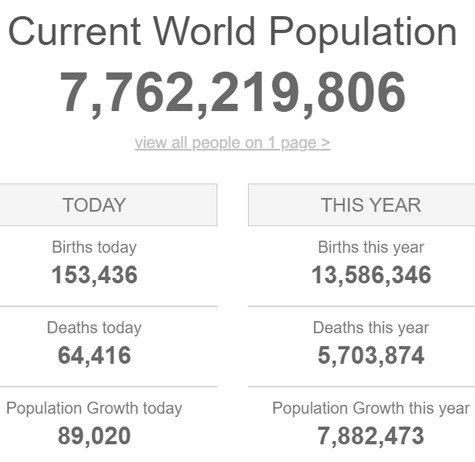
Real Time World Population Growth – Wow!!
Watch as the world population changes every second of the day or see where everyone is.

Knowing exactly what’s happening with the World’s population can be both intriguing and a bit scary at the same time. Just getting one’s head around the rate of increase and where all these people live is a daunting task. But given the issues facing the world today learning a bit more about all its peoples is worth knowing.
Click here to view the interactive information contained in the image below but also click here to see how all these people fit across all the countries of the world.
ATO audits continue to target Lifestyle assets
Around 350,000 high-net-worth taxpayers with lifestyle assets are set to undergo scrutiny from the ATO after it revealed it would obtain five more years of policy details from insurers.

The ATO has today revealed its request to receive a further five years’ worth of policy information from over 30 insurance companies about taxpayers who own marine vessels, thoroughbred horses, fine art, high-value motor vehicles and aircraft.
The request will see the Tax Office’s lifestyle assets data-matching program extended up to 2019–20, with the agency already holding insurance policy information for the 2013–14 and 2014–15 financial years.
Marine vessels over the value of $100,000, motor vehicles worth over $65,000, thoroughbred horses worth over $65,000, fine art over $100,000 per item, and aircraft worth over $150,000 all fall within the ATO’s data-collection scope.
The Tax Office will use this information to form a more complete picture of a taxpayer’s financial situation to ensure they are fulfilling their tax and superannuation reporting obligations.
ATO deputy commissioner Deborah Jenkins said that while the Tax Office anticipates receiving information about assets owned by around 350,000 taxpayers, the data would not be used to initiate automated compliance activity.
“Taxpayers selected for compliance activities are identified through other methodologies. The data is made available to our compliance teams to support their risk profiling of the selected taxpayers. Existence of an insurance policy may or may not prompt the compliance officer to pursue a particular line of inquiry,” Ms Jenkins said.
“If a taxpayer is reporting a taxable income of $70,000 to us but we know they own a $3 million yacht, then this is likely to raise some red flags.
“Regardless of your level of wealth, we all need to pay the correct amount of tax, and this data will allow us to ensure those people who can afford these kinds of items are doing the right thing, along with everyone else.”
The ATO will retain each financial year’s data for five years from receipt of the final instalment of verified data files from the data providers.
Ms Jenkins also noted that aside from helping identify taxpayers who may be understating their income, the data from insurers may be used by the ATO to identify taxpayers who have made capital gains on the disposal of certain assets but who have not declared this to the ATO.
“With high-value assets like fine art, there can be some significant capital gains made when these assets are sold, and capital gains tax may need to be paid on the sale or disposal of these items,” Ms Jenkins said.
The data will also be used by the ATO to identify incorrect goods and services tax (GST) input tax credits where taxpayers are purchasing the assets for purely personal reasons and claiming GST credits as if the item was a business asset.
Self-managed superannuation funds that the ATO suspects may be acquiring lifestyle assets purely for personal enjoyment of the fund’s trustee or beneficiaries are also likely to be looked at by the ATO.
Insurers are required to provide the ATO with policy information where the value of assets is equal to or exceeds the following thresholds:
- Marine vessels $100,000
- Motor vehicles $65,000
- Thoroughbred horses $65,000
- Fine art $100,000 per item
- Aircraft $150,000
Jotham Lian
18 December 2019
accountantsdaily.com.au
Property deduction errors down to ‘lack of understanding’: ATO
A fundamental knowledge gap is continuing to trip property investors up, leading to simple mistakes and heaping pressure on tax agents, the ATO has revealed.

Last year, the ATO singled out rental property deductions as a “top priority” for the agency, with Commissioner of Taxation Chris Jordan claiming that errors were found in almost 90 per cent of returns.
For tax time 2019, the ATO doubled its number of in-depth audits for rental deductions to 4,500, with a specific focus on overclaimed interest, capital works claimed as repairs, incorrect apportionment of expenses for holiday homes let out to others, and omitted income from accommodation sharing.
Speaking on sister title Smart Property Investment’s podcast, ATO acting assistant commissioner of individuals and intermediaries, Adam O’Grady said a vast majority of these errors were down to “simple mistakes” from investors and failing to disclose information to their accountants at tax time.
“What we find when we do review returns and audit people is more often than not, it's a simple mistake or it's a lack of understanding of what they're allowed to do, what they're not allowed to do,” said Mr O’Grady.
“The vast majority of people don't deliberately go out to claim things they shouldn't or obtain refunds. Those that do, finish up in front of the courts and prison and those sorts of things.
“It's really that lack of education, that lack of understanding. So, what we hear stories of when we sort of audit, they walked up to their accountant and said, ‘Oh, here's my income from the real estate agent. Here are my line statements; I don't know about the rest of the expenses,” and just sort of scribble it down on a notepad and paper and say, ‘Oh, look, that's about what I think it is.’”
Mr O’Grady acknowledged that accountants are often at the mercy of their investor clients, noting that they are only as good as the information provided to them by their clients.
“Accountants out there are highly skilled, they understand the tax law, they can really help you, make sure you're structured in the right way and help you set up the proper recording requirements and all those sorts of things. But, they can only do that if you're open and honest with them,” said Mr O’Grady.
“You need to talk to your accountant, explain what you've done, why you've done it, how you've set it up, and then they can give you that right advice. But [if] you don't tell the accountant, they're not giving you the advice you need.”
Sharing economy focus
Mr O’Grady said investors receiving income from short-term rentals through sharing economy platforms such as Airbnb should be aware of the ATO’s new data-matching program that will identify taxpayers who have left out rental income and over-claimed deductions.
“Last calendar year for the first time, we actually collected data off a lot of these platforms, so we can see who rented their property out, for how long, what sort of income they earned from it, and we're working through that data and comparing that to tax returns to understand people that haven't reported that income or haven't reported the full amount, all those sort of things,” said Mr O’Grady.
“What we've been doing with the data we've acquired recently, is actually writing to people and giving them really an opportunity to self-correct their own return.
“It's more in that trying to educate people, that we can see you've got this income, you need to go and fix up your own affairs, and from this point forward, make sure you're reporting correctly,” he added.
“On top of that, we will use the data to audit people. So those, we do have some examples where people are on these platforms renting out 10, 20, 30 properties or rooms across various properties and not reporting on their tax obligations. So for those people, again, we'll take a pretty firm stance.”
Jotham Lian
31 January 2020
smsfadviser.com
There’s still time to move to Single Touch Payroll (STP)
It’s not too late to join the other 550,000 employers who are reporting through Single Touch Payroll (STP), but time is running out.
If you aren’t reporting through STP, you can start by:
- finding a software solution that’s right for you.
- asking for a concession. This could be reporting quarterly at the same time as your activity statement. Eligibility will depend on your circumstances.
- asking for more time if you're not ready.
We understand that it takes time to transition to STP, but there are a range of options to assist your transition. Watch our video of a small business owner's experience transitioning to STP.
If you have been affected by a natural disaster, there is additional support available and we will help you sort out your tax affairs later.
Remember, registered tax agents can help you with your tax.
Find out more about:
ATO
Debate heats up around $10k cash ban bill
Concerns around a bill that will criminalise business cash payments above $10,000 continue to be raised as the industry waits on a parliamentary committee’s final report.

A total of 2,659 submissions were received by the Senate Economics Legislation Committee in the course of its inquiry into the Currency (Restrictions on the Use of Cash) Bill 2019, with the committee recently concluding its latest round of public hearings.
With the committee’s report due this Friday, the Australian Taxpayers’ Alliance has raised the temperature on the proposed measure, labelling it an “attack on economic freedom”.
“A $10,000 restriction on the use of cash would harm small businesses, give more power to corporate banks, and would fail to restrict any criminal activities,” said Australian Taxpayers’ Alliance policy director Emilie Dye.
“Many Australians still use cash and wish to continue using this legal tender for their privacy and security. Banks and electronic payment methods are not always reliable. Look at the bushfire crisis and the thousands of Australians forced to use cash during a natural disaster.”
The bill, which proposes to make it a criminal offence for businesses to make or accept a cash payment of $10,000 or more by introducing penalties of up to two years of imprisonment and a $25,200 fine for individuals, is currently before the Senate and was slated to come into effect from 1 January.
The Australian Small Business and Family Enterprise Ombudsman has also expressed its concerns with the bill, arguing that small businesses should not be disadvantaged in the marketplace where a customer chooses to pay with cash and the record keeping is compliant.
It also argues that regional and remote small businesses and pastoral family enterprises in rural Australia will be disadvantaged due to their lack of reliable access to internet and electronic banking facilities.
The major accounting bodies have been undecided on the measure, with some arguing that the law should not criminalise the use of legal tender, and others believing the cash ban should be extended to all payments.
In particular, CPA Australia has questioned the need to introduce criminal offences and penalties, noting that there are already a number of checks and balances in the system to address illegal activities where cash is involved.
“While we are aware that cash is an enabler of illegal activity, criminalising certain cash transactions in the manner proposed is an unnecessarily harsh response to the problem of avoiding scrutiny by the Commissioner of Taxation and other government agencies,” said CPA executive general manager Dr Gary Pflugrath in his submission to the committee.
“There has also been insufficient reasoning as to why criminal offences are seen as being the most appropriate solution or why the power to set exceptions should be delegated to the minister.
“We remain of the view the policy intent behind this bill would best be achieved by a mix of administrative penalties for breaches, but also incentives for business to move to electronic payment options.”
However, Chartered Accountants Australia and New Zealand (CA ANZ) believes there is merit in the measure, believing it will help level the playing field for small businesses, particularly in industries where cash transactions are common, including the building and construction industry, and motor vehicle sales and repairs.
“In a modern economy where the vast majority have access to, and regularly utilise, online payment arrangements, with cash usage in rapid decline, examples of situations where the cash payment limit will cause actual difficulty in day-to-day transactions are hard to find,” said CA ANZ tax leader Michael Croker.
“Yes, the measure is tough in terms of sanctions, but CA ANZ continues to agree with the simplicity and interoperability rationale for this measure — and the policy arguments more generally — which were articulated so well in the Final Report of the Black Economy Taskforce.”
Jotham Lian
04 February 2020
accountantsdaily.com.au
Client Alert – February 2020

ATO backs down from controversial time limit ruling
In 2018, the ATO issued a controversial draft ruling which took a very strict stance on the four-year time limit for claiming input tax credits and fuel tax credits. The ruling had been used by the ATO to deny input tax credits and fuel tax credits where the Commissioner of Taxation made a decision outside the four-year period on an objection or amendment request, even where the objection or request was made within the period. However, a recent observation by a judge ruling on a related matter has put the ATO’s strict stance in doubt and as a result the ruling (Draft Miscellaneous Taxation Ruling MT 2018/D1) has been withdrawn.
Where the Commissioner makes a decision on an objection or requests for amendment in relation to input tax credits and/or fuel tax credits outside the four-year period but the initial objection or amendment request was lodged within the time limit, the taxpayer will no longer be automatically denied the credits in situations where the decision is in the taxpayer’s favour.
As a result, any taxpayer that the draft ruling has affected is encouraged to contact the ATO.
ATO extends bushfire assistance: lodgments deferred
On 20 January 2020 the ATO announced an extension of the tax assistance package for people impacted by the 2019–2020 bushfires in New South Wales, Victoria, Queensland, South Australia and Tasmania.
Commissioner of Taxation Mr Chris Jordan said the 3.5 million businesses, individuals and self-managed super funds (SMSFs) in the impacted local government areas will have until 28 May 2020 to lodge and pay BAS and income tax returns. This additional time is on top of the two-month extension previously granted.
Additionally, the ATO said it will fast-track any refunds that are due to taxpayers in the impacted regions. For example, businesses expecting a refund as a result of GST credits due to large purchases to replace stock are encouraged to lodge their activity statements at the first opportunity. The ATO will also remit any interest and penalties applied to tax debts since the commencement of the bushfires.
Expansion of Tax Avoidance Taskforce activity
The ATO has recently expanded its Tax Avoidance Taskforce activity to include top 500 private groups, high wealth private groups, and medium and emerging private groups.
The Tax Avoidance Taskforce was originally conceived in 2016 to ensure that multinational enterprises, large public and private business pay the right amount of tax. The Taskforce’s main role is to investigate what the ATO considers aggressive tax avoidance arrangements, including profit shifting.
As a part of the expansion, the ATO now has three “programs” for private groups under the Taskforce’s umbrella: top 500 private groups, high wealth private groups, and medium and emerging private groups. The expansion that will perhaps affect the most taxpayers will be the program covering medium and emerging private groups. This program includes private groups linked to Australian resident individuals who, together with their associates, control wealth between $5 million and $50 million, and businesses with an annual turnover of more than $10 million that are not public or foreign owned and are not linked to a high wealth private group. The ATO estimates this will cover around 97% of the total private group population.
No-cost strategies to increase your super
With all the pandemonium of the new year, your super is probably the last thing on your mind. However, this is precisely the right time to think about implementing some strategies to increase your super for the coming year.
Currently, 5.8 million people in Australia have two or more super accounts. Every year the ATO runs a postcode “lost super” campaign to help raise community awareness. As a consequence of the 2018 campaign, more than 66,000 people consolidated over 105,000 accounts worth over $860 million. For the latest campaign, the ATO has created tables of lost and unclaimed super per state and postcode that anyone can access.
Finding and consolidating your lost super with your active account means you’ll pay fewer management fees and other costs, saving you in the long term.
Another easy way to grow your super is to make sure the super fund that you’re putting your money into is performing well. Recently, the regulator of super funds, the Australian Prudential Regulation Authority (APRA), released “heatmaps” that provide like-for-like comparisons of MySuper products across three key areas: investment performance, fees and costs, and sustainability of member outcomes. While the ultimate purpose of the heatmap is to have trustees with areas of underperformance take action to address it, they can also be an invaluable resource in choosing the right super fund.
TIP: A complete list of the impacted areas is available at www.ato.gov.au/individuals/dealing-with-disasters. If you have been affected by the bushfires in a postcode not currently in the list, you can use the ATO Emergency Support Infoline to ask for tailored help: phone 1800 806 218.
Better protection for consumers: new ASIC powers
In response to the recommendations of the Banking and Financial Services Royal Commission and the ASIC Enforcement Review Taskforce Report, the government has proposed new enforcement and supervision powers for ASIC to restore consumer confidence in the financial system, particularly in relation to financial advice. These new powers include enhanced licensing, banning, warrant and phone tap powers, all designed to ensure that avoidable financial disasters uncovered during the Royal Commission are not repeated again.
While the Banking and Financial Services Royal Commission seems long ago in the minds of many, the people who have been financially affected by dubious practitioners will no doubt carry the scar of mistrust for life. This is precisely why the government has introduced new laws which will give ASIC new enforcement and supervision powers in relation to the financial services sector: to weed out the “bad apples” and restore consumer confidence.
SMSF sole purpose test and fractional investments
To be eligible for superannuation fund tax concessions, self-managed super funds (SMSFs) must be maintained for the sole purpose of providing retirement benefits to members. This is known as the sole purpose test. Failing the test could expose trustees to civil and criminal penalties in addition to the SMSF losing concessional tax treatment.
Previously, it was thought that any benefit provided directly or indirectly to members or related parties of an SMSF from an investment would contravene the sole purpose test. However, a recent Full Federal Court decision will provide some flexibility to trustees on certain investments. The Court decided that an SMSF investment in a fund to acquire a fraction interest in a property to be leased at market rent to the member’s daughter did not breach the sole purpose test.
While the Full Court found the SMSF had not breached the sole purpose test, it ultimately ruled against the trustee, finding that the investment was an in-house asset and breached the 5% limit. Crucially, the ATO warned it may still apply compliance resources to scrutinise whether an SMSF investment in fractional property investments contravenes other legal requirements.
$10,000 cash payment limit: the facts
The proposed $10,000 economy-wide cash payment limit has understandably elicited some confusion. While the proposal is not yet law, once enacted it will be a criminal offence for certain entities to make or accept cash payments of $10,000 or more. This is intended to combat the use of cash in black economy activities.
Chief among the questions is to what extent personal transactions will be included in the limit. The government has now released information outlining the circumstances in which the limit would not apply in relation to personal or private transactions.
Among other categories, payments relating to personal or private transactions (excluding transactions involving real property) would not be subject to the limit. Cash gifts to family members (as long as they are not donations to regulated entities such as charities) and inheritances are likely to be exempt. In other words, it is unlikely you will be prosecuted if you give your family members a lavish cash wedding gift or help your kids with a house deposit that happens to be over $10,000. However, if you occasionally sell private assets (e.g. a used car) you may need to be careful and take reasonable steps to ascertain whether the other party is acting in the course of an enterprise.
Introductory Rates & Interest Free Periods
Consumers are enticed to transfer balances owing on credit cards, but need to be aware of all the costs, not just the benefits.

During the promotion period:-
- a lower interest rate may apply, and/or
- fees, and charges may be lower, or may be waived altogether
The credit provider must take care that consumers are not misled about the details of the offer – The Corporations Act, the ASIC Act and National Consumer Credit Protection Act, are in place to ensure a balanced message and consumers have a realist impression of the overall costs.
If an advertisement includes details of a discounted interest rate, or discounted/waived fees, the advertisement must also make clear with equal prominence, the period for which the discounted rate applies.
The advertisement must also state what the interest rate revers to after the promotional period.
Pose yourself questions such as:-
- can I pay off the debt during the promotional free period?
- will the rate after the promotional period be higher than the current rate?
- can I change my habits to avoid future credit cards interest?
There is no substitute for careful reading or asking for a second opinion from your accountant before you sign up.
AcctWeb
Latest Industry News

How Do I Write Legally Compliant Terms and Conditions for My Business?
Terms and conditions bind your customers only where they actively accept them, so a tick box at checkout holds...

Paid parental leave super contributions have started
From July 2026, the new Paid Parental Leave Superannuation Contribution (PPLSC) has started. From...

If the business is no longer profitable, and is unlikely to be profitable in the future, your best option may...

Check out the this visualization, which tracks the evolution of dietary calorie intake from 1930 to...

Taxpayer given 35% penalty for BAS recklessness
Following an application for a refund of nearly $94,000, the Administrative Review Tribunal has set aside an...

SMEs warned as ATO ramps up tax debt collection
One insolvency specialist has emphasised the importance of small businesses engaging their accountants to stay...

Does Your Small Business Need to Follow AML Privacy Rules?
Compliance with new anti-money laundering (AML) laws may subject your small business to additional privacy...

Don’t get caught out at tax time with your multiples jobs
Picking up a second job, holding multiple part-time roles, or doing gig work is now part of everyday life. But...

Global companies turn to cost-cutting amid ongoing inflation
Rising operating costs and persistent inflation are placing renewed pressure on businesses worldwide, despite...

Warning for early lodger this tax time!
The ATO has a clear message this year: slow down and get it right. Early lodgers are far more likely to make...

ATO no longer treating debt the same as during COVID
One expert has stressed the importance of tax agents reminding their clients that the ATO is no longer as...

The evolution of the world’s languages
Check out the evolution of the world's most spoken languages from 2500 BC to...
Latest Guests News
Newsletter Newslettter We are pleased to supply you with the latest edition of Client Alert, which...