- 234 Balaclava Road, Caulfield North VIC 3161
- contactus@guests.com.au
- (03) 9509 7033
Budget 2020 – At a Glance, Overview, Outlook
These three areas cover all you will need to know but the accompanying two articles cover more specific topics and they might help you better understand how the Budget affects you.

Budget 2020
At a glance
Overview
Economic and fiscal outlook
Appendices
Budget Documents
Federal Government
Temporary home office expenses shortcut extended again
The 80 cents per hour work-from-home deduction method has now been extended for a further three months to the end of the year.

The temporary shortcut method for calculating home office expenses has now been extended to 31 December 2020, after it was due to expire at the end of September.
Taxpayers have been able to apply the 80 cents per hour method since March, after the ATO introduced the temporary method in light of COVID-19 restrictions forcing many workers to adopt remote working practices.
The extension comes as most workers in metropolitan Melbourne continue to be barred from returning to their workplace as the Victorian government works through its reopening roadmap.
The ATO’s updated Practical Compliance Guideline 2020/3 notes that the 31 December end date will be revisited and may be further extended.
Tax & Super Australia tax counsel John Jeffreys welcomed the extension but urged taxpayers to ensure they were not accidentally double dipping on other working-from-home expenses.
“Employees working from home should note that if they use the ATO’s shortcut method for home office expenses, they can’t claim other home office-related items, such as technology, desks, monitors and chairs. It’s a one or the other approach. Some may be mistaken about this,” Mr Jeffreys said.
“Finally, when the ATO outlined its shortcut method, it noted that taxpayers should keep adequate records — diary notes, timesheets or rosters — to substantiate work.
“It’s unlikely the ATO would audit this, but it’s worth employees having this evidence just in case. It could be that significantly higher claim by an employee compared to benchmark claims for same hours worked would be a red flag to the ATO.”
The temporary shortcut method will continue to be supplementary to the 52 cents fixed rate method and the actual cost method of calculating running expenses, with taxpayers able to choose the appropriate method for their circumstances.
View the ATO’s updated PCG 2020/3 here.
Jotham Lian
30 September 2020
accountantsdaily.com.au
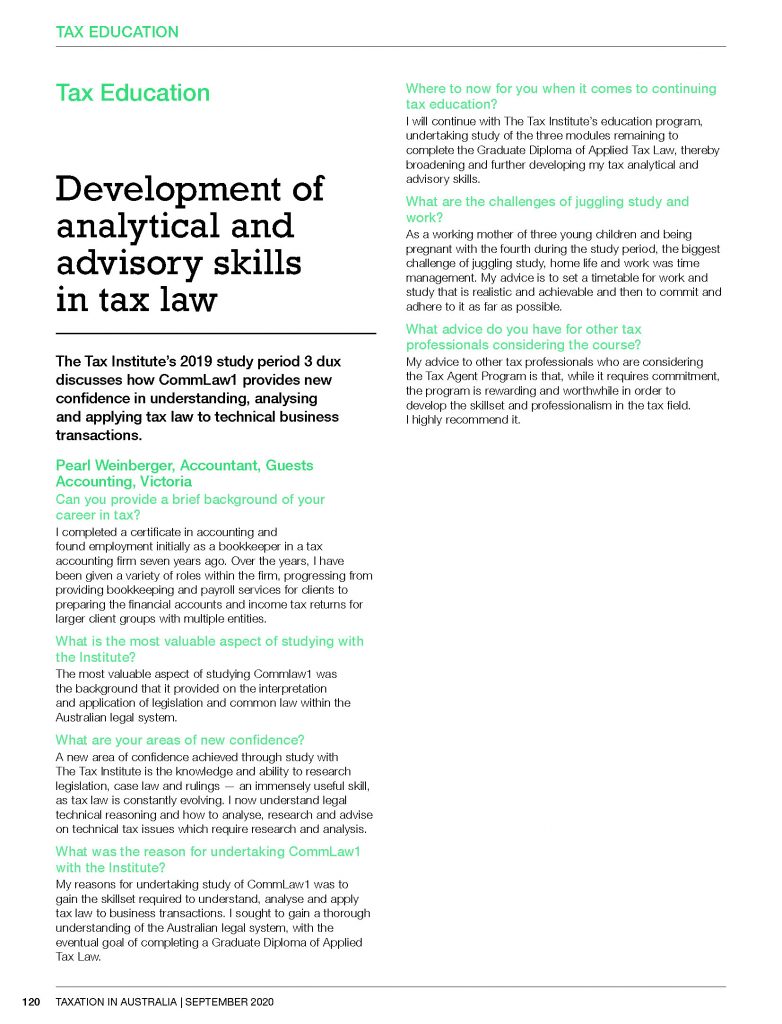
HARD WORK PAYS OFF FOR ONE OF OUR BRIGHT EMPLOYEES
JobKeeper extension – changes implemented
The legislative instrument implementing the changes to the JobKeeper scheme over the extended period was registered on 15 September 2020.

In brief
- The legislative instrument implementing the Government’s changes to the JobKeeper scheme was registered on 15 September 2020
- Entities are now required to reassess their decline in turnover over two set periods
- There are two tier payment rates for JobKeeper based on an 80 hour work/actively engaged test over a specified 28-day period
The extension of JobKeeper applies to qualifying entities in respect of their eligible employees and business participants. The changes in the Rules build more flexibility into the JobKeeper scheme recognising that circumstances can change quickly. Thus, there is the requirement to reassess an entity's actual decline in turnover for two set periods and a two-tiered payment based on hours of work or engagement.
Nevertheless, the changes do not affect any entitlements payable under the original JobKeeper scheme prior to 27 September 2020. Similarly, the changes to do not provide the opportunity for entities to change any elections they have previously made under the JobKeeper scheme.
Reassessing decline in turnover
For an entity to continue to receive the JobKeeper payments over the extended period, the entity must satisfy the actual decline in turnover test (section 8B of the Rules):
- if the JobKeeper fortnight begins before 4 January 2021 – the test must be satisfied for the quarter ending on 30 September 2020
- if the JobKeeper fortnight begins from 4 January 2021 onwards – the test must be satisfied for the quarter ending 31 December 2020.
This mean entities on JobKeeper do not have to satisfy the actual decline in turnover test for both the September quarter and December quarter to be able to receive payments for the JobKeeper fortnights beginning 4 January 2021. Furthermore, according to the explanatory statement to the Rules, an entity that drops out of the JobKeeper scheme after 28 September 2020 and then requalifies in the next period, does not need to notify the Commissioner again that it elects to participate in the scheme.
Actual decline in turnover test
The actual decline in turnover test applies the same thresholds for the original decline in turnover test (i.e. the percentage decline for the quarter must be equal to or greater than 30% for entities with $1 billion or less aggregated turnover and 50% for entities with over $1 billion aggregated turnover) but uses current GST turnover rather than projected GST turnover. According to the explanatory statement, it does not matter for the purposes of the new test whether the entity was required to use a different percentage in applying the original decline in turnover test at an earlier time (e.g. because it applied the original test in the previous income year).
Entities can still use the Commissioner's alternative decline in turnover test (for specified situations where using the 2019 period as a comparison is not appropriate) and the modified decline in turnover test (for group structures with employer entities) in assessing whether they qualify for the JobKeeper scheme – current GST turnover is to be used in place of the projected GST turnover.
New participants
Entities that have not previously participated in the JobKeeper scheme are required to satisfy both the original decline in turnover test and the new decline in turnover test. However, the Rules have modified the original decline in turnover test to give entities the choice to compare the 'projected GST turnover' of:
- a calendar month that ends after 30 September 2020 and before 1 January 2021, or
- the quarter ending 31 December 2020
with a relevant comparison period.
This extension of the testing period ensures that JobKeeper can still be accessed by entities that first experience a significant decline in turnover during the December quarter.
Two tiered payment rate
The Rules sets out two tiers of payment rates for eligible employees and business participants which have not changed from the Government's announcement. To recap:
- Higher rate:
- 28/9/2020 – 3/1/2021 – $1,200
- 4/1/2021 – 28/3/2021 – $1,000
- Lower rate:
- 28/9/2020 – 3/1/2021 – $750
- 4/1/2021 – 28/3/2021 – $650.
However, whether an individual is eligible for the higher rate depends on whether the individual worked or was actively engaged for 80 hours or more for a reference period. Otherwise, the individual is eligible for the lower rate.
Reference period means for (section 4A):
- an eligible employee – 28-day period at the end of the most recent pay cycle for the employee that ended before 1 March 2020 or 1 July 2020
- the eligible business participant – the month of February 2020
Entities applying the 80 hour test for:
- Eligible employees – take into account hours of work, paid leave and paid public holidays
- Eligible business participant – work out the time spent 'actively engaged in the business' and the individual must provide:
- a written declaration (approved form) to the entity to confirm the 80 hours
- if the entity is a sole trader, a notification via the business monthly declaration
If the standard reference period is not suitable, the Commissioner has made a determination, to provide an alternative reference period for the 80 hour test for particular employees.
Employers already on JobKeeper and are eligible for the first extension period can notify the ATO whether their eligible employees are on the higher rate or lower rate in their business monthly declaration in November 2020.
The ATO has allowed employers until 31 October 2020 to meet the wage condition for all employees on JobKeeper for JobKeeper fortnights starting on 28 September and 12 October 2020.
JobKeeper Participants – are “workers”
Although JobKeeper has been in place for many months and is now scaling back, all eligible participants may not have enrolled. The program is targeted to workers in the broad sense.

An “eligible business participant” is an individual who’s not an employee of the business but is actively engaged (i.e. a worker).
The eligible business participant must be an individual, who could be:-
- a sole trader,
- a director of, or shareholder in a company,
- a partner in a partnership, or
- an adult beneficiary of a trust (but not a trustee)
They must be actively engaged in the business, – although recently this does not include providers of childcare.
Even if the business has several people who meet the criteria (e.g. two or three partners or directors), only one can be nominated as the participant.
Whilst there are now continuing reporting obligations, which means you may not always be a “worker”- even a few fortnights JobKeeper receipts can be significant – check your enrolment basis regularly.
AcctWeb
Commissioner registers updated JobKeeper alternative tests
The Commissioner of Taxation has now released the updated alternative decline in turnover tests for the JobKeeper extension.

The Coronavirus Economic Response Package (Payments and Benefits) Alternative Decline in Turnover Test Rules (No. 2) 2020 legislative instrument has now been registered by the commissioner, setting out the revised alternative tests for JobKeeper fortnights from 28 September onwards.
The new alternative tests remain broadly in line with the original, with the same seven circumstances available to entities where there is not an appropriate relevant comparison period in 2019.
These include businesses that started after the comparison period, businesses that acquired or disposed part of the business, and where a business restructure changed the entity’s turnover.
The alternative tests also account for businesses that had a substantial increase in turnover, were affected by drought or natural disaster, have an irregular turnover, and had sole traders or small partnerships that experienced sickness, injury or leave during the comparable period.
A key difference in the updated alternative tests is that current GST turnover is now used in place of projected GST turnover, in line with the basic decline in turnover test for the JobKeeper extension from 28 September.
Knowledge Shop tax director Michael Carruthers told Accountants Daily the new legislative instrument also confirms that the commissioner’s rules in determining the timing of supplies for the JobKeeper decline in turnover tests apply to these new alternative tests.
“This should mean that if an entity is registered for GST, it needs to calculate current GST turnover using the same accounting method that is used for GST reporting purposes (i.e. cash or accruals). Entities that are not registered for GST can choose which method but must use a consistent approach,” Mr Carruthers said.
Changes to the ‘substantial increase in turnover test’
Entities that experienced a substantial increase in their current GST turnover will now be able to choose between using the period immediately before the turnover test period or before 1 March 2020.
“Under the original version of the rules, you had to start by checking if there was an increase in turnover of at least 50 per cent, 25 per cent or 12.5 per cent in the 12, six or three months before the test period,” Mr Carruthers explained.
“While this is still possible under the updated version of this test, an entity can also access the test if there was an increase in turnover of at least 50 per cent, 25 per cent or 12.5 per in the 12, six or three months before 1 March 2020.”
Changes to the ‘irregular turnover test’
A similar change has been made for businesses looking to access the irregular turnover test, with a choice of now using the period immediately before the applicable turnover test period or before 1 March 2020.
“Under the original version of the rules, you started by looking at whether the entity’s lowest turnover quarter was no more than 50 per cent of the highest turnover quarter for the quarters ending in the 12 months immediately before the applicable turnover test period,” Mr Carruthers said.
“However, under the updated version, you look at whether the entity’s current GST turnover for any consecutive three-month period before the applicable test period or 1 March 2020 is no more than 50 per cent of the highest of the entity’s current GST turnover for any other of those three-month periods.”
Changes to multiple disposals, acquisitions and restructures
The new alternative test removes the requirement for entities with multiple acquisitions, disposals and restructures to use the period after the last of the sequential transactions.
Where an entity has had multiple acquisitions, disposals or a sequence of restructure transactions at or after the start of the relevant comparison period but before the applicable turnover test period, the entity may apply these tests to each acquisition, disposal or restructure separately.
Sole trader or small partnership with sickness, injury or leave
The new alternative test for sole traders or partnerships affected by the sole trader or a partner not working for all or part of that period due to sickness, injury or leave has also been updated.
The revised test now uses the current GST turnover for the month immediately before the month in which the sole trader or partner did not work, rather than the turnover for the month immediately after the month in which they returned to work.
ATO web guidance is expected to be published shortly.
View the new alternative tests legislative instrument here.
View the accompanying explanatory statement here.
Jotham Lian
23 September 2020
accountantsdaily.com.au
Varying Pay As You Go (PAYG) Instalments
The first instalment of 2021 income tax, due for quarterly taxpayers on 28th October may be varied down.

If your business or investment income has been affected by covid-19 (or any other factors) and has reduced, the instalment can be varied.
You must make a variation on or before the payment due date. An estimate of tax payable for the year, based on the current circumstances, will result in a reduced instalment.
You can vary instalment amounts multiple times throughout the year, reflecting current income and legislation announcements (e.g. new depreciation write offs, new incentives).
The varied amount will apply for the remaining instalments for the year, or until another variation is made.
Importantly, it should be done before the payment due date – and payment made of the recalculated amount.
An estimate of next years tax payable during this pandemic can be extra-ordinarily difficult, but the Australian Taxation Office have advised that no penalties will be imposed if a best attempt is made, although general interest charges may apply to outstanding PAYG.
AcctWeb
Reminder of Medicare Levy Surcharge (MLS)
A warning to taxpayers who may be considering cancelling private health insurance because of higher premiums starting for many on 1st October 2020.

You could become liable for a surcharge in its place – and have no benefits.
A single taxpayer will be liable for MLS for the number of days you do not have an appropriate level of private patient hospital cover (unless exempt), if your adjusted income was more than $90,000. Taxpayer with spouse or dependent children threshold is joint $180,000.
A couple includes taxpayers living together on a genuine domestic basis.
Income is a complicated calculation with reportable fringe benefits, first home saver super, net financial investment losses, net rental property losses, reportable employer superannuation contributions, deductible personal superannuation contributions, some trust distributions and some superannuation lump sums, included in the calculation.
Private patient hospital cover is provided by registered health insurers for hospital treatment in an Australian hospital or day hospital. Singles must have an excess of $750 or less.
Extras cover (e.g. optical, dental) is not private patient hospital cover.
The single levy is:-
$90,000 + 1%
$105,000 + 1.25%
$1,40,000 + 1.5%
Family income is double these thresholds,
If you have two or more dependent children, the family income is increased by $1,500 for each dependent child after the first child.
Hence, cancelling private health insurance will save the insurance outlay, (with no insurance fund benefits ) but it may increase the tax payable. Do your sums.
And then consider whether your health is something you should insure – even in preference to some other insurance.
AcctWeb
Federal Budget 2020

PERSONAL TAXATION
Personal tax cuts brought forward to 1 July 2020
In the Budget, the Government announced that it will bring forward to 1 July 2020 the personal tax cuts (Stage 2) that were previously legislated in 2018 to commence from 1 July 2022. The Stage 3 tax changes remain unchanged and commence from 1 July 2024, as previously legislated:
- Stage 2 tax rates – was 1 July 2022, now 1 July 2020; and
- Stage 3 tax rates – unchanged; to commence on 1 July 2024, as previously legislated.
The Government will bring forward the Stage 2 personal income tax cuts to 1 July 2020 (from 1 July 2022, as previously legislated in 2018). The Treasurer said this will see more than 11 million taxpayers get an immediate tax cut backdated to 1 July 2020.
From 1 July 2020:
- the top threshold of the 19% personal income tax bracket will increase from $37,000 to $45,000; and
- the top threshold of the 32.5% tax bracket will increase from $90,000 to $120,000.
The new low income tax offset (maximum $700) has also been brought forward to 2020–2021, while the low and middle income tax offset (maximum $1,080) has been retained for 2020–2021.
Mr Frydenberg said more than seven million individuals are expected to receive tax relief of $2,000 or more for the 2020–2021 income year compared with the 2017–2018 tax settings. Low and middle income tax payers will receive relief of up to $2,745 for singles and $5,490 for dual income families.
Stage 3: from 2024–2025
The Stage 3 tax changes remain unchanged and commence from 1 July 2024, as previously legislated. From 1 July 2024, the 32.5% marginal tax rate will be cut to 30% for one big tax bracket between $45,000 and $200,000. This will more closely align the middle tax bracket of the personal income tax system with corporate tax rates. The 37% tax bracket will be entirely abolished at this time under the Government’s already legislated plan.
Therefore, from 1 July 2024, there will only be three personal income tax rates: 19%, 30% and 45%. From 1 July 2024, taxpayers earning between $45,000 and $200,000 will face a marginal tax rate of 30%.
With these changes, around 94% of Australian taxpayers are projected to face a marginal tax rate of 30% or less.
Low income offsets: new LITO brought forward and LMITO retained
The Government announced in the Budget that the new low income tax offset (LITO) will be brought forward to start as from the 2020–2021 income year. The new LITO was intended to replace the existing low income and low and middle income tax offsets as from 2022–2023. Although the existing LITO is scrapped, the low and middle income offset (LMITO) will be retained for 2020–2021.
Bringing forward the new LITO is a consequence of bringing forward to 2020–2021 the tax cuts that were scheduled to start in 2022–2023.
The maximum amount of the new LITO is $700. The LITO will be withdrawn at a rate of 5 cents per dollar between taxable incomes of $37,500 and $45,000 and then at a rate of 1.5 cents per dollar between taxable incomes of $45,000 and $66,667.
The amount of the LMITO is $255 for taxpayers with a taxable income of $37,000 or less. Between $37,000 and $48,000, the value of LMITO increases at a rate of 7.5 cents per dollar to the maximum amount of $1,080. Taxpayers with taxable incomes from $48,000 to $90,000 are eligible for the maximum LMITO of $1,080. From $90,001 to $126,000, LMITO phases out at a rate of 3 cents per dollar.
CGT exemption for “granny flats”
The Budget confirms that the Government will put in place a “targeted” CGT exemption for granny flat arrangements.
Under the measure, CGT will not apply to the creation, variation or termination of a granny flat arrangement providing accommodation where there is a formal written agreement in place. The Budget states that it will apply to arrangements that provide accommodation for “older Australians or those with a disability”. There are no further details as to what constitutes “older” or “disability”.
The exemption will only apply to agreements that are entered into because of “family relationships or other personal ties” and will not apply to commercial rental arrangements.
It is intended that the measure commence from 1 July 2021 (i.e. next financial year), subject to the passage of necessary legislation.
The measure was earlier announced by the Treasurer and Assistant Treasurer on 5 October 2020, the day the Government also publicly released the Board of Taxation’s report on the taxation of granny flat arrangements (the report had been provided to the Government in November 2019). That report recommended the CGT exemption.
First Home Loan Deposit Scheme: additional 10,000 places
The Government will allocate an additional 10,000 places for first home buyers under the existing First Home Loan Deposit Scheme.
Under the existing Scheme, eligible first home buyers can obtain a loan to build a new home or purchase a newly built home with a deposit of as little as 5%. The Scheme provides a Government-backed guarantee equals to the difference between the deposit (of at least 5%) and 20% of the purchase price. Applications can be made as part of the standard home loan application process through participating lenders. The Scheme has already helped almost 20,000 first home buyers.
The Treasurer said eligible first home buyers will also be able to take advantage of the Federal Government’s First Home Super Saver Scheme and HomeBuilder. First home buyers may also be eligible for State and Territory grants and concessions.
The additional 10,000 places under the scheme will be provided from 6 October 2020. The additional guarantees will be available until 30 June 2021.
BUSINESS TAXATION
Small business tax concessions extended to medium businesses
The Budget confirmed the Government’s announcement on 2 October 2020 that a range of tax concessions currently available to small businesses (aggregated annual turnover under $10 million) will be made available to medium sized businesses (aggregated annual turnover of $10 million or more but less than $50 million). The extension of these concessions to medium businesses will be delivered in three phases:
- From 1 July 2020, eligible businesses will be able to immediately deduct certain start-up expenses and certain prepaid expenditure.
- From 1 April 2021, eligible businesses will be exempt from the 47% FBT on car parking and multiple work-related portable electronic devices, such as phones or laptops, provided to employees (note that an FBT exemption for retraining redeployed employees will also apply from 2 October 2020).
From 1 July 2021:
- eligible businesses will be able to access the simplified trading stock rules, remit PAYG instalments based on GDP adjusted notional tax, and settle excise duty and excise-equivalent customs duty monthly on eligible goods;
- The time limit for the ATO to amend income tax assessments will be reduced from four to two years for eligible business for income years starting from 1 July 2021; and
- the ATO power to create a simplified accounting method determination for GST purposes will be expanded to apply to businesses below the $50 million aggregated annual turnover threshold.
The eligibility turnover thresholds for other small business tax concessions will remain at their current levels.
Outright capital assets deduction until 30 June 2022 for most businesses
Businesses with aggregated annual turnover of less than $5 billion will be enable to deduct the full cost of eligible capital assets acquired from 7:30pm AEDT on 6 October 2020 (Budget night) and first used or installed by 30 June 2022.
Full expensing in the year of first use will apply to new depreciable assets and the cost of improvements to existing eligible assets. For small and medium sized businesses (with aggregated annual turnover of less than $50 million), full expensing will also apply to second-hand assets.
Businesses with aggregated annual turnover between $50 million and $500 million can still deduct the full cost of eligible second-hand assets costing less than $150,000 that are purchased by 31 December 2020 under the current instant asset write-off rules. Businesses that hold assets eligible for the $150,000 instant asset write-off will have an extra six months (until 30 June 2021), to first use or install such assets.
Small businesses (with aggregated annual turnover of less than $10 million) can deduct the balance of their simplified depreciation pool at the end of the income year while full expensing applies. The provisions which prevent small businesses from re-entering the simplified depreciation regime for five years if they opt-out will continue to be suspended.
Loss carry-back from 2019–2020, 2020–2021 and 2021–2022
The Government will allow eligible companies to carry back tax losses from the 2019–2020, 2020–2021 or 2021–2022 income years to offset previously taxed profits in 2018–2019 or later income years.
Corporate tax entities with an aggregated turnover of less than $5 billion will be able to apply tax losses against taxed profits in a previous year, generating a refundable tax offset in the year in which the loss is made.
The tax refund will be limited by requiring that the amount carried back to not exceed the earlier taxed profits and to not generate a franking account deficit. The tax refund will be available on election by eligible businesses when they lodge their 2020–2021 and 2021–2022 tax returns.
Companies that do not elect to carry back losses under this measure can carry losses forward as normal.
Instant asset write-off: minor change
The following information sets out the rates and thresholds as they currently operate – but should be read in the context that the instant asset write-off rules are effectively irrelevant for most eligible assets purchased after 6 October 2020 until 30 June 2022. The rules set out three taxpayer categories.
For this reason, businesses with aggregated annual turnover between $50 million and $500 million can still deduct the full cost of eligible second-hand assets costing less than $150,000 that are purchased by 31 December 2020 under the instant asset write-off provisions. The tweak is this: businesses that hold assets eligible for the $150,000 instant asset write-off will have an extra six months, until 30 June 2021, to first use or install those assets.
The new outright deduction rules do not apply to second-hand goods, other than those acquired by small and medium businesses (with aggregated annual turnover of less than $50 million) – who can fully expense costs associated with second-hand goods.
Accordingly, there were no changes to the rules, other than a slight tweaking for costs relating to second-hand goods acquired by large businesses (with annual aggregated turnover between $50 million and $500 million).
Given the largesse of the new outright deduction for capital assets until 30 June 2022, the instant asset write-off rules have become temporarily irrelevant for most taxpayers (those with aggregated annual turnover of less than $5 billion).
Small business entities
Those taxpayers with aggregated turnover of less than $10 million and who satisfy the other tests in Subdiv 328-C of ITAA 1997 can qualify as small business entities for the purpose of the instant asset write-off rules. A depreciating asset is a low cost asset if its cost as at the end of the income year in which the taxpayer starts to use it, or installs it ready for use, for a taxable purpose is less than the relevant threshold: s 328-180.
For small business entities, when the asset is first acquired and first used/installed ready for use, or the amount is included in the second element of cost from:
- 3 April 2019 to 11 March 2020 – the threshold is $30,000
- 12 March 2020 to 31 December 2020 – the threshold is $150,000.
The threshold is due to revert back to $1,000 on 1 January 2021 (although it has not been $1,000 since 2015).
Medium business entities
The next category of taxpayer for instant asset write off purposes is medium sized business entities. This applies to those with an aggregated annual turnover of $10 million or more, but less $50 million.
For medium business entities, when the asset is first acquired and first used/installed ready for use, or the amount is included in the second element of cost from:
- 3 April 2019 to 11 March 2020 – the threshold is $30,000
- 12 March 2020 to 31 December 2020 – the threshold is $150,000.
There was an increase in the threshold from $30,000 to $150,000 when the COVID measures started. The instant asset write-off under s 40-82 will cease to be available to medium businesses from 1 January 2021.
Large business entities
The third category of taxpayer for instant asset write off purposes is large business entities. This applies to those with an aggregated annual turnover of $10 million or more, but less $500 million. The write-off has only been available to such entities while the COVID measures are in place.
For large business entities, when the asset is first acquired and first used/installed ready for use, or the amount is included in the second element of cost from:
- 12 March 2020 to 31 December 2020 – the threshold is $150,000.
to first use or install assets (rather than 31 December 2020). It otherwise ceases on 31 December 2020.until 30 June 2021As noted, taxpayers in this category have
Depreciation rules still relevant
There were no changes to the capital allowance rules in the 2020–2021 Federal Budget. This means that the depreciation rules as currently legislated will not change.
This is not a surprise, given the ability of pretty much all businesses to claim an outright deduction for new asset purchases from 7 October 2020 to 30 June 2022.
Note, though, that as part of its response to the COVID-19 pandemic, the Government had earlier enacted to allow businesses with aggregated turnovers of less than $500 million in an income year to deduct capital allowances for depreciating assets at an accelerated rate. This is a temporary measure – it is due to finish on 30 June 2021.
It is worth revisiting these rules because there may be acquisitions that may fall outside the outright deduction rules but still qualify for depreciation (eg certain second-hand goods). The rules still have an ongoing relevance for acquisitions made on or before 6 October 2020.
Due to the temporary nature of the concession, the measures were enacted in the Income Tax (Transitional Provisions) Act 1997 (TPA).
To be eligible for the accelerated depreciation, the depreciating asset must be (s 40-125 TPA):
- new and not previously held by another entity (other than as trading stock or for the purposes of reasonable testing or trialling) – this excludes most second-hand assets;
- first held on or after 12 March 2020 (a post-11 March 2020 asset); and
- first used or first installed ready for use for a taxable purpose on or after 12 March 2020 and before 1 July 2021.
A depreciating asset will not qualify for the accelerated depreciation if (s 40-120(3) TPA):
- the decline in value of the asset has already been deducted under the instant asset write-off rules;
- the decline in value of the asset is worked out using low-value and software development pools; or
- the decline in value of the asset is worked using Subdiv 40-F of ITAA 1997 (ie certain primary production depreciating assets).
In terms of working out the accelerated depreciation, different rules apply depending on whether or not an entity is using the simplified rules for capital allowances for small businesses.
An entity with aggregated turnover of less than $500 million in the income year that does not use the simplified depreciation rules may deduct an amount at an accelerated rate for qualifying assets. The amount the entity can deduct in the income year the asset is first used or installed ready for use for a taxable purpose is:
- 50% of the cost (or adjustable value where applicable) of the depreciating asset; and
- the amount of the usual depreciation deduction that would otherwise apply but calculated after first offsetting a decline in value of 50%.
A small business entity (with aggregated turnover less than $10 million in the income year) that uses the simplified depreciation rules may deduct an amount equal to 57.5% (rather than 15%) of the taxable purpose proportion of the adjusted value of a qualifying depreciating asset added to the general small business pool in an income year.
Corporate residency test to be clarified
The Government will make technical amendments to clarify the corporate residency test.
The law will be amended to provide that a company that is incorporated offshore will be treated as an Australian tax resident if it has a “significant economic connection to Australia”. This test will be satisfied where both the company’s core commercial activities are undertaken in Australia and its central management and control is in Australia.
The Government said that the corporate residency rules are fundamental to determining a company’s Australian income tax liability. The ATO’s interpretation following the High Court’s decision in Bywater Investments Ltd v FCT (2016) 104 ATR 82 departed from the long-held position on the definition of a corporate resident. The Government asked the Board of Taxation to review the definition in 2019–2020.
This measure is consistent with the Board’s key recommendation in its 2020 report: Review of Corporate Tax Residency and will mean the treatment of foreign incorporated companies will reflect the position prior to the High Court’s decision in Bywater.
The measure will have effect from the first income year after the date of the enabling legislation receives assent, but taxpayers will have the option of applying the new law from 15 March 2017 (the date on which the ATO withdrew Ruling TR 2004/15: Residence of companies not incorporated in Australia — carrying on a business in Australia and central management and control).
FBT exemption for retraining redeployed employees
The Budget confirmed the Government’s announcement on 2 October 2020 that it will provide an FBT exemption for employer-provided retraining and reskilling benefits provided to redundant, or soon to be redundant, employees where the benefits are not related to their current employment.
Currently, FBT is payable if an employer provides training to its employees that is not sufficiently connected to their current employment. For example, a business that retrains their sales assistant in web design to redeploy them to an online marketing role in the business can be liable for FBT. By removing FBT, the Treasurer said employers will be encouraged to retain redundant employees to prepare them for their next career.
The FBT exemption will not extend to retraining acquired by way of a salary packaging arrangement or training provided through Commonwealth supported places at universities, which already receive a benefit, or extend to repayments towards Commonwealth student loans.
In addition, the Government said it will consult on allowing an individual to deduct education and training expenses they incur themselves where the expense is not related to their current employment. In this respect, the Government acknowledged that the current rules, which limit self-education deductions to training related to current employment, may act as a disincentive to individuals to retrain and reskill to support their future employment and career.
The FBT exemption will apply from 2 October 2020.
Note that an FBT exemption from 1 April 2021 will also apply for eligible businesses on car parking and multiple work-related portable electronic devices, such as phones or laptops.
The proposed FBT exemption for retraining employees follows a Senate Committee recommendation calling for eligible outplacement training to be included under the FBT exemption. The interim report by the Senate Select Committee on Financial Technology and Regulatory Technology recently called on the Government to explore the inclusion of eligible outplacement training under the FBT exemption for eligible start-ups.
FBT record-keeping: reducing compliance burden
To reduce the FBT compliance burden, the Government will provide the ATO with the power to allow employers to rely on existing corporate records, rather than employee declarations and other prescribed records, to finalise their FBT returns.
Currently, the FBT legislation prescribes the form that certain records must take and forces employers, and in some cases employees, to create additional records in order to comply with FBT obligations.
This measure will apply from the start of the first FBT year (1 April) after the date the enabling legislation receives assent.
R&D Tax Incentive changes
The Government has announced a number of changes to the R&D tax offset measures contained in the Treasury Laws Amendment (Research and Development Tax Incentive) Bill 2019 and deferred the start date of those measures to income years starting on or after 1 July 2021.
In broad terms, the Bill proposes:
- increasing the R&D expenditure threshold from $100 million to $150 million and making the threshold a permanent feature of the law;
- linking the R&D tax offset for refundable R&D tax offset claimants to claimants’ corporate tax rates plus a 13.5% premium;
- capping the refundability of the R&D tax offset at $4 million per annum; and
- increasing the targeting of the incentive to larger R&D entities with high levels of R&D intensity.
Refundable tax offset increased
For companies with an aggregated annual turnover of less than $20 million, the refundable R&D tax offset will be set at 18.5% above the claimant’s company tax rate (compared to 13.5% in the Bill).
Annual cap on cash refunds abandoned
The Government will not proceed with the measure proposed in the Bill to impose an annual cap on R&D tax offset refunds of $4 million (with any remaining offset amounts being treated as non-refundable carry-forward tax offsets).
The Bill provided an exclusion from the annual cap for eligible expenditure on clinical trials registered as R&D activities. This carve out acknowledged opportunities for growth in the medical technology, biotechnology and pharmaceutical sectors. The Budget Papers do not provide any guidance as to whether clinical trials will be given special recognition by other means under the R&D incentive rules.
R&D intensity bands reduced
For companies with aggregated annual turnover of $20 million or more, the Government will reduce the number of R&D intensity tiers from three to two.
The Bill makes provision for R&D premium offsets (above the company’s tax rate) tied to a company’s incremental R&D intensity (notional deductions/total expenses).
State COVID-19 business support grants: NANE income
The Federal Government announced that the Victorian government’s business support grants for small and medium business will be non-assessable, non-exempt (NANE) income for tax purposes. The Victorian Government announced the grants on 13 September.
The Federal Government will extend this arrangement to all states and territories on an application basis. Eligibility would be restricted to future grants program announcements for small and medium businesses facing similar circumstances to Victorian businesses.
A new power will be introduced in the income tax laws to make regulations to ensure that specified state and territory COVID-19 business support grant payments are NANE income.
Eligibility for this treatment will be limited to grants announced on or after 13 September 2020 and for payments made between 13 September 2020 and 30 June 2021.
JobMaker Hiring Credit
The Budget announced that the Government will provide $4 billion over three years from 2020–2021 to accelerate employment growth by supporting organisations to take on additional employees through a hiring credit. The JobMaker Hiring Credit will be available to eligible employers over 12 months from 7 October 2020 for each additional new job they create for an eligible employee.
Eligible employers who can demonstrate that the new employee will increase overall employee headcount and payroll will receive $200 per week if they hire an eligible employee aged 16 to 29 years or $100 per week if they hire an eligible employee aged 30 to 35 years. The JobMaker Hiring Credit will be available for up to 12 months from the date of employment of the eligible employee with a maximum amount of $10,400 per additional new position created.
To be eligible, the employee will need to have worked for a minimum of 20 hours per week, averaged over a quarter, and received the JobSeeker Payment, Youth Allowance (other) or Parenting Payment for at least one month out of the three months prior to when they are hired.
New jobs created until 6 October 2021 will attract the JobMaker Hiring Credit for up to 12 months from the date the new position is created.
To be eligible, the employee must have received the JobSeeker Payment, Youth Allowance (Other), or Parenting Payment for at least one of the previous three months at the time of hiring.
The JobMaker Hiring Credit will be claimed quarterly in arrears by the employer from the ATO from 1 February 2021. Employers will need to report quarterly that they meet the eligibility criteria.
To attract the JobMaker Hiring Credit, the employee must be in an additional job created from 7 October 2020. To demonstrate that the job is additional, specific criteria must be met, requiring that there is an increase in:
- the business’s total employee headcount (minimum of one additional employee) from the reference date of 30 September 2020; and
- the payroll of the business for the reporting period, as compared to the three months to 30 September 2020.
Employer eligibility
Employers are eligible to receive the JobMaker Hiring Credit if they:
- have an ABN;
- are up to date with tax lodgment obligations;
- are registered for PAYG withholding;
- are reporting through Single Touch Payroll (STP);
- meet the “additionality criteria”;
- are claiming in respect of an eligible employee; and
- have kept adequate records of the paid hours worked by the employee they are claiming the hiring credit in respect of.
Newly established businesses
Newly established businesses and businesses with no employees at the reference date of 30 September 2020 can claim the JobMaker Hiring Credit where they meet the criteria. The minimum baseline headcount is one, so employers who had no employees at 30 September 2020 or whose business was created after this reference date will not be eligible for the first employee hired, but will be eligible for the second and subsequent eligible hires.
Supporting small business and responsible lending
The Budget confirmed that the Government will implement reforms to support consumers and businesses affected by COVID-19 to facilitate Australia’s economic recovery. The reforms are designed to reduce regulatory burden to ensure a timely flow of credit and resolution for distressed business. These include:
- introducing a new process to enable eligible incorporated small businesses in financial distress to restructure their own affairs;
- simplifying the liquidation process for eligible incorporated small businesses;
- support for the insolvency sector;
- introducing a standard licensing regime for debt management firms who represent consumers in dispute resolution processes with credit providers;
- removing duplication between the responsible lending obligations contained in the National Consumer Credit Protection Act 2009 and the Australian Prudential Regulation Authority (APRA) standards and guidance for authorised deposit-taking institutions (ADIs) and establishing a similar new credit framework for non-ADIs;
- enhancing the regulation of small amount credit contracts and consumer leases to ensure that the most vulnerable consumers are protected.
Wage subsidy for new apprentices
The Government will provide a capped 50% wage subsidy to businesses who take on a new Australian apprentice from 5 October 2020 to 30 September 2021.
It will be available to employers of any size or industry, Australia-wide, regardless of geographic location or occupation. There are two important caps:
- it is limited to 100,000 new apprentices or trainees in total; and
- the 50% subsidy will be limited to $7,000 per quarter ($28,000 per annum).
More information can be found on the Department of Education, Skills and Employment website. The payment will be paid in respect of commencing or recommencing apprentices; that is, it will be possible to re-employ former apprentices whose employment had been terminated.
The scheme will run from 5 October 2020 to 30 September 2021. The measure was earlier announced by the Prime Minister on 5 October 2020. The Department of Education, Skills and Employment states that the start date for claims is 1 January 2021; that is, payments will be made in arrears.
SOCIAL SECURITY
$250 cash payments for income support recipients
The Government will pay two $250 economic support payments for eligible income support recipients and concession card holders. The payments will be made from November 2020 and early 2021 to eligible income support recipients and concession card holders, including:
- Age Pension;
- Disability Support Pension;
- Carer Payment;
- Family Tax Benefit, including Double Orphan Pension (not in receipt of a primary income support payment);
- Carer Allowance (not in receipt of a primary income support payment);
- Pensioner Concession Card (PCC) holders (not in receipt of a primary income support payment);
- Commonwealth Seniors Health Card holders; and
- eligible Veterans’ Affairs payment recipients and concession card holders.
The $250 cash payments are tax exempt and will not count as income support for social security purposes. These cash payments follow the two $750 stimulus payments in April and July 2020 for social security and veteran income support recipients and concession card holders.
Paid Parental Leave: alternative work test
The Government announced in the Budget that it is also supporting new parents whose employment was interrupted by the COVID-19 pandemic by introducing an alternative Paid Parental Leave work test period for a limited time.
Under normal circumstances, parents must have worked 10 of the 13 months prior to the birth or adoption of their child to qualify, but that is being temporarily extended to 10 months out of the 20 months for births and adoptions that occur between 22 March 2020 and 31 March 2021. This measure is estimated to allow about 9,000 mothers to regain eligibility for Parental Leave Pay and allow a further 3,500 people to claim Dad and Partner Pay.
SUPERANNUATION
Super reforms: accounts to be stapled to members; best financial interests duty; other
The Government will provide $159.6 million to implement reforms to superannuation to improve outcomes for super fund members.
The Your Future, Your Super package, which will seek to reduce the number of duplicate accounts held by employees as a result of changes in employment and prevent new members joining underperforming funds, includes:
- YourSuper portal – the ATO will develop systems so that new employees will be able to select a superannuation product from a table of MySuper products through the YourSuper portal;
- stapled accounts – an existing superannuation account will be “stapled” to a member to avoid the creation of a new account when that person changes their employment. Future enhancements will enable payroll software developers to build systems to simplify the process of selecting a superannuation product for both employees and employers through automated provision of information to employers;
- MySuper benchmarking – from July 2021, APRA will conduct benchmarking tests on the net investment performance of MySuper products, with products that have underperformed over two consecutive annual tests prohibited from receiving new members until a further annual test that shows they are no longer underperforming. Non-MySuper accumulation products where the decisions of the trustee determine member outcomes will be added from 1 July 2022. The funding for this initiative will be met through an increase in levies on regulated financial institutions; and
- super trustees – best financial interests duty – to improve transparency and accountability of super funds, the Government will legislate to compel super trustees to also act in the best “financial” interests of their members.
The Treasurer said this package of reforms will help improve the $3 trillion superannuation system, and save members $17.9 billion over 10 years, by:
- having an individual’s super follow them – preventing the creation of unintended multiple superannuation accounts when employees change jobs. Instead, an individual’s super will follow them so that a new employer will pay their super contributions into the individual’s existing account;
- making it easier to choose a better fund – members will have access to a new interactive online YourSuper comparison tool which will encourage funds to compete harder for members’ savings. It will show a member’s current super accounts and prompt them to consider consolidating accounts if they have more than one;
- holding funds to account for underperformance – to protect members from poor outcomes and encourage funds to lower costs, the Government will require superannuation products to meet an annual objective performance test. Those that fail will be required to inform members by 1 October 2021. Persistently underperforming products will be prevented from taking on new members; and
- improving transparency and accountability – the Government will increase trustee accountability by strengthening their obligations to ensure trustees only act in the best financial interests of members. The Government will also require super funds to provide better information regarding how they manage and spend members’ money in advance of Annual Members’ Meetings.
All measures will commence by 1 July 2021.
Stapled accounts: how they will work
The first phase of the reforms is proposed to commence on 1 July 2021. Employers will no longer automatically create a new superannuation account in their chosen default fund for new employees when they do not decide on a super fund. Instead, employers will obtain information about the employee’s existing super fund from the ATO, if it is not provided by the employee. The employer will do this by logging onto ATO online services and entering the employee’s details. Once an account has been selected, the employer will pay super contributions into the employee’s account.
The second phase of the reforms will see the ATO provide a new service for employers. As of 1 July 2022, the ATO will enable digital software providers to give employers the option to automate the communications between the employer’s payroll system and the ATO system. Once this new service is adopted, it will remove the need for the employer to manually enter into their payroll system their employees’ superannuation fund details, reducing business administration costs.
Under both phases, if an employee does not have an existing super account (eg is new to the workforce) and does not make a decision regarding a fund, the employer will pay the employee’s super into their nominated default super fund.
Super trustees: best financial interests duty
The Government will legislate to compel super trustees to act in the best financial interests of their members. Consistent with the recommendation of the Productivity Commission to clarify what it means for a trustee to act in members’ best interests, the Government said it will put beyond doubt that trustees must act in the best financial interests of members. The measure seeks to remove ambiguity on how super trustees should be spending members’ money.
It will also give effect to the statement in the Explanatory Memorandum to the Superannuation Legislation Amendment (MySuper Core Provisions) Act 2012 that “RSE [Registrable Superannuation Entity] licensees will have a heightened obligation to act in the best financial interests of members that accept the default option”.
In addition to strengthening the duty owed by trustees, the onus on demonstrating compliance with the new duty will be reversed so that trustees must establish that there was a reasonable basis to support their actions being consistent with members’ best financial interests.
To ensure that the best financial interests duty is complied with by super funds, these changes will be accompanied by anti-avoidance measures, to ensure payments from the super fund to a third party (including an interposed or a related entity) do not undermine the intent of the changes. No materiality threshold will apply to the new duty.
The penalty provisions introduced by the Government under the Treasury Laws Amendment (Improving Accountability and Member Outcomes in Superannuation Measures No 1) Act 2019 will apply for breaches of the new duty for both the trustee and individual directors.
Super Guarantee: no change to rate increase set for July 2021
The Budget did not announce any change to the timing of the next Super Guarantee (SG) rate increase. The SG rate is currently legislated to increase from 9.5% to 10% from 1 July 2021, and by 0.5% per year from 1 July 2022 until it reaches 12% from 1 July 2025.
Prior to the Budget, there was speculation as to whether the Government may consider delaying this legislated SG rate increase in the interest of promoting spending and jobs, at the expense of workers’ retirement savings. Association of Superannuation Funds of Australia (ASFA) modelling has previously suggested that an average income earner aged 30 today, and on a $70,000 salary would have $71,600 less when retiring at 67 if the SG stays at 9.5%.
While the Budget did not announce any change to the start date for the SG rate increase, the Government probably does not need to decide this policy issue until next year’s Federal Budget in May 2021, ahead of the 1 July 2021 legislated change date for the SG rate.
Client Alert – October 2020

COVID-19 and FBT: updated ATO advice
The ATO has updated its COVID-19 and fringe benefits tax (FBT) advice, providing a useful outline of some issues that may arise due to an employer’s response to COVID-19.
Tip: Although the following summary deals with FBT specifically, it is worth thinking through the related income tax consequences. Contact us to find out more.
Working from home devices
Items provided to employees to allow them to work from home (or otherwise offsite) due to COVID-19 will usually be exempt from FBT if they are primarily used by employees for work.
Also, the minor benefits exemption or the otherwise deductible rule may apply if an employer:
- allows an employee to use a monitor, mouse or keyboard that they otherwise use in the workplace;
- provides them with stationery or computer consumables; or
- pays for their phone and internet access.
The minor benefits exemption may apply for minor, infrequent and irregular benefits under $300.
In addition, the otherwise deductible rule may allow an employer to reduce the taxable value of benefits by the amount that an employee can claim as a once-only deduction.
Garaging work cars at employees’ homes, and logbooks
Employers may have been garaging work cars at their employees’ homes due to COVID-19. There may not be an FBT liability depending on:
- the type of vehicle;
- how often the car is driven; and
- the calculation method chosen for car benefits.
Employees’ driving patterns may have changed due to the effects of COVID-19. If an employer uses the operating cost method, it may have an existing logbook. If so, the employer can still rely on this logbook to make a reasonable estimate of the business kilometres travelled. However, the employer can also choose to keep a new logbook that is representative of its business use throughout the year.
The issue of logbooks is also addressed in more detail in the COVID-19 and car fringe benefits fact sheet.
There is also a separate ATO fact sheet on these matters.
Emergency accommodation, food and transport
An employer will not have to pay FBT if it provides emergency accommodation, food, transport or other assistance to an employee where:
- the benefit is emergency assistance to provide immediate relief; and
- the employee is, or is at risk of being, adversely affected by COVID-19.
An employer will also not have to pay FBT for benefits that are considered “emergency assistance”.
Items that help protect employees from COVID-19
An employer may need to pay FBT on items it gives employees to help protect them from contracting COVID-19 while at work. These include gloves, masks, sanitisers and antibacterial spray.
The ATO says, however, that these benefits are exempt from FBT under the emergency assistance exemption if employers provide them to employees who:
- have physical contact with – or are in close proximity to – customers or clients while carrying out their duties; or
- are involved in cleaning premises.
Where employment duties are not of this kind, the minor benefits exemption may apply if an employer provides an employee with minor, infrequent and irregular benefits under the value of $300.
Emergency health care
There is a limited exemption from FBT if an employer provides emergency health care to an employee who us affected by COVID-19.
If an employer pays for its employee’s ongoing medical or hospital expenses, FBT applies. However, if an employer pays to transport an employee from the workplace to seek medical help, that cost is exempt from FBT.
Flu vaccinations for employees working from home
Providing flu vaccinations to employees is generally exempt from FBT because it is work-related preventative health care.
COVID-19 testing
COVID-19 testing also qualifies for the FBT exemption for work-related medical screening, under ceration conditions.
Cancelled events
An employer will not have to pay FBT if it is required to pay non-refundable costs for cancelled events that its employees were due to attend.
However, an employer may have to pay FBT if its employees were required to pay for their attendance at the cancelled event and the employer reimbursed them. This would be an expense payment fringe benefit – unless the otherwise deductible rule applies.
ATO updates on new JobKeeper arrangements
The ATO has also released an array of new and updated information sheets addressing the changes to JobKeeper. Here is a summary of some main points to consider.
Actual decline in turnover test
The ATO states that the actual decline in turnover test can be satisfied in two ways, using:
- the basic test; or
- the alternative test.
The basic test involves the comparison of actual GST turnover for the relevant comparison periods (eg September 2020 to September 2019). Generally, businesses will use the basic test. The option of an alternative test has been made available for some cases where the normal comparison period is not appropriate. There is also a modified basic test for group employer labour entities.
The actual decline test is similar to the “original” decline in turnover test, except that:
- it must be used for specific quarters only;
- actual sales made in the relevant quarter must be used, not projected sales, when working out GST turnover; and
- sales must be allocated to the relevant quarter in the same way a business would report those sales to a particular BAS (if registered for GST).
Decline in turnover tests
The ATO states that existing JobKeeper participants have already satisfied the original decline in turnover test, and do not need to satisfy it again. They do, however, need to satisfy the actual decline in turnover test.
New participants also need to satisfy the actual decline in turnover test. Although they need to satisfy the original decline in turnover test, they will satisfy it if they satisfy the actual decline in turnover test – and they can enrol on that basis.
Employers now unable to claim JobKeeper should notify their eligible employees. Employees should also be advised that the employer is no longer obligated to pay them the amount equivalent to JobKeeper. Those employees will not be eligible to be nominated for JobKeeper by any other entity.
There is no obligation to do monthly reporting during extension period in which an employer is not eligible to receive JobKeeper.
JobKeeper key dates
For the JobKeeper fortnights starting 28 September 2020 and 12 October 2020 only, the ATO is allowing employers until 31 October 2020 to meet the wage condition for all employees included in the JobKeeper scheme. In addition, to claim payment for the September JobKeeper fortnights, employers must have enrolled by 30 September.
80-hour threshold for employees
The ATO states that a full-time employee who has been employed for their full 28-day reference period will usually satisfy the 80-hour threshold.
However, closer examination may be required for eligible employees who are:
- part-time;
- long-term casual;
- not paid on an hourly basis; and/or
- stood down.
If an employee has been stood down, an alternative reference period may apply to them.
Any overtime performed by an employee in the course of their employment in their 28-day reference period will count towards the 80-hour threshold. It is the actual hours of overtime performed that count; that is, if a penalty rate loading applies, it does not increase the number of hours counted.
Eligible employees
Employers cannot claim for employees who:
- were first employed after 1 July 2020;
- left employment before 1 July 2020 (except in limited circumstances);
- have been, or have agreed to be, nominated by another employer (except in limited circumstances); or
- are casual employees, unless they were employed by the employer on a regular and systematic basis during the 12-month period that ended 1 July 2020.
If employees have multiple employers, they can usually choose which employer they want to be nominated by. However, if employees are long-term casuals and have other permanent employment, they must choose their permanent employer. They can’t be nominated for the JobKeeper payment by more than one employer.
Employers must also have given a JobKeeper employee nomination notice to any additional employees who first become eligible on or after 3 August 2020 using the 1 July test. This should have been given to any newly eligible employees by 24 August 2020. If not already done, the ATO says it should be done as soon as possible.
Extended COVID-19 support and relief measures
JobKeeper
The end date of the JobKeeper scheme has now been extended from 27 September 2020 to 28 March 2021, as announced by Prime Minister Scott Morrison on 21 July 2020. The relevant legislation also amends tax secrecy provisions in relation to JobKeeper and extends certain provisions of the Fair Work Act 2009 implemented in response to COVID-19.
From 27 September until March 2021, there will be a two-tiered JobKeeper payment:
- for the December quarter, payments will be reduced from $1,500 to $1,200 per fortnight per employee, or $750 for workers employed for less than 20 hours a week; and
- for the March quarter, payments will be $1,000 per fortnight, or $650 for workers employed for less than 20 hours a week.
The employment reference date has also been extended from 1 March to 1 July 2020 via a change in the statutory rules.
The law now requires that an eligible financial service provider issues a written certificate that relates to a specified employer, stating that the employer satisfied the 10% “decline in turnover test” for the designated quarter applicable to a specified time.
Coronavirus Supplement
The period for payment of the COVID-19 Supplement has now been extended from 25 September to 18 December 2020, but at the reduced rate of $250 per fortnight (down from $550). This measure was announced by Federal Treasurer Josh Frydenberg on 21 July 2020. A further instrument will be made to extend the COVID-19 Supplement from 19 December to 31 December 2020.
The income-free area is temporarily increased to $300 a fortnight for certain JobSeeker Payment recipients for the period 25 September 2020 to 31 December 2020, and the partner income taper rate for JobSeeker Payment recipients has been adjusted.
COVID-19 early release of super
As part of the Economic and Fiscal Update in July 2020, the Government announced that it would extend the application period to allow those dealing with adverse economic effects of COVID-19 to access up to $10,000 of their super (tax-free) for the 2020–2021 year. This has now been achieved, allowing an application via the myGov website to access $10,000 of super until 31 December 2020 (extended from 24 September).
Bankruptcy concessions and director liability safe harbour extension
The Government has announced that it will extend its temporary insolvency and bankruptcy protections until 31 December 2020. Federal Treasurer Josh Frydenberg said that regulations will be made to extend the temporary increase in the threshold at which creditors can issue a statutory demand on a company and the time companies have to respond to statutory demands they receive.
The changes will also extend the temporary relief for directors from any personal liability for trading while insolvent.
ASIC grants hardship relief for withdrawals from frozen funds
The Australian Securities and Investments Commission (ASIC) has announced new relief measures for operators of managed funds to facilitate withdrawals by members who are facing financial hardship during the COVID-19 pandemic.
The conditional relief will apply to all responsible entities (REs) of registered managed investment schemes (MIS) that have become “frozen funds”.
At times of extreme market volatility, some managed funds may need to suspend redemptions and freeze funds to protect the interests of the members as a whole. A fund is frozen when the responsible entity has suspended or cancelled redemptions to prevent withdrawals from destabilising their fund. When a fund is frozen members will generally not have access to their investments for a period of time. This does not necessarily mean that there has been a loss of asset value or that investors will not get their money back eventually.
The relief measures will ease some of the statutory restrictions on REs and improve access to investments by members who meet specific hardship criteria. REs will still have to act in the best interests of members.
Super choice of fund and enterprise agreements
With recent changes to Australia’s superannuation law, the “choice of super fund” regime now extends to employees covered by enterprise agreements and workplace determinations made from 1 January 2021.
Federal Treasurer Josh Frydenberg has said this will allow another 800,000 people to make choices about where their super guarantee contributions are invested, representing around 40% of all employees covered by a current enterprise agreement. The measure was originally announced as part of the Government’s response to the Murray Financial Services Inquiry (FSI) in October 2015.
Super guarantee amnesty now closed
The ATO has reminded employers that the superannuation guarantee (SG) amnesty closed on 7 September 2020. The amnesty enabled employers to self-correct historical SG underpayments, without incurring the normal penalties, for SG shortfalls from 1 July 1992 until 31 March 2018.
Any amnesty applications received by the ATO after 11:59pm on 7 September will not qualify for the amnesty and but instead will be treated as a standard lodgment of a super guarantee charge (SGC) statement.
The ATO will notify late applicants in writing of the quarters that aren’t eligible for the SG amnesty and charge the administrative component ($20 per employee per quarter), also considering whether to remit the additional SGC penalty (up to 200%). A minimum penalty of 100% will apply if the ATO subsequently commences an audit in respect of non-disclosed quarters covered by the amnesty.
The ATO will issue a notice of amended assessment with the increased SGC amount owing. Any SGC payments made after 7 September 2020 are not deductible, even if they relate to SG shortfalls disclosed under the amnesty.
To retain the benefits of the amnesty, the law requires an eligible employer to pay the outstanding SGC amount in full or enter into a payment plan with the ATO. Note that the SGC amount disclosed in an amnesty application must be paid to the ATO (not the employee’s super fund).
Amnesty payments made after 7 September 2020 are not deductible (including amounts paid under a payment plan after 7 September). If an employer is subsequently unable to maintain payments under a payment plan, the ATO will disqualify the employer from the amnesty and remove the amnesty benefits for any unpaid quarters.
Latest Industry News

How Do I Write Legally Compliant Terms and Conditions for My Business?
Terms and conditions bind your customers only where they actively accept them, so a tick box at checkout holds...

Paid parental leave super contributions have started
From July 2026, the new Paid Parental Leave Superannuation Contribution (PPLSC) has started. From...

If the business is no longer profitable, and is unlikely to be profitable in the future, your best option may...

Check out the this visualization, which tracks the evolution of dietary calorie intake from 1930 to...

Taxpayer given 35% penalty for BAS recklessness
Following an application for a refund of nearly $94,000, the Administrative Review Tribunal has set aside an...

SMEs warned as ATO ramps up tax debt collection
One insolvency specialist has emphasised the importance of small businesses engaging their accountants to stay...

Does Your Small Business Need to Follow AML Privacy Rules?
Compliance with new anti-money laundering (AML) laws may subject your small business to additional privacy...

Don’t get caught out at tax time with your multiples jobs
Picking up a second job, holding multiple part-time roles, or doing gig work is now part of everyday life. But...

Global companies turn to cost-cutting amid ongoing inflation
Rising operating costs and persistent inflation are placing renewed pressure on businesses worldwide, despite...

Warning for early lodger this tax time!
The ATO has a clear message this year: slow down and get it right. Early lodgers are far more likely to make...

ATO no longer treating debt the same as during COVID
One expert has stressed the importance of tax agents reminding their clients that the ATO is no longer as...

The evolution of the world’s languages
Check out the evolution of the world's most spoken languages from 2500 BC to...
Latest Guests News
Newsletter Newslettter We are pleased to supply you with the latest edition of Client Alert, which...