- 234 Balaclava Road, Caulfield North VIC 3161
- contactus@guests.com.au
- (03) 9509 7033
Cost of retirement up in December quarter
The cost of retirement for Australians has gone up, with the increases in health insurance and domestic holiday prices, according to the Association of Superannuation Funds of Australia’s (ASFA) latest figures.

The cost of retirement for Australians has gone up, with the increases in health insurance and domestic holiday prices, according to the Association of Superannuation Funds of Australia’s (ASFA) latest figures.
The ASFA’s Standard December 2020 quarterly figures indicate that couples aged around 65 living a comfortable retirement need to spend $62,562 per year and singles $44,224, both up by 0.9 per cent on the previous quarter.
Older retirees are continuing to experience financial pressures, with retirement budgets for those aged around 85, up by around 0.9 per cent from the previous quarter for couples and by around 1.0 per cent for singles.
“COVID-19 impacted on just about every aspect of Australia’s financial and economic conditions. Now, price increases are returning to a more standard pattern following a few quarters of suspension or delay in key costs, such as health insurance premiums,” ASFA deputy chief executive Glen McCrea said.
The ASFA figures revealed health insurance premiums remained unchanged for much of the year, but increased from 1 October by around 3 per cent for many retirees. There are now 2.2 million Australians aged over 65 with private health insurance, up from 2.0 million just three years earlier.
“As a greater number of people ventured out of their homes in search of a meal out or a domestic holiday, we saw price rises in those areas, which is not altogether favourable for retirees on a budget,” Mr Mcrea said.
During the quarter there was a 6.3 per cent increase in the price of domestic holiday travel and accommodation, in response to the opening of state and territory borders (at least for a time) and the commencement of the peak summer period, according to the report.
Western Australian retirees benefitted from a $600 household electricity credit but electricity prices were generally flat elsewhere in the country.
There was also a 1.1 per cent increase in the price of meals out and takeaway foods, in part due to more consumers being able to dine at restaurants.
However, the ASFA noted there are still significant differences in retiree lifestyles compared to the December quarter 2019.
“No retirees are travelling overseas for a holiday with at least some expenditure normally devoted to such recreation activity shifted to purchasing furniture, appliances and home improvements,” Mr Morea said.
“The overall increase in the December quarter All Groups CPI of 0.9 per cent was very similar to the average price increases for retirees. However, there were different factors at work for retirees relative to the overall population. For instance, the retiree budgets are not affected by the significant rises in the price of child care.”
Tony Zhang
04 March 2021
smsfadviser.com
‘Much more complex’: ATO introduces new partnership profit guidelines
The Tax Office has released long-awaited partnership profit guidelines, three years after it first commenced a review of how professional firms engage in income splitting.

The ATO has released draft Practical Compliance Guideline 2021/D2, outlining how partners in law, accounting, engineering, architectural and medical firms should split profits.
The new guidelines, which are set to apply from 1 July this year, come three years after the ATO withdrew its “Assessing the Risk: Allocation of profits within professional firms guidelines” and “Everett Assignment” web material in late 2017.
According to the draft PCG, partners and firms must satisfy two gateways to prove that arrangements are commercially driven, and do not present any high-risk features, to be able to self-assess based on the ATO’s risk assessment methodology made up of three risk zones, namely low risk, moderate risk and high risk.
Failure to satisfy a gateway or falling outside the green risk zone will see the commissioner more likely to give closer scrutiny to the arrangement, including a deeper consideration of whether anti-avoidance provisions apply.
The Institute of Public Accountants general manager of technical policy Tony Greco believes the draft guidelines will present an opportunity for partners to self-assess the risk levels of their arrangements.
“On the one hand, it’s clear in that it’s identifying what [arrangements] are in weighting,” Mr Greco said. “People can sort of self-assess what level of interests their arrangement will attract from the ATO.”
But the density of the guidelines themselves make them a double-edged sword, Mr Greco said, as following them could prove a heavily involved process.
“The previous [guidelines were] nowhere near as granular,” he said. “We just had to satisfy one of the guidelines in the previous allocation and document.
“Now you’ve got to go through gateway one and gateway two, and then self-assess risk. So, it’s a much more involved process.”
The new guidelines will not only require more work from taxpayers, but from the Tax Office, too, expects Mr Greco.
Part IVA of the guidelines offers clear risk assessment criteria, but will test whether people follow the guidelines, and leaves questions to be asked for those who find themselves in high-risk arrangements.
“It’s good from an administration point of view, and puts to the test whether people are applying these guidelines appropriately at the end of the day,” Mr Greco said.
“It poses some questions. If you self-assess and you’re high-risk, what are you going to do about it?”
The draft guidance comes after a group of organisations — including the joint professional accounting bodies — criticised the ATO’s ongoing consultation process on the guidelines which, Mr Greco said, left those it impacted in a “void”.
“You had a lot of consultation happening behind the scenes between that consultation group and the ATO,” Mr Greco said.
“[But] I think what we’ve got to do now is sort of test them in the real world. And this is why it’s in draft format.
“It obviously has input from practitioners, but at the end of the day, it’s the way they would like to identify risks and what falls within and outside of this compliance framework.”
The guidelines and the way they’re applied will be revisited for review in 2022.
View draft PCG 2021/D2 here. Consultation closes on 26 March.
John Buckley
03 March 2021
accountantsdaily.com.au
ATO’s good-faith approach to crypto won’t last much longer
The ATO has maintained its good-faith approach to the accounting of cryptocurrencies, though it isn’t expected to last much longer, says a national tax and accounting network.

Speaking to Accountants Daily, H&R Block director of tax communications Mark Chapman said that now is time for those involved in cryptocurrencies to pay attention to the “tax side of things”, before the ATO ramps up enforcement of undeclared crypto assets.
“I think the first thing to say is that the ATO has, within the last year or so, started gathering data from cryptocurrency exchanges, the actual providers,” he said. “As a result of that, I think the ATO now has a much better understanding of who’s involved in this market.”
While the ATO has been expected to ramp up auditing around cryptocurrencies for the past three years, and hasn’t, its “light touch” isn’t expected to last much longer.
The ATO first showed signs of cracking down on compliance in March last year, when an undisclosed number of letters were sent to taxpayers, warning them to come clean with their capital gains or losses.
“Quite a few clients and non-clients have received these letters from the ATO, flagging that there’s a mismatch in their data,” Mr Chapman said. “And I think that’s prompting a lot of people to come in to see their tax agent, or maybe to see a tax agent for the first time if they’ve been doing it themselves.
“But I’m not convinced that [the ATO’s light-touch approach] will necessarily last forever.
“I think, as the data comes in, as the ATO has a greater awareness of how many people are in this space, they will start to take a slightly firmer line.”
Getting a handle on the crypto landscape
As cryptocurrencies become increasingly embedded in the mainstream, Mr Chapman said, one of the biggest challenges in accounting for them has been that some investors may not know that they need to disclose crypto assets to their accountants.
“I think a lot of advisers need to educate themselves in relation to this as well,” Mr Chapman said. “They need to make sure that when they’re speaking to their clients, they’re asking the question, you know, ‘Have you been involved in buying and selling, or investing in cryptocurrencies over the course of the past year?’”
Though, beyond prompting their clients to disclose their crypto assets, practitioners should see this period as a “warning flag” and familiarise themselves with how cryptocurrencies “actually work”, before the ATO moves forward with compliance action.
“Just getting that understanding of where they fit into the overall picture of people’s investments,” he said. “When you get down to it, the basic tax rules are pretty much the same as they are for other forms of investments.
“[Practitioners] need to understand how to treat cryptocurrency transactions, and maybe compare that to the way other types of transactions are treated, and really get a handle on the kind of records that people have in relation to cryptocurrencies.”
John Buckley
25 February 2021
accountantsdaily.com.au
ATO Small Business Newsroom
Help to keep up with the ATO.

Visiting the ATO's website can be daunting but here is a page that links to information important to small businesses everywhere.
For example:
- Schemes such as Jobkeeper,
- tips on claiming GST credits,
- information on expanding Single Touch Payroll (STP), and
- much more.
Click here to access this resource.
ATO
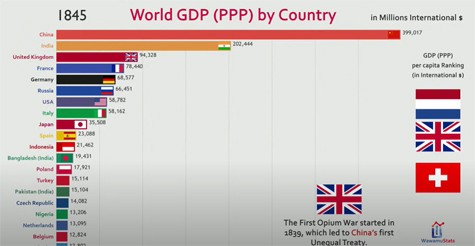
Country GDP 1800 to 2040
The information in this chart is fascinating from both an historical perspective as well as what it predicts. It also guarantees you'll be the BBQ expert every time.
Please click on the following image to view how the world has changed in the past 220 years and how it is expected to change in the next 19.
Small businesses urged to register assets before insolvency explosion.
The Australian Small Business and Family Enterprise Ombudsman (ASBFEO) Kate Carnell says it is essential for small business owners to secure their assets and business loans, with economists predicting a steep rise in insolvencies this year.

Ms Carnell says small businesses need to secure their assets through the Personal Property Securities Register (PPSR) so they are better protected in the event of an insolvency.
“Given the incredibly tough past 12 months we’ve had and predictions of a wave of insolvencies to come, PPSR has never been more important,” Ms Carnell says.
“The greatest pity is that many small businesses find it too difficult to use.”
Releasing ASBFEO’s PPSR Research Paper today, Ms Carnell said the PPSR, if used correctly, is a powerful tool that can deliver significant benefits to small businesses.
“Many small businesses are not aware that correctly registering their interests can save them a world of pain in the long run,” Ms Carnell says.
“So many small businesses have invested heavily in their businesses over the past 12 months, but few know that they can secure these loans, pushing them higher up the security chain if there’s an insolvency.
“More importantly, small businesses that register their interests won’t need to fight tooth and nail to retain title to their goods if a business customer winds up.
The Ombudsman’s research paper found an urgent overhaul of the PPSR system is required to make it accessible to small businesses.
“Unfortunately the PPSR in its current form is not making life easier for small businesses,” Ms Carnell says.
“The name is confusing, the language is overly technical and the operation of the register is very complicated.
“Many small businesses we spoke to said they would need a lawyer to help them register their interests – an additional cost burden for struggling small businesses.
“Put simply – systems and regulations imposed on small businesses by government need to be easy to get right and hard to get wrong. At the moment PPSR is hard to get right and easy to get wrong.
“Our report recommends streamlining the system, including encouraging small business cloud accounting platforms in to provide regtech solutions such as pop-up reminders to small business owners who record a personal loan to the balance sheet, alerting them to register it on the PPSR.
“I urge the government to implement the recommendations in our report, to build a system that works for the small business community and provides them with the certainty they need.
Source: Australian Small Business and Family Enterprise Ombudsman
ASIC sounds warning around high-yield bond scams
The corporate regulator has warned of a rise in scammers targeting Australian investors by pretending to be associated with well-known domestic and international financial service firms.

The high-yield bond scams usually occur after an investor completes an online enquiry form expressing interest in receiving investment advice, often via a third party or comparison site.
Scammers pretend to be associated with well-known domestic and international financial service firms and send professional-looking fake prospectuses with unrealistically high returns.
ASIC also notes that other common tactics include falsely claiming investor funds will be pooled to invest in government bonds or the bonds of companies with AAA credit ratings, and falsely claiming the purchase price of the bonds is protected under the Commonwealth Governments Financial Claims Scheme.
ASIC acting chair Karen Chester has urged investors to be wary of claims that are “too good to be true”, noting that money lost to such scams are hard to retrieve, especially if scammers are based outside Australia.
“Interest rates globally are currently extremely low and expected to remain so for some time. If you see or receive offers of high-yield bonds, they are either high-risk or they may simply be bogus and a scam,” Ms Chester said.
“Investors searching for income-generating investments are at risk of being duped into buying these imposter bonds. Any prospectus offering incredible returns in today’s economic environment is likely to be just that: incredible.
“ASIC warns investors to be sceptical and make proper inquiries before investing.”
Ms Chester has also urged Australian investors to be careful with sharing their personal information online.
“We remind investors to check that they are actually dealing with the company they think they are dealing with,” she said.
“Do not share personal information online unless you can verify who is using the information and how it will be used. We are seeing a rise in suspicious websites that are simply lead generators for scammers.
“Ensuring investment products are true-to-label is front and centre for ASIC. While true-to-label covers all aspects of the investment product being offered, the foundation stone is basic truthfulness, and none more so than that the product issuer is actually who they say they are. This conduct is beyond not being true-to-label; it’s bogus-to-label.”
Jotham Lian
29 January 2021
accountantsdaily.com.au
Victorian Government Circuit Breaker

The State Government has announced details of additional grants. Please read the below documents regarding qualification.
Should you require any assistance, please contact Guests Accounting for guidance
Business Costs Assistance Program
The new Business Costs Assistance Program helps eligible businesses with costs incurred as a result of the circuit breaker action.
For example, businesses may have incurred costs through loss of perishable food or produce and cancelled bookings.
Eligible businesses with an annual payroll of up to $3 million can receive a one-off grant of $2000, whether they have employees or not.
Licensed Hospitality Venue Fund – Circuit Breaker Action Payment
Eligible businesses who received a grant through the Licensed Hospitality Venue Fund will receive a further one-off payment of $3000 to help with costs incurred as a result of the circuit breaker action. Businesses that receive this payment will not be eligible to receive a grant from the Business Costs Assistance Program.
You do not need to apply for this payment. We will contact you with further information.
Victorian Accommodation Support Program
The new Victorian Accommodation Support Program is an expansion of the Regional Tourism Accommodation Support Program and includes tourist accommodation premises in Greater Melbourne. This will support accommodation providers whose bookings were cancelled due to the circuit breaker action to limit the spread of COVID-19.
The $16.2 million Program supports tourism accommodation providers with a grant of one of two tiers of support for those with demonstrated booking cancellations between Friday 12 February and Wednesday 17 February 2021:
- Tier 1: Funding of $2250 (ex GST) per Accommodation Premises experiencing 10 or fewer cancelled nights.
- Tier 2: Funding of $4500 (ex GST) per Accommodation Premises with 11 or more cancelled nights.
The Victorian Accommodation Support Program will open soon. Register your interest in this program now.
Travel Voucher schemes
Two travel voucher schemes will encourage Victorians to travel across the state, as our tourism industry recovers from the impacts of COVID-19 and bushfires.
The schemes include:
- a new Melbourne Travel Voucher Scheme with 40,000 vouchers to support travel in greater Melbourne will launch soon
- an expanded Regional Travel Voucher Scheme with an additional 10,000 vouchers to support travel in regional Victoria
This brings to 200,000 the total number of vouchers offered under the travel voucher schemes.
JobMaker Resources – ATO
All our key resources for the JobMaker Hiring Credit scheme. Included are a User Guide, four Factsheets, Information, a Payment Estimator, and a video.

Please click on the following link to access these resources, plus a new extra Fact Sheet on JobMaker Hiring Credit eligible additional employee.
ATO
Government mulls HECS-style business loans
A HECS-style loan scheme for businesses, currently being considered by the Treasury, would provide a lifeline for many industries recovering from the economic shock of COVID-19, says the small business ombudsman.

According to The Australian, the government is currently considering a revenue-contingent business loan scheme to support businesses after JobKeeper expires at the end of March.
The Australian Small Business and Family Enterprise Ombudsman, Kate Carnell, had previously called for the government to consider such loans, where borrowers start repaying when their turnover reaches a designated level.
Under the ASBFEO’s proposal, the loan would be federal government-funded and capped at a percentage of the small business’s annual revenue.
Applicants would need to satisfy a viability test conducted by an accredited adviser to be eligible.
Ms Carnell said the Treasury’s consideration of such loans was welcome, and would be vital once other government support measures taper off.
“Access to credit will be critical to keeping small businesses afloat as various government support measures are withdrawn, rent relief ends and those overheads start to pile up,” Ms Carnell said.
“We know that many small businesses haven’t been able to fully recover from the COVID crisis, so this targeted support measure could mean the difference between life and death for them.
“Even in the best of times, small businesses have struggled to secure finance. Taking into account the enormous challenges that they are now facing, the impact of insufficient working capital could be devastating for the small business owner and staff, not to mention the broader economy.
“A revenue-contingent loan scheme would give small businesses the confidence they need to seek funding so they can survive and employ again.”
Jotham Lian
05 February 2021
accountantsdaily.com.au
Latest Industry News

How Do I Write Legally Compliant Terms and Conditions for My Business?
Terms and conditions bind your customers only where they actively accept them, so a tick box at checkout holds...

Paid parental leave super contributions have started
From July 2026, the new Paid Parental Leave Superannuation Contribution (PPLSC) has started. From...

If the business is no longer profitable, and is unlikely to be profitable in the future, your best option may...

Check out the this visualization, which tracks the evolution of dietary calorie intake from 1930 to...

Taxpayer given 35% penalty for BAS recklessness
Following an application for a refund of nearly $94,000, the Administrative Review Tribunal has set aside an...

SMEs warned as ATO ramps up tax debt collection
One insolvency specialist has emphasised the importance of small businesses engaging their accountants to stay...

Does Your Small Business Need to Follow AML Privacy Rules?
Compliance with new anti-money laundering (AML) laws may subject your small business to additional privacy...

Don’t get caught out at tax time with your multiples jobs
Picking up a second job, holding multiple part-time roles, or doing gig work is now part of everyday life. But...

Global companies turn to cost-cutting amid ongoing inflation
Rising operating costs and persistent inflation are placing renewed pressure on businesses worldwide, despite...

Warning for early lodger this tax time!
The ATO has a clear message this year: slow down and get it right. Early lodgers are far more likely to make...

ATO no longer treating debt the same as during COVID
One expert has stressed the importance of tax agents reminding their clients that the ATO is no longer as...

The evolution of the world’s languages
Check out the evolution of the world's most spoken languages from 2500 BC to...
Latest Guests News

Newsletter Newslettter We are pleased to supply you with the latest edition of Client Alert, which...