- 234 Balaclava Road, Caulfield North VIC 3161
- contactus@guests.com.au
- (03) 9509 7033
Raids stop $33m in tax avoidance, ATO claims
Charges are pending following an operation with the Australian Federal Police (AFP) that uncovered 70 sales systems using suppression technology.

.
The ATO has stopped an estimated $33 million in tax avoidance after raids on dozens of retailers suspected of using electronic sales suppression tools (ESST).
Conducted with the AFP, the raids recovered 70 point-of-sales systems suspected of using ESST and charges were pending, the ATO said.
The operation was part of a global effort by the Joint Chiefs of Global Tax Enforcement (J5) with the search and seizure action coordinated with similar raids in the US and UK.
ATO deputy commissioner and J5 chief John Ford said: “These dodgy sales suppression tools allow retailers to keep a separate set of books and launder the money in one transaction.
“They conceal and transfer this income anonymously, sometimes offshore.”
Mr Ford said a point of sale system with ESST could change a fine dining experience to read like a fast food snack.
“So what might happen is that the customer orders a $60 steak and a $100 bottle of wine and the ESS tool then puts it through the point-of-sale system as a $10 bowl of chips and a $4 bottle of soft drink,” he said.
“Adding ESST to your point of sale system is a deliberate and underhanded act designed purely to under-report income and avoid tax obligations.”
The ATO said the raids of 35 separate premises nationwide suspected of using ESST had prevented tax avoidance of around $33 million, and investigations with the AFP were ongoing.
Mr Ford said businesses using or promoting this technology were effectively stealing from the Australian community and international co-operation meant thieves could not avoid detection.
“Through the international collaboration, we have access to a global network of intelligence analysts and investigators — it’s only a matter of time before you’re caught by us, or one of our partners,” said Mr Ford.
“We’ve seen ESSTs appear in hardware connected to the point of sales system, cloud-based software, and capability built directly into the software.”
The ATO encouraged businesses using ESST to come forward voluntarily as those that do could be provided with a reduction in penalties.
Josh Needs
13 December 2022
accountantsdaily.com.au
ATO plans publicity campaign for final Work From Home guidance
More demanding record-keeping requirements in the November draft have been in place since 1 January.

The ATO is just days away from publishing its final guidance on work from home (WFH) expense deductions and said it plans a publicity campaign to alert taxpayers to the changes, which have already taken effect.
The tax industry gave the November draft guidance, which proposed substantial changes to the fixed rate method, a harsh reception with criticism of the “opaque” calculations behind the revised fixed rate of 67c and the “demanding” record-keeping requirements.
Under PCG 2022/D4, the more stringent record-keeping regime began on January 1 and many taxpayers are thought to be unaware of the changes.
The ATO said it was finalising the WFH rules after consultation with the tax industry and would launch a publicity campaign at the same time.
“We will be undertaking a range of communications through various channels that will coincide with the publication of the final PCG later this month,” the Tax Office said.
“Communication after publication of the final PCG will be ongoing and continue into the period for lodgement of 2023 income tax returns.
“We are developing supporting materials, including web content and a fact sheet to assist taxpayers and their advisers.”
The ATO failed to say whether it would postpone the tighter record requirements and believed tax agents would want to help communicate the changes.
“We expect that many tax professionals will have their own preferences for how they like to communicate with their clients, and our information and publications will be available to be used by tax professionals to meet these needs,” it continued.
“We acknowledge and appreciate the important role played by tax professionals and industry associations in development of the revised fixed rate for working from home deductions. Many have been involved in our consultation processes and have supported the development of the guidance materials.”
The initial response from the tax industry last November was damning, with the director of tax communications at H&R Block Mark Chapman one of the sternest critics. He said the PCG gave most people Hobson’s choice when it came to work-from-home deductions.
“Claiming ‘actual costs’ isn’t feasible for many taxpayers — the record-keeping obligations are just too high,” he said. “Therefore for millions of people, they will be forced to claim the 67c an hour fixed rate — which could result in a lower deduction and increased paperwork.”
He said the ATO revisions looked sensible “on the face of it” but short changed taxpayers and imposed fresh obligations.
“The amount that can be claimed is low and the compliance obligations are high — the taxpayer not only needs to keep a record of times spent working from home, but also there is a need to keep an invoice/receipt for each of the additional costs, such as an electricity bill. This is new — it never used to be necessary using either of the old fixed rate methods.”
CPA Australia raised the issue in its budget submission and said the fixed rate method required legislation.
“The ATO’s revised fixed rate for WFH expenses is an administrative method and cannot be used as a valid approach at objection where the Commissioner must apply the general principles,” it said.
“To improve certainty and clarity for the ATO and taxpayers, a legislated fixed rate method for WFH expenses should be introduced. This should be similar to the cents per kilometre method for motor vehicle expenses.
“This measure should also address the current uncertainty about the ability to deduct WFH expenses without a dedicated space, absent the revised fixed rate.”
The ATO said the consultation process had resulted in updates to the final PCG and it is understood that a compendium of comments received would also be published.
By Philip King
06 February 2023
accountantsdaily.com.au
Downsizer age reduction now in force
With the eligibility age for downsizer contributions now age 55, the SMSF Association has highlighted some important considerations for younger clients looking to use the measure.

.
With Treasury Laws Amendment (2022 Measures No. 2) Bill 2022 receiving royal assent in mid-December last year, the eligibility age for making downsizer contributions has now been reduced to age 55 as of 1 January this year. The eligibility age was previously 60.
This means that eligible individuals aged 55 years and older can now choose to make a downsizer contribution into their super fund of up to $300,000 per person or $600,000 per couple, from the proceeds of selling their home.
Speaking to SMSF Adviser, SMSF Association deputy chief executive, Peter Burgess, said while the downsizer contributions measure has been a popular measure so far, it remains to be seen what the take-up will be among those under age 60.
Ms Burgess said it’s important that younger clients looking to use this measure are aware that there is only one opportunity to use it.
“For some clients it may be best to wait until they have another opportunity to use it later in life,” he explained.
Given that a downsizer contribution counts against an individual’s total super balance, Mr Burgess warned that making one of these contributions may impact a client’s ability to make contributions in the future.
“So, the timing around when you make a downsizer contribution is very important,” he cautioned.
Where a client is below the age of 65, Colonial First State senior technical manager, Tim Sanderson, previously warned that advisers and their clients also need to carefully consider the preservation age with these contributions.
“They won’t have access to the funds till after they meet a condition of release such as retirement which may not be until age 65,” Mr Sanderson said in a FirstTech podcast.
“You need to be very careful when considering whether or not they may need access to the funds because they may not be able to for up to 10 years.”
Advisers should also consider how much cash the client has to contribute to super and whether making a downsizer contribution is actually a viable strategy, he said.
“For many people, utilising the bring-forward rule and contributing up to $330,000 may be sufficient and allows clients to save their once off ability to make a downsizer contribution for the future,” he explained.
“On the other hand, if a couple has a lot of cash available, it may be advantageous to make a downsizer contribution in addition to a non-concessional contribution. This can be particularly tax effective for individuals who are still working and on a higher marginal tax rate.”
Miranda Brownlee
01 January 2023
smsfadviser.com
Auditor flags knowledge gaps with loans and financial assistance amongst SMSFs.
Loans to members and financial assistance continues to be the most commonly reported type of contravention based on ATO statistics.

Speaking in a recent Accurium webinar, SMSF specialist auditor Frank La Spada noted that loans to members and financial assistance continues to be the most commonly reported type of contravention based on ATO statistics.
Mr La Spada said this is also the case for his firm where loans to members account for more than a third of its reported contraventions.
Section 65 of the Superannuation Industry (Supervision) Act 1993 (SIS Act), he reminded practitioners, prohibits trustees from lending money or providing financial assistance to a member of the fund or a relative of a member.
Mr La Spada said it’s important to be aware that where this does occur, it will be an automatic breach of section 65.
One of the key issues is this area, he said, is that some SMSF professionals and trustees don’t have a thorough understanding of what the definition of a relative is in relation to Section 65.
“We see firms that aren’t really across the definition of a relative. The definition is very broad and includes parents, grandparents, brother, sister, uncle, aunt. It doesn’t include cousins.”
Knowledge of the relatives of a member is therefore critical, he said.
“If you’re aware of that, you’re then going to know when the fund is in breach of the Act.”
Understanding the definition of a loan or financial assistance is equally important, he said.
“A loan is an advancement of money and the loan is considered to have occurred at the time the amount is paid,” he noted.
“Financial assistance is using the resources of the SMSF to give any other form of financial assistance. In other words, anything other than lending money.”
Determining exactly what financial assistance is can be more difficult, he noted.
“The problem that we see is that some firms just aren’t aware of the financial assistance occurring in the first place and then the fund will go to audit where it gets queried and the [practitioner is left] a little blindsided.”
Some examples of financial assistance breaches, he said, include giving a gift of an SMSF asset to a member or relative of a member, selling an SMSF asset for less than its market value to a member or relative of a member and purchasing an asset for greater than its market value from a member or relative of a member.
It can also include forgiving a debt owed to the SMSF by a member or relative of a member or releasing a member or relative or a member from a financial obligation owed to the SMSF, including where the amount is not yet due and payable, he added.
“SMSFR 2008/1 is a really important ruling that provides a range of different examples and case studies of what exactly financial assistance is and what is a loan to a member.”
By Miranda Brownlee
06 February 2023
smsfadviser.com
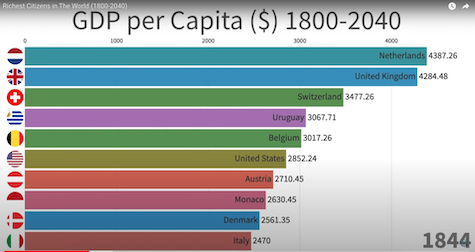
Countries with the highest GDP per capita between 1800-2040
Check out 240 years of countries with the highest GDPs per capita
About the working from home safety and wellbeing checklist
You and your business can still be held responsible for injuries that happen in the home while carrying out work-related duties.

.
So, just as you audit your workplace for OHS issues, you must audit any home workspace used by you or your employees.
In most instances employees can do their own home OHS checks to make sure their workspace complies with the guidelines you set.
Provide all remote-working staff with a copy of this checklist so they can assess their workspaces and fix any potential issues before they start.
business.vic.gov.au
Tips for small business owners
We see common behaviours among small businesses that get their tax right. These tips will help you to pay the right tax.

.
Seek advice and support
A tax professional can help keep you on track and avoid costly mistakes.
Make sure you:
- choose a tax agent or BAS agent who is registered with the Tax Practitioners BoardExternal Link or a reputable bookkeeper
- keep your tax professional in the loop – regular contact will help them understand your business and give you the right advice
- talk to your tax professional or come to us if you’re unsure of something or considering making changes to your business.
Check your business structure
Unnecessarily complex business structures can overcomplicate tax
obligations. Talk to your tax agent to ensure your business structure suits
the needs of your business.
Keep good records
Keeping good records is essential and will make it easier to report to us:
- Talk to your software provider or tax professional to check that your record keeping processes meet current requirements.
- Make sure you conduct regular reconciliation processes by cross-checking figures with your bank statements and source documents (for example, till tapes, tax invoices and receipts).
- Use suitable digital systems to run your business, such as point of sale software, accounting systems and mobile apps. These products can save you time and help you report accurately.
Get your income and expenses right
Ensure what you report is accurate:
- Report all your business income, even if it has been paid in cash, or into a private account. We use data matching and benchmarking to help us identify hidden activities.
- The figures you report need to be exact – so keep up to date records from the start and don't try and ‘guestimate’ after the event.
- Make sure your deductions relate to your business, and that you have the required evidence to support your claims.
ATO targets dodgy deductions for holiday homes
Thousands of dollars in claims “that would fail the pub test” contribute to $1.6bn tax shortfall, assistant commissioner says.

.
Expense claims running to thousands of dollars for occasionally rented holiday homes fail the pub test and will fall foul of the ATO’s crackdown on property deductions, says assistant commissioner Kath Anderson.
She said 2.2 million property owners filed rental expense claims of $42.6 billion in 2021, but full compliance by the sector would add $1.6 billion in revenue and she called on tax agents to help bring owners into line.
“Holiday homes might sound minor in the scheme of things,” Ms Anderson said at last week’s Accountants Daily Strategy Days in Melbourne and Sydney. “But if we applied the pub test, I don't think we would find many Australians would think it's OK for someone to claim thousands – in some cases hundreds of thousands – of dollars in deductions for their holiday home.
“Many of the returns that have errors in them have actually been prepared by agents. Quite often clients are not telling their agents or providing them with all of the information that they should.
“We need your help to educate clients about what is a valid rental deduction and what's not. We also need your help to get the message out there that claiming deductions and effectively taking money from the community to pay for your holiday home is not OK.”
Ms Anderson said rental property claims were high on the ATO’s hitlist for 2022-23 as it attempted to reduce the tax gap – the difference between what is collected and what full compliance would yield – down from $33 billion.
“The gap represents an unfair advantage that those not doing the right thing have over those who are doing the right thing. And in the context of a business, especially a small business, this unfair advantage can be significant.
“As you would expect, integrity and levelling that playing field will continue to be a high priority for us.”
The recent budget had delivered funding to extend the personal income tax compliance program for two years and, as well as rentals, omitted income and work expenses were also key targets.
She said work-related claims accounted for $3.7 billion of the tax gap and while many were “optimistic” characterisations of personal expenses some were more creative, “like the Maltese terrier guard dog or weekends away for stress relief”.
Increasing digitisation of ATO processes was a key feature of the compliance mission but would also make the work of tax agents easier.
“In 2022-23, you'll see us continuing to use data as much as we can. We’ll provide it in prefill will harness advances in digitalisation and data to provide more real time nudges and prompts for income and claims that seems to be a little bit outside of the norm,” she said.
“We've been delivering nudges and individual income tax returns for some time now, but we're also starting to use nudges in relation to GST reporting by delivering those upfront messages for clients that are due to get a refund, just helping them to check their claims before they finish lodging.
“Enabling them to self correct where they've made an error removes the need for follow-up contact from us, which nobody likes.”
As of October, GST lodgement nudge messaging had resulted in corrections of about $57 million and approximately 400,000 individual income tax returns had been fixed up in real time before being finalised.
With lodgement deferrals at a record high number of almost 2 million over the past year, another ATO initiative would make the process smoother.
“We know that the lodgement deferrals process can be an irritant for you,” she said. “We've not only listened, but we've actually taken active steps to address your concerns. A new lodgements deferrals function in online services for agents will be delivered in the first part of 2023.
“I'm sure you'll be happy to hear that a new lodgements deferrals function in Online Services for Agents will be delivered in the first part of 2023. Now this is a digitised version of that current clunky spreadsheet, which is more intuitive lodgement deferral experience and it will also deliver real-time visibility and quicker processing times.”
Philip King
06 December 2022
accountantsdaily.com.au
How crypto assets can trigger CGT tripwires
Lending digital currency can be viewed as disposal while losses from the recent downturn may offer little relief from previous capital gains.

.
In its October 2021 report, the Select Committee on Australia as a Technology and Financial Centre (Senate Report) canvassed the uncertainty and potential harsh tax outcomes presented by cryptocurrencies and other digital assets.
In particular, the Senate Report discussed how the existing tax framework did not contemplate such technology, and as a result, whenever a crypto asset interacts with a protocol where it is swapped, accessed, staked, wrapped, burned or exchanged, CGT event A1 may be triggered.[1]
Regardless of whether you are familiar with these precise terms, the point to note is that when it comes to digital assets, CGT liabilities may be inadvertently triggered in cases where there may have been no underlying disposal, including, for instance, from mere technological upgrades akin to a stock split.[2]
Once triggered, taxpayers cannot rely on CGT rollover relief to mitigate the consequences of this outcome as the strict and limited requirements for rollover do not extend to digital assets.
After outlining these potential tax issues by reference to various submissions, the Senate Report recommended that the CGT regime be amended so that digital asset transactions only create a CGT event when they genuinely result in a clearly definable capital gain or loss.[3]
An example of an inadvertent tax liability – “lending” or “staking” digital assets
By way of example, it may surprise some crypto users that an ATO officer had informally flagged that “lending” digital assets may trigger CGT event A1 (a disposal).[4] So while a “lender” may consider that they continue to hold the “lent” asset”, depending on the particular terms under which it occurs, the “lending” may actually result in a disposal within the meaning of CGT event A1.
Although the latest FTX scandal may have constituted fraud, it serves as a timely reminder of the need to carefully and thoroughly understand how each product/arrangement is governed and what risks exist, including counterparty risk. It is only by carefully analysing the terms of the arrangement and understanding your precise legal rights as the “lender” that the commercial risks and resulting taxation implications can be properly identified.
To this end, the specific terms adopted to conveniently describe an offering may not accurately reflect the actual commercial and legal realities.
To properly understand the tax ramifications of “lending” digital assets, including whether CGT event A1 is triggered, it may be necessary to consider whether the “lender” will continue to hold legal title and/or beneficial title. The analysis of whether ownership is retained can be further complicated in circumstances where the “lender” relinquishes control of the digital assets and subjects it to a self-executing “smart contract”.
Takeaway
It is important not to rely on labels but to properly review the terms of all arrangements and new product offerings to ensure you understand your rights. It is only after doing so that you can properly assess the risks as well as the taxation ramifications.
Digital assets, including bitcoin, are not regarded as currencies and that outcome is about to be enshrined in legislation. As a result, they will likely fall within the CGT regime and they will not be eligible for the Commissioner’s administrative indulgence not to treat them as CGT assets.[5]
Crystallising large capital losses during the latest downturn may be of limited use in mitigating the consequences of having triggered inadvertent capital gains at market highs in earlier income years.
The Board of Taxation is considering the tax treatment of digital assets and is due to report this month.
Jeremy Makowski is special counsel in tax at law firm Cornwalls.
Jeremy Makowski
23 December 2022
accountantsdaily.com.au
The Most Valuable Brands in the World 2000 – 2022
Check out who are the biggest brands in the world.
.

Latest Industry News

How Do I Write Legally Compliant Terms and Conditions for My Business?
Terms and conditions bind your customers only where they actively accept them, so a tick box at checkout holds...

Paid parental leave super contributions have started
From July 2026, the new Paid Parental Leave Superannuation Contribution (PPLSC) has started. From...

If the business is no longer profitable, and is unlikely to be profitable in the future, your best option may...

Check out the this visualization, which tracks the evolution of dietary calorie intake from 1930 to...

Taxpayer given 35% penalty for BAS recklessness
Following an application for a refund of nearly $94,000, the Administrative Review Tribunal has set aside an...

SMEs warned as ATO ramps up tax debt collection
One insolvency specialist has emphasised the importance of small businesses engaging their accountants to stay...

Does Your Small Business Need to Follow AML Privacy Rules?
Compliance with new anti-money laundering (AML) laws may subject your small business to additional privacy...

Don’t get caught out at tax time with your multiples jobs
Picking up a second job, holding multiple part-time roles, or doing gig work is now part of everyday life. But...

Global companies turn to cost-cutting amid ongoing inflation
Rising operating costs and persistent inflation are placing renewed pressure on businesses worldwide, despite...

Warning for early lodger this tax time!
The ATO has a clear message this year: slow down and get it right. Early lodgers are far more likely to make...

ATO no longer treating debt the same as during COVID
One expert has stressed the importance of tax agents reminding their clients that the ATO is no longer as...

The evolution of the world’s languages
Check out the evolution of the world's most spoken languages from 2500 BC to...
Latest Guests News

Newsletter Newslettter We are pleased to supply you with the latest edition of Client Alert, which...