- 234 Balaclava Road, Caulfield North VIC 3161
- contactus@guests.com.au
- (03) 9509 7033
Five questions that indicate how financial literate you are.
Australia has a relatively high level of financial literacy when ranked globally. In a study of 140 economies, Australia ranked in the top 10 countries for financial literacy.

.
Notwithstanding this favourable global performance there is widespread financial illiteracy within Australia, particularly amongst young people. There are also large and significant gender gaps with women, on average, less financially literate than men.
Statistics suggests that around 8.5 million (or 45%) of adults in Australia are financially illiterate.
The following five questions indicate how financial literate you are:
Q1: Interest Rate: “Suppose you put $100 into a no-fee savings account with a guaranteed interest rate of 2% per year. You don’t make any further payments into this account and you don’t withdraw any money. How much would be in the account at the end of the first year, once the interest payment is made?”
Q2: Inflation: “Imagine now that the interest rate on your savings account was 1% per year and inflation was 2% per year. After one year, would you be able to buy more than today, exactly the same as today, or less than today with the money in this account?”
Q3: Diversification: “Buying shares in a single company usually provides a safer return than buying shares in a number of different companies.” [True, False]
Q4: Risk: “An investment with a high return is likely to be high risk.” [True,False]
Q5: Money Illusion: “Suppose that by the year 2024 your income has doubled, but the prices of all of the things you buy have also doubled. In 2024, will you be able to buy more than today, exactly the same as today, or less than today with your income?” or “don’t know”.
NB: To some these questions are easy to answer but remember that research has found that around 8.5 million Australians will struggle to answer all five.
WORKING FROM HOME EXPENSES FOR 2023
If you performed some of your work from your home office during the 2022-2023 financial year, you may be able to claim a deduction for the costs you incurred, even if the space you used is not set aside solely for work-related purposes.

.
CHANGES FOR 2023
To be eligible to claim a deduction for working from home expenses, you must:
- incur additional running expenses as a result of working from home
- be working from home to fulfil your employment duties, not just completing minimal tasks
- keep records at the time you work to prove you incur the cost.
To calculate your working-from-home expenses, you can use the revised fixed rate method or the actual cost method.
REVISED FIXED RATE METHOD
The revised fixed rate method allows you to claim 67 cents per hour you work from home for the expenses listed below. You no longer require a dedicated home office to use this method.
Expenses included in the revised fixed rate are:
- data and internet
- mobile and home phone usage
- electricity and gas
- computer consumables (e.g. printer ink)
- stationery.
You can’t claim a separate deduction for any of the expenses the revised fixed rate includes.
You can claim a separate deduction for:
- the decline in value of assets used while working from home, such as computers and office furniture
- the repairs and maintenance of these assets
- cleaning (only if you have a dedicated home office).
ACTUAL COST METHOD
The actual cost method allows you to claim a deduction for the actual expenses you incur as a result of working from home.
You may be able to claim a deduction for each of the expenses you incur, such as:
- data and internet
- mobile and home phone usage
- electricity and gas
- computer consumables (e.g. printer ink)
- stationery
- the decline in value of assets used while working from home, such as computers and office furniture, as well as any maintenance and repairs of these items
- cleaning (only if you have a dedicated home office).
The actual cost method requires detailed calculations and records. For example, you will need to know and have records of the cost per unit of electricity and the average units used per hour.
These shortcut arrangements do not prohibit people from making a working-from-home claim under existing arrangements, where you calculate all or part of your running expenses.
The ATO will review the special arrangement for the next financial year as the COVID-19 situation progresses.
RECORD KEEPING CHECKLIST
Revised Fixed Rate Method
You will need the following records:
- a record of all the hours you work from home for the entire year (e.g. a timesheet, roster, diary or similar document)
- evidence you paid for the expenses covered by the revised fixed rate method (for example, if you use your phone and electricity when you work from home, keep one bill for each of these expenses).
You will also need records for items you claim as a separate deduction.
From 1 July 2022 to 28 February 2023, the ATO accept a record which represents the total number of hours worked from home (for example a 4 week diary).
From 1 March 2023 onwards, a record of all the hours you worked from home is required.
Actual Cost Method
You will need to keep a record for every expense you claim.
Also, you need the following evidence to show you have incurred additional running expenses:
- receipts, bills or invoices which show the supplier, amount of the expense, nature of the goods, date it was paid and the date of the document
- evidence of your personal and work-related use of the items or services you buy and use.
You can work out your work-related expenses using records for the entire year or over a 4-week period that represents your work use – for example, using a diary or itemised bill.
Decline in Value of Assets and Equipment
You will need records for depreciating assets, that show:
- when and where you buy the item and its cost
- when you started using the item for a work-related purpose
- how you work out your percentage of work-related use, such as a diary that shows the purpose of and use of the item for work
- either:
- a copy of the Commissioner’s Determination of Effective Life you use to work out the decline in value.
- how you work out the effective life if you don’t use the Commissioner’s determination.
- which method you choose to work out the decline in value
OCCUPANCY EXPENSES
Claims for occupancy expenses are allowed only if the home is used as a place of business. Occupancy expenses include rent, mortgage interest, water rates, repairs, house insurance premiums.
The claim can be made as an apportionment of total expenses incurred on a floor area basis.
Warning: Being able to claim theses expenses may affect your ‘main residence exemption’ for capital gains tax purposes if you sell your house in the future.
WHEN IS A HOME A PLACE OF BUSINESS?
The following factors, none of which is necessarily conclusive on its own, may indicate whether, or not, an area set aside has the characteristics of a place of business:
- the area is clearly identifiable as a place of business
- the area is not readily suitable or adaptable for use for private or domestic purposes in association with the home generally
- the area is used exclusively, or almost exclusively, for carrying on a business, or
- the area is used regularly for client or customer visits.
If you use your home to carry out income-producing activities as a matter of convenience, you are not entitled to a deduction for occupancy expenses. It would be rare for an employee to be able to claim occupancy expenses.
Things you can do in our digital office
Our website includes a number of tools and resource that will help us work more closely as well as help you find information needed to keep on top of tax and superannuation issues and changes.

We have always tried to provide resources through our website to help us better cover your tax and superannuation needs. Another aim is to provide one place where you can find information, news and tools that are relevant to your needs. Also, if you have a question then you can use the form and just ask.
Educational videos month videos cover
-
How Interest Rates Affect Your Loans
-
Why Choose an Accountant
-
Cup Of Advice – Inheritance
-
Cloud Based Accounting
-
Planning To Succeed
-
Understanding Estate Planning
Latest news articles. 7-9 articles are added every month and all chosen for their relevance. Our website is a great place to stay informed.
Calculators. A good range of calculators to help you better understand and manage your personal and family financial issues. Four of the more popular are: Compound interest calculator; Pay calculator; Budget Calculator; Loan Calculator, and Super Calculator
Client portals. Portals are quite common on many sites and can be used to store your data, pay bills, log onto investment systems, and more.
Ask us a question at any time. If you have a question on any related topic then don’t hesitate to use a form on our site to ask.
Your information is private and confidential and should be treated that way. Our website includes high levels of security (via SSL certificates) to ensure what you enter stays just between you and us.
Many sites also have a message window feature that displays messages of interest or that cover topics and deadlines you should be aware of.
* Not all are on every website.
Client Alert – July 2023

Key tax considerations this tax time
As the financial year draws to a close, it’s time to start thinking about whether your year-end tax planning is in order. Tax planning requires consideringyour income and deductions for the whole financial year, as well as you’ve met your obligations – for example, whether you’ve made tax-related elections on time and prepared other appropriate documentation and records. Here are some key considerations for this tax time.
Working from home deductions
The shortcut method of claiming a rate of 80 cents per hour worked from home is no longer available – the measure was temporarily introduced during the COVID-19 pandemic and ended on 30 June 2022.
Instead, you can now claim deductions using the revised fixed-rate method, at a rate of 67 cents per hour, as long as you incur deductible expenses while genuinely carrying out work from home, and keep appropriate records, like timesheets for your work hours and receipts for the expenses.
If your work from home doesn’t meet these conditions, you won’t be able to rely on the fixed-rate method and will need to calculate and apportion the actual expenses. You can also simply choose the actual expenses method if it suits your situation better.
The fixed-rate method covers work-related costs like electricity/gas, stationery, your mobile/landline phone and internet. If you use the fixed-rate method you can’t also claim additional deductions for any of these categories. Depreciation of furniture and equipment (eg if you buy a desk, computer and printer for work) may be calculated separately (and in addition) to the fixed rate.
Rental properties and holiday homes
The ATO has flagged rental properties and holiday homes as an area of particular focus for this 30 June.
It’s important to remember that the ATO receives information from sources like sharing economy platforms, rental bond agencies and state and territory revenue authorities that enables it to detect under-reporting of income and inappropriate deduction claims.
Temporary full expensing
The immediate deduction for the cost of eligible depreciating business assets that has been available under the temporary full expensing concession since 2020 is coming to an end. To access the concession, your business must use the depreciating asset or have it installed ready for use by 30 June 2023.
From 1 July 2023, an immediate deduction will only be available to small business entities (with aggregated turnover less than $10 million) for assets costing less than $20,000.
Loss carry-back for corporate tax entities
Subject to certain rules being satisfied, corporate tax entities may be entitled to claim a refundable tax offset by carrying back a tax loss arising in the 2022–2023 income year to one or more of the four previous income years (that is, as far back as 2018–2019).
Deductions for superannuation contributions
For an employer to be entitled to a deduction for superannuation contributions, the contribution must be received by the fund on or before 30 June. The super guarantee contribution rate increased to 10.5% of an employee’s ordinary time earnings from 1 July 2022.
Individuals wishing to claim a deduction for personal contributions must provide their fund with a notice of intention to claim a deduction and have that acknowledged by the fund before the earlier of the day the individual’s tax return is lodged and 30 June of the next income tax year.
Stay alert for tax time scams
The Federal Government has warned of scammers targeting Australians ahead of tax time 2023. The number of scam reports received to date this year has topped 19,843 and impersonation scams are becoming increasingly commonplace. These scams typically consist of unsolicited contact through SMS, email, or on social media offering refunds or help to solve tax issues. The ATO recommends not engaging with any unsolicited contact, ending any conversations as soon as possible and independently looking up the ATO’s number to initiate contact in order to verify any communication is genuine.
Tax time scams typically involve the impersonation of the ATO to obtain personal information or solicit unlawful payment. The common tricks tax scammers are using recently include:
- posing as the ATO on social media and offering to help individuals with tax and super questions, which require the individuals to hand over personal information such as tax file numbers, dates of birth, names, addresses etc;
- luring unsuspecting individuals with an offer of a fake tax refund in return for the provision of personal information;
- initiating conversations via phone, social media private messages, email and SMS, attempting to keep the individual engaged for as long as possible through various means including threats and intimidation, offers to help and so on, to either collect personal information or solicit payment.
Many scammers will use spoofing technology to show a real ATO or Australian phone number in the caller ID or call log. The ATO’s genuine calls will be in fact be shown as No Caller ID. The ATO will also never insist on a conference call with a third party, not even your own tax agent or law enforcement officers.
In terms of SMS and emails, the ATO will never send an unsolicited message asking you to return personal identifying information through these channels. It also does not send links or attachments for you to open or download.
If you think you may have fallen victim to a scam, you should contact your bank or financial institution, make an official report to local police, and report the scam through either the ATO’s phone hotline or its specific scams email address.
Tip: The ATO now has a dedicated team that monitors queries and assists taxpayers who have fallen victim to scammers. You can look up and use the ATO’s phone numbers and other contact details on the official ATO website, www.ato.gov.au.
Small business lodgment amnesty: reminder
The ATO has reminded eligible small business taxpayers to take advantage of the lodgment penalty amnesty program announced in the recent 2023–2024 Federal Budget. The amnesty applies to tax obligations covering income tax returns, business activity statements or FBT returns that were originally due between 1 December 2019 and 28 February 2022. Superannuation obligations and penalties associated with the taxable payments reporting (TPAR) system are not included as a part of the program. The amnesty is running for the period 1 June 2023 to 31 December 2023.
To be eligible for the amnesty, your small business must have had an annual turnover of less than $10 million at the time the original lodgment was due, and lodge the relevant overdue forms and returns during the amnesty period.
Where your eligible business lodges relevant overdue forms and returns during the amnesty period, any associated failure to lodge (FTL) penalties will be proactively remitted – you won’t need to separately request a remission.
Although FTL penalties will be remitted, the ATO emphasises that no other administrative penalties or general interest charge (GIC) amounts will be remitted as a part of the amnesty. So, businesses with an existing debt or that accrue a new debt through late lodgment may still have GIC applied to those debts.
The ATO is also encourages businesses outside of the amnesty to lodge any overdue forms or returns to avoid being classified as “not being actively engaged with the tax system”, which is a red flag that may lead to other action. While FTL and other penalties may apply to those businesses, the ATO will consider the unique circumstances and may remit penalties on a case-by-case basis.
The ATO has a range of support options available for businesses where debts arise out of their lodgment activity, including payment plans, compromise of tax debt, or deferring repayments.
“Buy now pay later” sector facing more regulation
As foreshadowed last year, the “buy now pay later” (BNPL) market will soon be facing more regulation. Assistant Treasurer Stephen Jones recently announced that the government will be moving forward to bring BNPL within the Credit Act’s application to apply a tailored version of the responsible lending obligations to BNPL products.
Late in 2022, the Federal Government released a consultation paper seeking views on options to regulate the BNPL market. The paper outlined three increasingly rigorous options for the regulation of the BNPL market, consisting of: strengthening the BNPL industry code plus an affordability test; limited BNPL regulation under the Credit Act; or full regulation under the Credit Act.
Consultation has since ended, and the Assistant Treasurer has announced that the government will moving forward with law changes to bring in limited BNPL regulation under the Credit Act, applying a tailored version of the responsible lending obligations to BNPL products so that BNPL providers must hold an Australia credit licence or be a representative of a licensee with a requirement to comply with most general obligations, including internal/external dispute resolution, hardship provisions, compensation arrangements and marketing rules.
Under the proposed changes, providers would be required to assess that credit is not unsuitable for an individual, and would be prohibited from increasing a consumer’s spending limit without explicit instructions from that consumer. Fee caps for charges relating to missed or late payments would be required, combined with additional warning and disclosure requirements. Merchants who offer BNPL products to consumers would not be required to be an authorised credit representative of the BNPL provider.
The government will be consulting with the industry and consumer groups in the coming months to bed down the details of the potential legislation. Draft legislation is expected to be released for consultation later this year, and the final Bill is expected to be introduced into Parliament by the end of the year.
Minimum pension payment changes
Retirees who draw an account-based pension from their super need to be aware that the 50% reduction in
the minimum pension drawdown rate for superannuation and annuities which applied for previous years will no longer apply from 1 July 2023.
This temporary measure was introduced by the previous Federal Government as part of its response to the COVID-19 pandemic, which was negatively impacting super and pension/annuity balances.
Most income streams paid from a super account held in an individual member’s name are account-based pensions. These pensions are required to meet minimum standards, including not being able to increase the capital supporting the pension using contributions or rollover amounts once the pension has commenced, and paying a minimum amount at least once a year.
In general, minimum payments need to be made at least once a year and are determined by the age of the beneficiary and the value of the account balance as at 1 July each year. For example, people aged between 65 and 74 will need to apply a 5% standard percentage factor to work out the minimum pension amount for 2023–2024.
While the minimum annual payments are mandated, there are no maximum annual payments, except for transition to retirement pensions which have a maximum annual payment limit of 10% of the account balance at the start of each financial year. This means that retirees can draw a pension above the minimum pension payment amount, which may be especially welcome given the current cost of living pressures.
Tip: With the cost of living going up every day, you may find that your pension arrangment is no longer fit for your lifestyle. Contact us today – we can help you work out the best strategy for your situation.
Key Considerations When Sharing Personal Information with Overseas Contractors
Engaging overseas contractors can be an effective way for businesses to respond to their business needs. However, while there are many advantages to hiring overseas contractors, you must consider this against legal risks, such as the risk of sharing the personal information of Australian individuals with overseas parties.

.
This article considers how you can comply with your privacy obligations under the Australian Privacy Principles outlined in the Privacy Act 1988 (Cth) when disclosing information with overseas contractors.
Are You an APP Entity?
Before sharing information with an overseas contractor, you must determine if you are an APP entity. This distinction is important because if an APP entity shares information overseas and that overseas party breaches the APPs, that breach will be taken to be a breach by the APP entity itself.
For example, suppose your business generates more than $3 million in annual turnover. In that case, it will likely be considered an APP entity and will have obligations under the Privacy Act, including concerning the disclosure of personal information overseas.
Sharing Information With Overseas Contractors
Suppose you are an APP entity. If so, let us explore several precautionary measures you can take when sharing information with your overseas contractors.
1. Privacy Policy
Before sharing information with any third party (including overseas contractors), you should review the terms of your privacy policy to ensure that you have informed your customers that you will share their personal information with overseas contractors.
If you have yet to inform customers of this intended use, you can update your privacy policy and provide notice of this to your customers. You should aim to give your customers at least 30 days’ notice before the privacy policy comes into effect. Accordingly, this will allow your customers to inform you of any issues with your intended use of their personal information before you disclose it.
2. Risk Mitigation
As a best practice, you should only share information essential for your overseas contractors to be able to deliver the services.
When engaging an overseas contractor, consider the following questions.
1. Whether the volume of information you are sharing with the contractor is necessary to enable them to perform the services?
- Tip: As a rule, do not provide the contractor with more personal information than is necessary. The more information you share, the higher the risk of individuals using data in a way that breaches the APPs.
2. What is the nature of the information?
- Tip: You should consider the nature of the information, and whether it is personal or sensitive information. Sensitive data requires a higher level of confidentiality due to its delicate nature.
3. How much access does the contractor have to my existing databases?
- Tip: Ensure that you only provide access to the databases that the contractor needs to perform their services. All other access should be limited or subject to your approval.
3. Contractual Terms
You should ensure that the terms of your contractor agreement impose strong privacy obligations on the contractor, particularly concerning any personal information they receive or have access to during the term.
You can include clauses addressing the following:
- an acknowledgement by the contractor that you are required to comply with the APPs;
- a warranty that the contractor will not breach the APPs;
- an indemnity by the overseas contractor if it breaches the APPs (for example, by disclosing personal information to an unauthorised party); and
- a data breach response plan that includes a straightforward process for reporting a data breach.
Saya Hussain
April 18
legalvision.com.au
Summary of Superannuation Issues and Recent Changes
Recent Issues and changes that could effect you

.
Concessional contributions cap: The annual concessional contributions cap is currently $27,500 per person effective from 1 July 2021.
Making catch-up concessional contributions: From 1 July 2018, a person with an account balance of less than $500,000 is able to make “catch up” concessional contributions by using any unused portion of their concessional contributions cap from the previous five consecutive years.
Division 293 tax: The income threshold after which an additional 15% of tax (making an effective contributions tax rate of 30%) was imposed on the contributions of “high income” earners is currently $250,000.
Spouse contributions: People who make contributions for their spouse are able to claim a tax offset up to $540 per annum (at the rate of 18% up to a maximum of $3,000) where their spouse earns below $37,000.
Non-concessional Contributions (After Tax Contributions):
- The standard annual non-concessional contributions cap is currently $110,000 effective from 1 July 2021.
- If a member’s super balance is above the superannuation balance cap at 30 June in a year currently $1.7m (increased to $1.9m from 1 July 2023), the member is not eligible to make non-concessional contributions in the following year.
- The three year bring forward rule is applied to enable after tax contributions up to three times the standard annual non-concessional cap, i.e. of contributions of up to $330,000 will be permitted at any time if under age 75.
- If a member’s super balance is close to the balance cap amount at 30 June being $1.7m ($1.9m from 1 July 2023) the member is only able to bring forward the $110,000 annual cap for the number of years that would take the member’s balance to the cap amount.
Individuals with super balances at or above the balance cap are only able to increase their overall super balance via concessional contributions and investment growth.
PENSIONS
Retirement phase transfer limits: From 1 July 2017, the total amount a member can “transfer into the retirement phase” was limited to $1,600,000. This was increased to $1,700,000 from 1 July 2021 and to $1,900,000 from 1 July 2023. Earnings arising from a pension account, which cause the account to exceed the cap, may be retained in the “retirement phase” account, but pension payments deducted cannot be replenished. Given this, a strategy of taking out only the minimum amount from pension accounts with supplementary additional amounts being withdrawn from accumulation accounts or withdrawn as commutations from the “retirement phase” accounts should be considered.
MARKET VALUATONS AS AT END OF FINANCIAL YEAR
Current market valuations of all assets were required to be incorporated into the Financial Statements. Valuations for listed investments are readily available. Valuation of unlisted investments, including property investments are required to be arranged as at 30 June 2023, and for following years.
In respect of property investments, the ATO valuation guidelines are not definitive, however it is recommended that at least two valuations from a real estate agent or one from an independent sworn valuer is obtained.
EVENT BASED REPORTING FOR SMSF’S
Self-managed super funds (SMSFs) are subject to a reporting regime relating to the transfer balance cap and event-based reporting framework.
The transfer balance account report (TBAR) is a separate form from the SMSF annual return (SAR). The TBAR enables the ATO to record and track an individual's balance for both their transfer balance cap and total superannuation balance cap.
From 1 July 2023, TBAR’s are required to be lodged for all Funds on a quarterly basis.
RECENT CHANGES TO SUPERANNAUTION
No Work Test
If you are under age 75, from 1 July 2022 you do not have to satisfy the work test in
order to make or receive non-concessional super contributions and salary sacrificed
contributions.
Super Guarantee increase
The rate of super guarantee payable by employers increases from 10.5% to 11.0% of employee wages from 1 July 2023.
Downsize your home and add to your super
From 1 January 2023, people aged 55 or over can make contributions into their super account of up to $300,000 ($600,000 for a couple) using the proceeds from the sale of their main residence. Although these ‘downsizer’ contributions are considered non-concessional (after-tax) contributions, they are in addition to any voluntary contributions made under the current non-concessional contributions cap ($110,000 in 2022/23).
Covid-19 Superannuation Changes
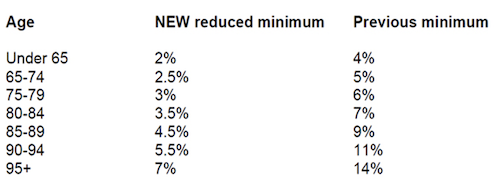
Pension Reductions
There is currently a reduction to minimum pension payments for the 2020/21, 2021/22 and
2022/23 financial years, of 50%, reducing minimum percentages to :
SMSF Investment Strategies
The ATO’s requirements
The guidance and requirements from the ATO are summarized as follows:
Extent of Diversification
The ATO have advised that trustees should consider including in the strategy the extent to which the fund investments are diverse and the risks which could apply from a lack of diversification.
Tailored and specific
The ATO has advised that an investment strategy permitting a range of investments, for all investment categories, of 0-100 % would generally not be acceptable, as it would indicate a lack of proper consideration by the trustee.
They advise that the trustees should consider the personal circumstances of each member and explain how the investment strategy meets the retirement objectives of each member.
Investment strategy compliance
To ensure a fund’s investment strategy meets the requirements of the ATO, it is
recommended that the trustee :
- have a current investment strategy in place;
- review it regularly (at least annually), and in doing so :
- document the personal circumstances of the members including their ages,
- retirement plans, likely future contributions and employment status;
- SUP795830
- consider the likely risk and return of the assets invested in;
- consider the liquidity and cash-flow requirements of the fund;
- consider the ability of the trustee to discharge the liabilities of the fund;
- consider the degree of diversification of the assets invested in; and
- consider whether insurance should be held for the members.
Proposed Super Changes
Pay Day Superannuation
It has been announced that from 1 July 2026, employers will be required to pay their employees’ super at the same time as their salary and wages.
The start date will provide employers, super funds, payroll providers and other parts of the superannuation system with sufficient time to prepare for the change. This measure is not yet law.
Additional 15% tax on earnings where member balances are in excess of $3m.
The proposal is effectively an additional 15% tax on “earnings” on balances (excluding the first $3m), calculated as described below. It is proposed that tax will be able to paid by the Fund, or by the member personally.
The proposed method of calculation is controversial as it includes taxing unrealised capital gains and a negative result is only available to be carried forward.
The proposed start date is 1 July, 2025, and after the next deferral election, so there’s a lot of water to go under the bridge.
Based upon published information, the tax calculation methodology is summarised as follows :
- Closing member balances (CMB) + any withdrawals for the year – any net contributions for year, less opening balance (OB) = earnings (E).
- Percentage of earnings (POE) = CMB less $3m/CMB
- Tax = POE * E * 15%.
Top 50 Greatest Inventions in History
Check out the greatest inventions in human history.

Low productivity threatens inflation outlook, RBA warns
The RBA expects that inflation will return to target in mid 2025 but rising unit labour unit costs presents a significant risk for inflation.

.
The Reserve Bank of Australia is taking a balanced course back to three per cent inflation but has major concerns about low productivity levels driving up unit labour costs, RBA governor Dr Philip Lowe has said.
“Unit labour costs is the difference between wages growth and productivity growth. Wages growth is around 3.75 per cent. Historically, that hasn’t been a problem, that would have been a good number,” Dr Philip Lowe.
However, with productivity growth at a standstill this has led to higher unit labour costs within Australia.
“Over the past three years there has been no increase in the average output produced per hour worked in Australia. There has been no productivity growth for three years,” said Dr Lowe speaking at a Senate Economics Legislation Committee this week.
“So we’ve got wages growth at 3.75 per cent and no productivity growth and that’s an issue I’ve been drawing attention. It’s a problem for the country and an its a problem for the inflation outlook at all.”
Other central banks are facing similar issues with the growth of unit labour costs, according to the Reserve Bank.
“It’s a problem. If you’ve got labour cost growth at 3.5 to 4 per cent. Then it's hard to have 2.5 per cent inflation,” he stated.
“The best solution to this is uplifting productivity growth.”
Dr Lowe said the RBA’s next decision on the cash rate target will depend not only on unit labour costs, but the global economy, inflation expectations and consumer spending.
With many businesses operating in survival mode rather than growth mode during the pandemic, this may have led to a slow down in investment, he said.
“We also saw disruptions were you couldn’t get investment goods and you couldn’t get people. All of those things hurt productivity growth during the pandemic. That’s now behind us so perhaps now we’ll see productivity growth pick up,” he said.
“If there's no productivity growth, then it's hard to have increase in real wages. That's the reality we really have to face.”
Inflation forecast to return to target range in mid-2025
The Reserve Bank is expecting the headline inflation rate to return to 3 per cent by mid-2025.
Dr Lowe said while this is a bit later than other countries, the RBA has consciously made the decision to have a “slower glide path back to target”.
“We want to preserve some of the gains in the labour market that have been achieved,” he said.
“Australia has not reached full employment in four decades and we’ve finally got there. This is one of the positive legacies of the pandemic. Youth unemployment is the lowest it’s been in decades and people have the opportunity to get more hours of work. Getting a job is the easiest it’s been in 50 years.
The RBA will still pursue a course back to 3 per cent inflation but it will be a balance course, said Dr Lowe.
A rebound in inflation for April raises risk of rate hike
The ABS’ Monthly CPI Indicator rose to 6.8 per cent year on year in April from 6.3 per cent year on year in March.
“This was stronger than market expectations for a rise to 6.4,” said AMP chief economist Shane Oliver.
“The Monthly CPI Indicator partly reflects the dropping out of the April 2022 drop in fuel prices due the halving of fuel excise and a 7 per cent rise in April in holiday travel and accommodation which looks to be seasonal due to Easter and school holidays.”
The ABS data showed that new dwelling purchase costs and household furnishing and equipment inflation are continuing to slow but rent inflation is continuing to accelerate and electricity inflation at 15.2 per cent year on year is set to rise further from July.
Dr Oliver said the trend in inflation still remains down.
“Given this along with falling real retail sales and signs of a rising trend in unemployment our base case remains for the RBA to keep rates on hold next week,” he said.
“However, with inflation still very high and upside risks to wages flowing from the upcoming minimum wage increase, the still tight jobs market and faster public sector wages growth the risk of another rate hike is now very high.”
01 June 2023
Miranda Brownlee
accountingtimes.com.au
ATO acts against foreign worker exploitation
The multi-agency operation found documents that allegedly showed the employment of unlawful non-citizens.

.
In a joint operation with several agencies, the ATO has cracked down on foreign worker exploitation after a raid at an ACT home uncovered identity documents and cash.
The operation was run by the Australian Border Force and the ATO as part of the Serious Financial Crime Taskforce (SFCT) with assistance from ACT policing, the AFP, and the Australian Criminal Intelligence Commission (ACIC).
The SFCT targets individuals and businesses suspected of using illegal debt evasion within the construction industry.
The search warrant was executed at the ACT property and revealed identity and financial documents which allegedly showed the employment of unlawful non-citizens and exploitation of foreign workers, along with $82,000 in cash.
ATO deputy commissioner and SFCT chief John Ford said individuals who take part in financial crime activities were often complicit in larger unlawful actions.
“These criminals are motivated by financial gain and their activities rob the Australian public of revenue to support essential services such as health and education,” said Mr Ford.
“This action demonstrates that the SFCT agencies will work together on operational activity that will ultimately bring criminals to account.”
ABF commander of special investigations Penny Spies said the action sent a clear method that the organisation would continue to work side by side to stamp out the illegal practices.
“Dishonest employers in the construction industry often pay workers in cash, meaning employees miss out on entitlements including superannuation,” said Ms Spies. “All workers deserve fair pay and fair treatment.”
“We will continue to disrupt those who seek to exploit foreign workers here in Australia and they will be brought to justice.”
“We will continue to target criminals who want to profit by engaging in visa and migration fraud, money laundering, tax evasion and foreign worker exploitation.”
ACT policing criminal investigations detective Matt Innes said joint operations such as the one carried out had continued to prove effective.
“The information sharing and joint response activity seen in this operation has once again disrupted those who seek to profit from illegal activities they consider victimless,” said Mr Innes.
“The reality is that the workers and the Australian people through unpaid taxation are the victims when this time of illegal activity occurs.”
Josh Needs
31 May 2023
accountantsdaily.com.au
Legal Considerations Around Recording Customers Who Enter My Business
As a business, you may consider installing video surveillance on your premises to discourage theft or ensure the safety of your customers and personnel. However, your business may suffer significant legal implications if you do not adhere to legal requirements around filming or recording customers that enter your store.

.
This article explains the legal requirements around the use of optical surveillance devices. Additionally, it considers the potential consequences of breaching customers’ privacy, as demonstrated by the 7-Eleven case.
Is it Legal to Record Customers Who Enter My Business?
There are certain situations where it is not illegal to collect the personal information of individuals. This includes collecting their images or identity information. Installing optical surveillance devices, such as CCTV, which collect videos or images of customers that enter your business is legal. However, if you elect to record customers through these devices, you must comply with certain laws.
Restrictions
The Privacy Act 1998 (‘Privacy Act’) applies to personal information and governs how businesses can handle their customers’ personal information. The Act will apply to a business if the business:
- has an annual turnover of over $3 million;
- provides a health service, or holds health information;
- is a contractor for the Commonwealth government; or
- trades in personal information (e.g. sells personal information to other parties).
Such businesses will be ‘APP entities’ that must comply with the provisions of the Privacy Act.
Suppose your business is covered under the law. Then any personal information that you collect through your surveillance devices must comply with the Australian Privacy Principles under the Act, which require you to:
- inform customers that you may capture their images before recording takes place. For example, you may post clear signage at the entrance of and throughout your premises, and install cameras in clearly visible locations on your premises to ensure adequate notification to customers that they may be under surveillance;
- ensure that any personal information recorded is stored securely, and either destroyed or de-identified when you no longer require the information. For example, you may delete CCTV footage of customers every month; and
- only use or disclose the information recorded for the primary collection purpose, for example, to seek action against a person who committed theft on your premises (or for a secondary purpose if an exemption applies).
May Preedeesanit
May 11
legalvision.com.au
Latest Industry News

How Do I Write Legally Compliant Terms and Conditions for My Business?
Terms and conditions bind your customers only where they actively accept them, so a tick box at checkout holds...

Paid parental leave super contributions have started
From July 2026, the new Paid Parental Leave Superannuation Contribution (PPLSC) has started. From...

If the business is no longer profitable, and is unlikely to be profitable in the future, your best option may...

Check out the this visualization, which tracks the evolution of dietary calorie intake from 1930 to...

Taxpayer given 35% penalty for BAS recklessness
Following an application for a refund of nearly $94,000, the Administrative Review Tribunal has set aside an...

SMEs warned as ATO ramps up tax debt collection
One insolvency specialist has emphasised the importance of small businesses engaging their accountants to stay...

Does Your Small Business Need to Follow AML Privacy Rules?
Compliance with new anti-money laundering (AML) laws may subject your small business to additional privacy...

Don’t get caught out at tax time with your multiples jobs
Picking up a second job, holding multiple part-time roles, or doing gig work is now part of everyday life. But...

Global companies turn to cost-cutting amid ongoing inflation
Rising operating costs and persistent inflation are placing renewed pressure on businesses worldwide, despite...

Warning for early lodger this tax time!
The ATO has a clear message this year: slow down and get it right. Early lodgers are far more likely to make...

ATO no longer treating debt the same as during COVID
One expert has stressed the importance of tax agents reminding their clients that the ATO is no longer as...

The evolution of the world’s languages
Check out the evolution of the world's most spoken languages from 2500 BC to...
Latest Guests News
Newsletter Newslettter We are pleased to supply you with the latest edition of Client Alert, which...