- 234 Balaclava Road, Caulfield North VIC 3161
- contactus@guests.com.au
- (03) 9509 7033
Federal Government toughens up employment laws.
A change to contract law you might not be away of but need to be. It is essential to understand the unfair contract terms (UCT) regime and how it affects your rights and responsibilities. Otherwise, you may face serious consequences.

In November last year, the Federal Government changed the UCT regime by expanding the small business threshold and introducing financial penalties for contravening the UCT regime. The penalties are significant, with the maximum penalties being the greater of $50 million, 30% of adjusted revenue or 3x the value of the benefit of the UCT (if it can be determined) for a body corporate and $2.5 million for individuals.
While the changes to the UCT regime only come into effect on 9 November 2023, it’s important to start reviewing your standard form consumer and business contracts now for UCTs.
Who do the changes affect?
From 9 November 2023, the UCT protections will apply to a small business contract if one party is a business that:
- employs fewer than 100 people; or
- has a turnover for the last income year of less than $10 million.
What do you need to do?
- If you haven’t already done so, review all consumer and standard form contracts immediately; and
- amend or remove UCTs from these contracts. For example, if you have a clause that allows you to unilaterally terminate the contract for convenience, or a clause that limits your liability (but not the customer’s), consider removing these clauses or making them mutual.
What Makes a Contract Term Unfair?
The definition of an unfair contract term remains unchanged. As a reminder, a contract term will be ‘unfair’ if it:
- causes a significant imbalance in the rights and obligations of the parties;
- is not reasonably necessary to protect the legitimate interests of the business; and
- causes detriment to one party if the other party seeks to rely on it.
Further, this may include terms that enable one party (and not the other) to:
- avoid or limit their obligations under the contract;
- terminate the contract;
- penalise the other party for breaching or terminating the contract; or
- vary the terms of the contract.
What is a Standard Form Contract?
Australian Consumer Law (ACL) does not specifically define ‘standard form’. However, it does provide a framework of factors for courts to consider when determining whether a standard form contract exists. These factors include where:
- one party possesses the bargaining power;
- one party prepares the contract without a discussion between the parties;
- the other party must accept or reject terms on a ‘take it or leave it basis’; or
- the other party does not have an adequate opportunity to negotiate the terms of the contract.
Additionally, some recognisable examples of standard form contracts include:
- mobile phone plans;
- airline sales terms and conditions;
- gym memberships;
- information technology licences; and
- online contracts where the party is required to tick an acceptance box to accept terms and conditions.
Alexandra Perry
Practice Leader
LegalVision.com.au
Practice Leader
LegalVision.com.au
Property investors beware: new data matching program
Individual property investors should be aware that the Australian Taxation Office (ATO) has announced a new data matching program that will obtain data from various financial institutions for the 2021–2022 to 2025–2026 income years

Records relating to approximately 1.7 million individuals will be obtained each financial year and used to identify relevant cases for administrative action, including compliance activities and education strategies.
Recent results of sample audits across individuals conducted under the ATO’s random enquiry program appeared to show a net tax gap of $9 billion for the 2020 income year, with the incorrect reporting of rental property income and expenses being a significant driver of the gap. Specifically, the estimated net tax gap for rental property expenses contributed around $1 billion or 14% of the total individuals gap, with a common driver being the incorrect apportioning of loan interest costs where the loan was refinanced or redrawn for private purposes. Many taxpayers believe that interest deductibility follows the loan security, but it follows the purpose (potentially of every transaction on the loan).
The data providers for the new program include the big four banks (ANZ, Commonwealth, Westpac and NAB), as well as other providers and their subsidiaries, including Adelaide Bank, Bank of Queensland, Bendigo Bank, Bankwest, ING, Macquarie Bank, Suncorp, RAMS, Ubank, St George, Bank of South Australia, Bank of Melbourne and ME Bank. The ATO will be the matching agency and the sole user of the data.
According to the ATO, after a return is lodged, it will use the data collected to identify relevant cases for administrative action including compliance activities and education strategies. If a discrepancy is identified, taxpayers will be contacted by phone, letter or email, and will then have 28 days to respond.
The ATO will also use the data to gain insights to help develop and implement treatment strategies to improve voluntary compliance. The data may also be made available to individual self-preparers through myTax, specifically the rental property schedule interest on loans and/or borrowing expense labels and rental income tax return labels.
AcctWeb
When will we learn to protect ourselves from ourselves?
For years now, Australians have been hacked, scammed, contaminated by viruses, and spammed.

If these forms of robbery were not profitable, they would have stopped by themselves. Unfortunately, it’s the common person who makes them profitable. The Australian government and associated entities that have tried to stop those behind these criminal acts have all failed.
In Russia they call this sort of thing ‘creative marketing’ and there are no rules to stop it.
Australians get scammed out of many millions of dollars every year because highly trained people prey on those bought up to think humanity is basically good.
The internet has made this belief into a real disadvantage by allowing criminals to exploit our naivety over and over again and at almost no cost to them. AI is going to make things worse.
What next?
- Remember: No matter how much you want one, there is no such thing as a ‘free lunch’; a lost and wealthy relative in Nigeria; a long-lost relative who left you a fortune; etc. Even on the very rare occasion there is a win coming your way you won’t be advised via a dodgy call centre or mail system in a poor part of the world.
- Your protection is up to you. A lesson we’ve all had to learn the hard way.
- Government protection has not eased the situation.
- Phone calls. Just hang up, though you might not be able to stop a shout of frustration first.
- E-mails. Never just click on links, always check the send address because a scammer cannot identically replicate the domain name of a legitimate supplier. If you can’t resist, then firstly confirm the offer via at least two other means.
- Don’t let your personal situation lead you to click on a link, reply, or open an attachment.
Given the millions of contacts looking to scam you out of something, the number who lose is very small.
DON’T BE ONE OF THOSE WHO LOSE. If you are in any way concerned just hang up, and keep hanging up.
AcctWeb
Intergenerational Report 2023
Australia’s future to 2063.

Overview:
Powerful forces will continue to shape Australia’s economy over the coming decades including population ageing, expanded use of digital and data technology, climate change and the net zero transformation, rising demand for care and support services, and increased geopolitical risk and fragmentation. These forces will influence the future path and structure of our economy and change how Australians live, work, and engage with the world.
By 2062–63, the economy is projected to be around two and a half times larger and incomes 50 per cent higher in real terms. However, like other advanced economies, Australia’s economic growth is projected to be slower than in the past 40 years. This is driven by lower projected population growth and reduced participation due to ageing, along with an assumption of slower long-run productivity growth. The economy is projected to grow by an average of 2.2 per cent per year in real terms over the next 40 years compared to 3.1 per cent over the past 40 years.
Slower economic growth will place pressure on the tax base at a time of rising costs, creating a long-term fiscal challenge. Despite recent improvements in Australia’s fiscal position, debt-to-GDP remains high by historical standards. Long-term spending pressures are also rising across health, aged care, the National Disability Insurance Scheme (NDIS), defence and interest on government debt. Gross debt is projected to decline from historical highs before rising again from the late 2040s to reach 32.1 per cent of gross domestic product (GDP) by 2062–63.
Australia’s ability to meet challenges while seizing future opportunities depends on choices today. The Government is repairing the budget, while also making the critical investments and productivity reforms necessary to grow the economy. This will position Australia to take maximum advantage of emerging technologies and the transformation to net zero. The Government is also investing in people, sustainably providing essential care and support services, expanding opportunity and addressing disadvantage, and continuing to position the nation’s diplomatic and defence capability for regional security.
Read the full report here
24 August 2023
2023 Intergenerational Report
treasury.gov.au
Superannuation and independent contractors: fresh Full Federal Court guidance
In February 2022, the High Court handed down a landmark decision in ZG Operations v Jamsek, which clarified the test for determining whether a worker is an employee or an independent contractor.

The High Court remitted the question of whether the workers were “employees” under the extended definition of that term in s 12(3) of the Superannuation Guarantee (Administration) Act 1992 (the SGA Act) back to the Full Federal Court.
In deciding that the relevant workers were not “employees” under the extended definition in s 12(3), the Full Federal Court determined that s 12(3) does not apply to an independent contractor relationship where the worker uses a company, trust or other service vehicle to contract with the putative employer instead of doing so in their personal capacity. This confirms the ATO’s guidance in Superannuation Guarantee Ruling SGR 2005/1.
Additionally, in determining whether a worker is an “employee” under the extended definition in s 12(3), the Full Federal Court has confirmed that a worker will not be taken to work under a contract that is “wholly or principally for [their] labour” in the following circumstances.
|
Finding |
Comment |
|---|---|
|
The contract is for labour and non-labour (eg the provision of substantial capital assets or the assumption of risk) components, and based on a quantitative valuation, the non-labour components predominate. |
In many independent contractor relationships, the contractor may be required to provide their own tools and equipment. Whether the contract is principally for labour or alternatively the provision of capital assets and the assumption of material risks is likely to turn on a valuation of the labour and non-labour components respectively. |
|
The worker has the ability to delegate the performance of work under the contract to other persons. |
The party that bears the onus of proof will need to substantiate the value of the labour and non-labour components through evidence. |
|
The worker is engaged under a contract for a “result”. |
This finding is consistent with previous case law and ATO guidance. The workers had a contractual right of delegation in this case. |
Employers are required to provide their employees with a minimum level of superannuation support (currently 10.5%) each quarter, otherwise the employer will become liable to pay the superannuation guarantee charge. An “employee” for these purposes includes an employee at common law.
The SGA Act also includes a number of provisions which extend the meaning of “employee”. Relevantly, s 12(3) of the SGA extends the meaning of “employee”, so that: “If a person works under a contract that is wholly or principally for the labour of the person, the person is an employee of the other party to the contract.”
This provision is broad and captures many independent contractor relationships. An entity that engages an independent contractor under a contract of this nature is required to provide the contractor with superannuation support (otherwise they will become liable to pay the superannuation guarantee charge).
Whilst there is nothing new about these conclusions at such a high judicial level, this is a prudent time to review independent contractor relationships.
Expansion of the superannuation net is inevitable.
AcctWeb
Contractor payments (TPAR) are increasingly on the ATO’s radar
The deadline for submitting this report is the 28th August 2023. While it may be difficult sometimes to differentiate between an employee and a contractor the form still has to be submitted. Your accounting software can most likely help.

The ATO has drawn a line in the sand for reporting contractor payments and warns tardy businesses that missing its deadline will involve penalties and set off alarm bells about dodgy behaviour.
It is estimated that the shadow economy costs Australia $12.4 billion a year in lost taxes. It is the job of the ATO to recover this money and reports such as the Taxable Payments Annual Report (TPAR), due by 28th August, and other ATO systems are increasingly effective at clawing this money back.
It is getting harder for businesses to hide from the ATO, like using cash payments to avoid tax, as the TPAR data gives the ATO the extra puzzle pieces it needs to catch-out such dishonest behaviour.
All lost taxes have to be made up by those business and individuals who do not indulge in activities such as paying cash, payments that temp some to pay less tax than they should. It may seem like a win to some, but it is a penalty for every honest business and individual.
The ATO says, “If you are asking for cash and not declaring it to the ATO, you will receive a ‘please explain’ and you will be penalised. It’s not a matter of ‘if’, it’s a matter of ‘when’.”
The TPAR system recorded $400 billion in payments made to almost 1.1 million contractors in 2022–23.
The typical businesses paying contractors included those in building and construction, cleaning, courier and road freight, information technology and security, and investigation or surveillance services.
The Tax Office had recently issued more than 16,000 penalties to businesses which failed to lodge previous TPARs with the average penalty about $1,110.
The ATO also said that failure to meet the deadline could be seen as a “red flag and prompt closer scrutiny”.
The TPAR is just one weapon in the ATO’s arsenal helping expose missing income and keeping things fair for businesses doing the right thing.
Steps to work out if you need to lodge
Step 1: calculate your total payments received from contractors for each relevant service.
Add up all payments your business received for each relevant TPRS service during the financial year. Include payments received when employees, contractors or sub-contractors performed services on your behalf.
Step 2: calculate your current or projected business income
If you have been operating your business for:
- the full financial year: use your current business income for the year
- less than 12 months of the financial year: use your projected business income. Do this by working out what your business income will be for the next full financial year.
Step 3: calculate what per cent of your business income is from a relevant service
Calculate this percentage by using the following formula for each financial year:
Total payments received for a relevant service ÷ current or projected business income x 100 = %
You must lodge a TPAR if:
- 10% or more of your business income for the financial year is from a relevant service, and
- you made payments to contractors for a relevant service during the year.
If you need to lodge a TPAR, report the total contractor payments made to each contractor for the relevant service provided on your behalf.
ATO
Considerations When Negotiating a Resolution
Set out below are some key considerations to utilise when negotiating and trying to resolve a dispute.

.
| Consideration | Strategy |
| What are the key issues in dispute? | What do both parties want, and why do they want this?
Understanding both sides of the dispute can help you find a happy medium and progress the dispute. Further, acknowledging the other party’s needs is helpful to bring the parties closer together and soothe any tensions. |
| Keep things impersonal and unemotional | When parties are in dispute, emotions often run high and may continue to fuel the dispute. This can keep parties from coming to a commercial agreement.
However, it is important to put these feelings aside to keep an open and honest dialogue open. |
| Before negotiating, consider the best alternative to a negotiated agreement (BATNA) | Before entering or starting the negotiation, consider the worst and best-case scenarios available if you cannot reach an agreement. Knowing your BATNA will help put the issues at hand into perspective. This includes what points you are willing to settle on, and what offers you will walk away from. |
When Should I Get a Lawyer Involved?
There are times when it is appropriate to get a lawyer involved early. The key factors to consider are:
- the value of the dispute;
- how much money is at stake;
- whether you have the resources to engage a lawyer or court;
- your dispute’s legal and factual complexity; and
- whether there is a risk of ongoing loss or damage to you or the other party if the matter cannot be resolved.
These are the primary commercial issues you and your lawyer need to consider when determining your next steps and how best to progress your dispute. Your lawyer will also need to consider your legal position and the strength of your case before advising how best to proceed.
While engaging a lawyer can be expensive, there are circumstances where it may be necessary to minimise your losses.
It is important to remember that going to court and litigating a dispute is expensive, time-consuming, and stressful.
When negotiating a dispute, there are no guaranteed or certain outcomes. You should always consider taking a commercially pragmatic approach to resolving your dispute and trying to compromise with or without a lawyer.
If you can reach an agreement by negotiating, you should document the terms and parameters of the agreement and engage a lawyer to prepare a Deed of Settlement.
Key Takeaways
Negotiation is a form of alternative dispute resolution. You can negotiate with or without a lawyer. However, legal advice can significantly benefit you in the long term depending on the value and risks involved with your dispute. Negotiation is generally more cost-effective than going to court. It can also preserve important business relationships and achieve better outcomes than court orders.
Frequently Asked Questions
What is negotiation?
Negotiation involves discussing with the other party to reach an agreement. You can do this with or without a lawyer, but you should consider engaging a lawyer for high-value disputes.
What other alternative dispute resolution methods are available to me?
You can also consider mediation, arbitration, and conciliation before litigation if negotiation fails.
Caroline Snow
September 7, 2022
legalvision.com.au
The top modes of transport in the world
Check out the top modes of transport and how prevalent they are.
.
.
.
.
.
..
.
.
.

How a registered trade mark can grow your sales and your business
Did you know that in 2022 almost 30% of all Australian businesses with a registered trade mark were in Victoria?

.
Your brand is often the first thing your customers see when interacting with your business, and by registering a trade mark for it, you have peace of mind that your brand is legally protected.
In addition, a business with a registered trade mark is 13% more likely to achieve high turnover growth, according to a study by IP Australia.
Despite the positive data, less than 4% of Australian small businesses have a registered trade mark.
What is a trade mark?
A registered trade mark legally protects your business’s unique brand, products or services, and helps customers distinguish your products or services in the market.
Those without a registered trade mark may be missing out on these potential benefits:
- after filing for an intellectual property (IP) right, such as a registered trade mark, small to medium enterprises (SMEs) are 16% more likely to experience high employment growth compared to businesses with no recent IP filings, according to research by IP Australia
- for businesses launching products, each additional registered trade mark is linked to an 8% revenue increase per employee
- applying for a trade mark is linked to an increase in start-up valuation
- SMEs that own IP rights on average employ 3.5 times as many people as their peers with no IP rights and pay a higher median wage.
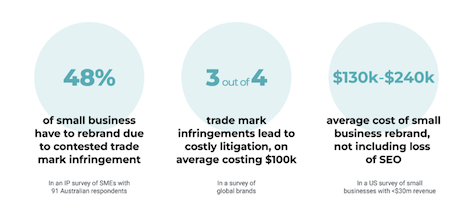
But what about the businesses that don’t check their branding? Checking the availability of your brand name or logo can be important to avoid infringing a competitor’s registered trade mark. By not checking, businesses can run the risk of needing to rebrand and may face litigation, and the associated costs. Check out the numbers below.
Case study – Fat Duck vs Heston Blumenthal
The Fat Duck restaurant opened in Sydney in 2011. Shortly after opening, the restaurant was required to relinquish their name and rebrand.
This rebranding was a result of celebrity chef Heston Blumenthal filing an application for trade mark protection. Intending to reserve and protect the name for his chain of fine dining restaurants, Heston’s company filed a claim in the Federal Court of Australia and won, having filed all the requirements for the trade mark rights.
The Fat Duck restaurant was required to rebrand their business, demonstrating that if you haven’t protected your name or logo against competitors, you may run the risk of losing the rights to it.
Case Study – SEO Shark
SEO Shark is a digital marketing agency that specialises in search engine optimisation (SEO).
In conversation with IP Australia, SEO Shark® explained that “as competition grew, we knew in order to protect and differentiate the brand from other businesses we needed to trade mark the name. The SEO Shark trade mark is our identity, the way we show who we are to customers and this is something we don’t want another business to replicate. We now have the name and logo of SEO Shark registered, meaning we can prevent other businesses in Australia using our trade marks.”
Their advice for other businesses looking to protect their brand is to understand the time and costs involved in applying for a trade mark. They may not be as much as you think! The cost of a trade mark is often assumed to be beyond the budget of a small business, but in total, the cost of protecting SEO Shark® was about $600 for ten years’ protection.
Case study – Tutu by You
Tutu by You was launched in 2020 by business partners and cousins, Steph Young and Emily Murray. They wanted to create a brand for kids, and something that would bring much joy and happiness to the world. Their strategy for IP protection was to protect what they could, with an emphasis on making sure they used the right type of protection.
Emily told IP Australia, “Protecting our IP is so important because it’s everything, right? We’ve worked so hard on this. We’ve only launched six months ago, but we’ve been working on this for two and a half years. There were moments where we thought, ‘Do we really need to spend that money to get that protected? Is anyone going to care about us? Are they really going to try and rip us off?’ You just don’t know. It’s a risk. You’ve got to take it.”
Tutu by You wanted to protect their business name using a trade mark, and their unique ‘sparkle band’ using a design right. They now feel confident in taking their products to market across all platforms because of their IP protection.
To read the full case study visit IP Australia’s website.
How can you check and register a trade mark?
The new, free pilot TM Checker tool makes it easier for small businesses to check if a trade mark is available. An initial check only takes a few minutes, then you can apply to register for a trade mark using the tool for as little as $330.
Registering your trade mark gives you:
- a business asset: the more successful your business becomes, the more valuable your trade mark becomes.
- the legal right to place the ® symbol next to your trade mark
- exclusive rights to use your trade mark in Australia
- the ability to legally deter others from using your trade mark
- the ability to sell your trade mark, or license it for others to use.
Small business owner Deborah had this to say about TM Checker:
Remember that a registered trade mark can be used to protect anything that identifies your business such as a brand name, logo, distinctive phrase, letter, number, colour, sound, smell, shape, picture, movement, aspect of packaging or a combination of these.
Australian Taxation Office (ATO) ride-sourcing data-matching program extended
Continuing its theme of closing the tax gap of individuals for budget repair, the ATO has notified the public of the extension of an existing data-matching program on ride-sourcing.

.
The program was previously designed to run from the 2015–2016 to the 2021–2022 financial years, capturing information from individuals engaged in providing ride-sourcing services (through platforms such as Uber); this has now been extended to apply to the 2022–2023 financial year.
It is estimated that records relating to approximately 200,000 individuals will be obtained.
The data obtained will be used to identify and address incorrect reporting of income in terms of income tax returns and activity statements. It will also be used to identify instances where individuals fail to meet registration or lodgement obligations (eg GST).
In addition to potential compliance activities, the ATO will use the program to promote voluntary compliance, understand behaviours and compliance profiles of individuals and businesses providing ride sourcing services and obtain a holistic view of taxpayers’ income.
This particular data-matching program will not be extended beyond the 2022–2023 financial year, given the introduction of the Sharing Economy Reporting Regime, which will require operators of various electronic distribution platforms to indefinitely report identification and payment information to the ATO for data-matching purposes from 1 July 2023 for ride-sourcing and short-term accommodation, and from 1 July 2024 for all other reportable transactions.
Latest Industry News

How Do I Write Legally Compliant Terms and Conditions for My Business?
Terms and conditions bind your customers only where they actively accept them, so a tick box at checkout holds...

Paid parental leave super contributions have started
From July 2026, the new Paid Parental Leave Superannuation Contribution (PPLSC) has started. From...

If the business is no longer profitable, and is unlikely to be profitable in the future, your best option may...

Check out the this visualization, which tracks the evolution of dietary calorie intake from 1930 to...

Taxpayer given 35% penalty for BAS recklessness
Following an application for a refund of nearly $94,000, the Administrative Review Tribunal has set aside an...

SMEs warned as ATO ramps up tax debt collection
One insolvency specialist has emphasised the importance of small businesses engaging their accountants to stay...

Does Your Small Business Need to Follow AML Privacy Rules?
Compliance with new anti-money laundering (AML) laws may subject your small business to additional privacy...

Don’t get caught out at tax time with your multiples jobs
Picking up a second job, holding multiple part-time roles, or doing gig work is now part of everyday life. But...

Global companies turn to cost-cutting amid ongoing inflation
Rising operating costs and persistent inflation are placing renewed pressure on businesses worldwide, despite...

Warning for early lodger this tax time!
The ATO has a clear message this year: slow down and get it right. Early lodgers are far more likely to make...

ATO no longer treating debt the same as during COVID
One expert has stressed the importance of tax agents reminding their clients that the ATO is no longer as...

The evolution of the world’s languages
Check out the evolution of the world's most spoken languages from 2500 BC to...
Latest Guests News

Newsletter Newslettter We are pleased to supply you with the latest edition of Client Alert, which...